
Breaking Down the Best Picks of the Giants’ 2026 Draft
In a draft in which they couldn't afford to fail, San Francisco had one of the more exciting classes in Major League Baseball.
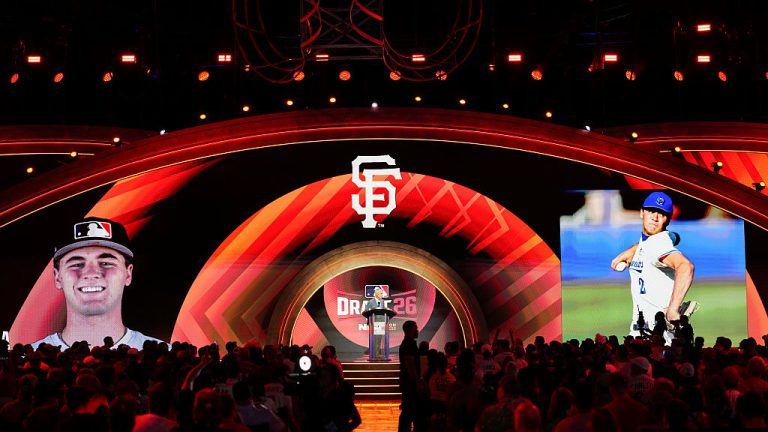
There was no room for errors entering the 2026 MLB Draft for the San Francisco Giants. Not only are they in the midst of their worst losing season in recent memory, but they’ve shown a clear inability to draft in the first round for the better part of a decade.
After lucking into the fourth overall selection and trading for the 29th pick, Michael Holmes, Buster Posey, and everybody in the Giants’ draft room knew they had to get this draft right.
Now a week removed from the process, San Francisco had one of the league’s better classes by several accounts. Of course, we’ll have to wait years to see how many actually become serviceable big-leaguers, but it’s a promising step in the right direction.
This class adds to a farm system that has already been picking up steam for the first time in over a decade.
Let’s get into the picks that made this such a successful year for San Francisco.
The Obvious
RHP Jackson Flora, UC Santa Barbara – 4th Overall
The 2026 draft gave the Giants their highest selection since 2018 when they took Joey Bart second overall. With a clear top three in this year’s class, San Francisco was the first team that had some real decisions to make with their pick.
Throughout the months leading up to last weekend, Jacob Lombard — a prep shortstop — was the name most connected to the pick. Eric Booth Jr. — a prep outfielder — was another name that was repeatedly mocked to San Francisco.
Whichever outlet you looked towards, it felt as if San Francisco was leaning prep throughout this entire process. However, Jackson Flora was always the name that made the most sense and that’s who the organization ended up going with.
In baseball, you take the best player available over organizational needs, but the Giants killed two birds with one stone here. Flora was undoubtedly the best arm in the class and, for a farm system that lacks top-end pitching talent anywhere near the big-leagues, he’ll slide right in as the organization’s top pitching prospect.
Not to mention, the 21-year-old who threw to a 1.06 ERA in 102 innings at UCSB this year grew up a diehard fan of the orange and black and attended the same high school as franchise legend Brandon Crawford. When Rob Manfred read his name with that fourth overall selection last Saturday, it felt as if the stars aligned.
A Pair of Prep Arms
- LHP Carson Bolemon, Southside Christian HS (SC) – 29th Overall
- RHP Kaden Waechter, Jesuit HS (FL) – 55th Overall
While he may not have been the first prep arm taken in this year’s draft, many scouts believed southpaw Carson Bolemon was the best high school pitcher in the class.
While there was a slight dip in velocity in his senior season, he dominated the South Carolina high school scene and was the 19th ranked prospect in the draft.
While this feels hyperbolic, based off the current state of pitching in the Giants farm system, this draft felt like an organizational win based solely off their first two picks in the class.
However, with their second round selection, Posey and Co. took another swing on a talented prep arm. This time, a more projectable righty with a strong knack for attacking hitters and an impressive ability to spin the ball in Kaden Waechter.
While he may not be as advanced as Bolemon, Waechter will still slide in as one of the org’s top pitching prospects and was the 67th overall prospect in the class.
Jim Callis, a draft and prospect writer for MLB Pipeline, had this to say about the Giants early selections on the There R Giants podcast:
You could argue that they may have gotten the lefty with the most pitch ability in the high school class… the righty with the most pitch ability in the high school class… and probably the best combination of pitch ability and stuff of anybody in the college class.
– Jim Callis
Middle-Round Magic
- RHP Eric Nachtsheim, McNeese State – 179th Overall
- LHP Beau Bryans, Jacksonville State – 208th Overall
- RHP Cody Brasch, Louisiana-Lafayette – 238th Overall
With three of their first four picks on day two, the Giants decided to stockpile on a few funky arms slots with little risk and high upside. While all three of these might best profile as high-leverage relievers in a few years, the Giants would welcome that.
Their bullpen has been one of baseball’s worst this season with zero surefire options in the upper minors looking to take hold of a spot in that group anytime soon.
The first of the bunch — Eric Nachtsheim out of McNeese State — was one of the more underrated starters in college baseball this past year. He pitched to a 3.60 clip in 85 innings split between the rotation and the bullpen.
While the Giants lack arms in general, they especially lack high-performing fastballs in the system. With Nachtsheim, they add one of the better heaters in college baseball. He struck out 98 hitters with the fastball, which led all of NCAA baseball.
Bryans and Brasch are virtually the exact opposite archetype of arms. Both throw relatively hard, but Bryans has a low, crossfire release from the left side while Brasch is a righty with an extreme over-the-top release.
MLB draft analyst Josh Catlett had high praise for this area of the draft from the Giants:
Nachtsheim and Bryans were arguably my two favorite money saving arms in the entire class too and San Francisco swooped them up today.
– Josh Catlett
If one of these three end up being a backend starter, that’s a win for the Giants. However, as mentioned earlier, all three most likely profile as back-end bullpen options. Either way, the addition of three high-velocity fastball fills an area where the organization lacked and they were able to do so on the cheaper side.
Back-Half Bombs
- 3B Drew Smith, Oregon – 448th Overall
- 3B Dalton Wentz, Wake Forest – 478th Overall
- 3B Mikey Bell, Gonzaga – 568th Overall
The first of the three, Drew Smith, is the only surefire signee of the group. The senior infielder out of Oregon has quietly been one the more productive third baseman in college baseball for a few seasons.
Not to mention, Oregon’s home ballpark — PK Park — is also the home of the Eugene Emeralds, the organization’s High-A affiliate. If the bat translates to pro ball as easily as it should, Smith could find himself in a familiar place sooner rather than later.
The other two third baseman of this bunch are going to be a little more difficult to sign, but if the Giants can save enough money with their picks in rounds four through 10, it’s doable.
Wentz was a draft-eligible sophomore out of Wake Forest who has been a well above-average bat in both of his college campaigns. As the 216th ranked prospect on Just Baseball’s board getting picked in the 16th round, San Francisco working some magic to make this signing would give them one of the best value picks in the class.
Bell, on the other hand, might be equally as difficult to sign for San Francisco. Not only is the 22-year-old the back-to-back West Coast Conference Player of the Year, but he recently committed to the University of Georgia to continue his collegiate career.
Similar to Wentz, the Giants potentially getting a guy who hit .369 with a 1.057 OPS over his last two seasons at Gonzaga in the 19th round would be a significant addition to the next crop of Giants prospects.
In a class dominated by a fun mix of arms in the earlier parts of the draft, the Giants took some big swings on a trio of high-performing college bats to close out their draft.
Names Worth Mentioning:
Peyton Bonds (90th Overall) – a strong, projectable bat with a profile the Giants have done well with in recent memory à la Bo Davidson and Dakota Jordan.
Josiah Kemp (358th Overall) – the Giants’ only prep position player taken this year is a tools-y outfielder committed to the reigning champion Oklahoma Sooners.
Tanner Malley (508th Overall) – an elite bat-to-ball bat who fits exactly what this regime has been drawn towards over the last year and a half.
Become a Member of Just Baseball
Subscribe and upgrade to go ad-free!
* Save 25% by subscribing annually.

Written by
Michael Monreal got his start in baseball media when he started his own website covering the San Francisco Giants after playing two years of college baseball.…