
What the Jake Bauers Signing Means for the Red Sox
Here are 10 takeaways from the Red Sox signing of Jake Bauers, what he'll bring to the team, and what comes next.

The Boston Red Sox signed the first big fish of the offseason last week, inking first baseman Jake Bauers to a four-year, $58 million contract fresh off a career year that ended with a World Series championship.
I have several thoughts about this signing, from what Bauers brings to the table for the Red Sox in 2027 to why he was the perfect fit for the ball club and what it says about Boston’s direction heading into the offseason.
Let’s dive right in.
1. The Chips Are Pushed Into the Middle of the Table for 2027
If it wasn’t clear when they traded three of their top five prospects for Adley Rutschman, a player with just over a year of team control remaining, the Red Sox are all-in for 2027. While the four-year, $58 million contract will be a steal if Bauers comes close to replicating his 2026 production, the Red Sox will have to sacrifice their second- and fifth-highest picks in next year’s draft.
This is a big blow for a team that has depleted its farm system with win-now trades over the past few seasons, but it further shows that the Red Sox will enter 2027 with legitimate championship aspirations rather than theoretical ones.
2. Craig Breslow Deserves Credit for Being Aggressive and Decisive
Perhaps Breslow learned his lesson last offseason, when his indecisiveness in the Alex Bregman negotiations allowed the Cubs to swoop in and led to a late pivot to Ranger Suárez and Caleb Durbin. There would be no such change of plans this time around.
The Red Sox targeted Bauers just minutes after free agency began and made him the only free agent with whom they conducted a Zoom meeting. He was their Plan A from the get-go, and Breslow and co. made sure he wasn’t going to get away.
3. There Are Tangible Reasons To Believe That Bauers’ Breakout Is Sustainable
It is understandable for fans to be suspicious of a player who has only posted one season with more than 0.6 bWAR and 12 home runs. Yet while the 2026 season and subsequent postseason run effectively served as Bauers’ coming-out party, his breakout actually started a year earlier.
His unremarkable .235/.353/.399 slash line overshadowed real improvements under the hood, including a nearly 3.5-mph increase in his already above-average bat speed and a career-high 14.7% walk rate that ranked 11th among all players with at least 200 plate appearances.
Having possessed a discerning eye even during his journeyman days, Bauers has taken it to another level over the last two seasons after establishing himself as a true power threat. Pitchers are throwing him fewer pitches to hit than ever before, and Bauers has obliged by taking more walks than ever before:
| Zone Percentage | Walk Rate | |
| 2024 | 53.2% | 11.3% |
| 2025 | 50.2% | 14.7% |
| 2026 | 46.8% | 16.3% |
While he posted his lowest overall swing rate since 2018, Bauers excelled at recognizing which pitches he could do damage with. His combination of power and patience put him in a select group of the game’s best sluggers.
Qualified hitters with a hard-hit rate above 50%, a barrel rate above 14%, and a walk rate above 15%:
| Hard-Hit Percentage | Barrel Rate | Walk Rate | |
| Yordan Alvarez | 53.8% | 16.0% | 15.8% |
| Munetaka Murakami | 56.8% | 20.5% | 16.6% |
| James Wood | 58.9% | 18.6% | 16.4% |
| Jake Bauers | 51.9% | 14.0% | 16.3% |
Another encouraging aspect of Bauers’ profile was his success against same-side pitchers. His 148 wRC+ in left-on-left matchups was topped only by Corbin Carroll, while his .526 slugging percentage trailed only Carroll and Shohei Ohtani.
Bauers’ dominance against southpaws speaks to his ability to drive the ball to all fields with authority, as well as his capability to handle all pitch types. Among the 309 batters to see at least 1,000 total pitches last season, Bauers ranked 19th in xwOBA against fastballs, 21st against off-speed pitches, and 89th against breaking balls.
Put simply, if you are worried about Bauers regressing “once the book comes out on him,” there is nothing in the data to suggest that will be the case.

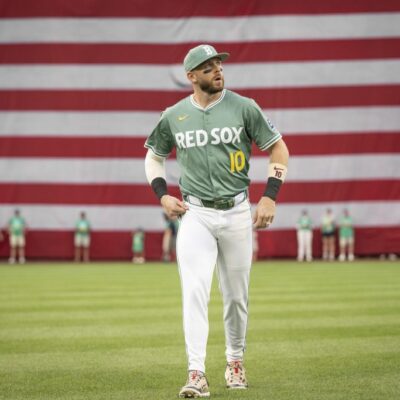
4. Bauers Fits the Red Sox in More Ways Than One
The main headline of this signing will be how Bauers addresses the Red Sox’s lack of power, but he’ll also bring several residual benefits beyond his 26 home runs.
The Red Sox were one of baseball’s worst teams at handling velocity, ranking 27th in xwOBA and 29th in xSLG against fastballs over 95 mph.
Bauers, on the other hand, posted a .401 xwOBA against such pitches last year, which ranked 16th among all hitters who saw at least 1,000 total pitches. Along with Curtis Mead, who had a .404 xwOBA, the Red Sox will insert two of the top 20 hitters in baseball at hitting high-velocity pitches into their lineup, which should at least give them a fighting chance against the pitchers who have carved them up in October.
Bauers’ positional versatility will also give the Red Sox a level of roster flexibility they haven’t had in the Masataka Yoshida era. While he will spend most of his time at DH, Bauers can mix in at first base to get Willson Contreras off his feet, a benefit that cannot be overstated given that Contreras has never played more than 140 games in a season. He can also serve as a contingency option in left field if Roman Anthony suffers another injury.
5. The Red Sox Continue To Bank on Projections Over Past Performance
For better or worse, targeting players before they reach their peak value has been a staple of Breslow’s tenure with the Red Sox. It’s why he traded for Garrett Crochet, who had just one full season as a starter, rather than sign established aces Blake Snell, Max Fried, and Corbin Burnes.
It’s why he acted quickly to extend the likes of Roman Anthony, Ceddanne Rafaela, Brayan Bello, and Kristian Campbell, and why he hesitated to meet Alex Bregman’s demands with a contract that would have paid him $35 million a year deep into his thirties.
The easiest thing for the Red Sox to do this winter would have been to sign Randy Arozarena or Seiya Suzuki, two established stars with a long track record as middle-of-the-order bats. Yet while each player may seem like a safer option, both come with their own offensive concerns as they enter their age-32 seasons.
Arozarena’s career year was aided by a 23-point overperformance in his expected batting average and a 31-point overperformance in his xwOBA, and his bat speed decreased for the fifth consecutive season.
Suzuki, meanwhile, saw his batted-ball metrics decline across the board, posting career lows in hard-hit rate (38.9%), average exit velocity (88.6 mph), and expected slugging percentage (.427).
Time will tell if these red flags are more legitimate than Bauers’ limited track record, but Breslow’s willingness to roll the dice on the less-proven option may have saved him tens of millions of dollars.
ESPN’s Jeff Passan reported that Arozarena is seeking a contract north of $100 million, while Just Baseball predicts Suzuki will earn a contract between $22 million and $30 million per year.
6. The Red Sox’s Offensive Identity Will Be Predicated on Patience
Even if Bauers and Mead replicate their 2026 breakouts, the Red Sox won’t suddenly jump from 26th in home runs to the top five. They are also unlikely to rank near the top of the league in batting average or steals, nor will they be among the league leaders in strikeout avoidance.
The 2027 Red Sox offense will be defined by its ability to control the strike zone and grind out at-bats. With the exception of the notoriously free-swinging Ceddanne Rafaela and whoever wins the shortstop job, every member of the projected lineup, along with the team’s top two bench players, ranked in the top half of the league in either chase percentage or walk percentage last season.
| Chase Percentage | Walk Percentage | |
| Mickey Gasper* | 21.0% (95) | 12.0% (86) |
| Jake Bauers | 21.7% (93) | 16.3% (98) |
| Roman Anthony* | 23.7% (87) | 12.0% (86) |
| Nick Sogard* | 24.5% (84) | 11.2% (77) |
| Curtis Mead* | 25.1% (79) | 11.9% (85) |
| Adley Rutschman | 27.6% (76) | 9.5% (55) |
| Caleb Durbin | 28.2% (60) | 8.7% (45) |
| Wilyer Abreu | 29.9% (49) | 10.4% (67) |
| Willson Contreras | 34.2% (23) | 11.0% (76) |
As opposed to the 2026 lineup, where the presence of Jarren Duran, Carlos Narváez, Marcelo Mayer, and Trevor Story offered little resistance and weighed down an otherwise strong top of the order, the 2027 Red Sox should trot out a lineup every night that wears down opposing starters with one quality at-bat after another.
7. Wilyer Abreu Is an Underrated Beneficiary of the Deal
It’s impossible to qualify Wilyer Abreu’s 2026 season as anything other than a complete success. He set new career highs in games played (157), doubles (38), home runs (24), and RBI (76), took home his third consecutive Gold Glove Award, and even received down-ballot MVP votes.
Abreu shed the label of an oft-injured platoon bat, but he also displayed the same streakiness that has plagued him throughout his career.
While he can carry the offense for weeks at a time when he gets hot, Abreu can also sink the offense during his cold spells. His most pronounced slump came when he hit just .164/.256/.260 from September 3 on, a key factor in the Red Sox scoring 18 fewer runs than any other team in the season’s final month.
All told, Abreu isn’t the type of player you want to depend on as the focal point of your offense over 162 games. With Bauers now slotted into the three-hole, Abreu can slide down to the fifth spot in the order, making his cold spells less detrimental than they would be in the heart of the lineup.
Bauers will also lessen the need for Abreu to play every day, something he was forced to do with the injuries to Roman Anthony and Masataka Yoshida. His 157-game workload, not to mention his month-long sprint with Team Venezuela in the WBC, undoubtedly played a role in his struggles down the stretch, particularly with regard to his power drop-off.
Like Contreras, Abreu will benefit from partial or full days off, something the Red Sox can now afford with Bauers capable of shouldering the offensive load and moonlighting in the outfield.
8. The Spotlight Will Be on Curtis Mead’s Defense
The most concerning trickle-down effect of Bauers’ arrival is that it will require Mead to be the primary second baseman. As much conversation as there has been surrounding the sustainability of Mead’s offense, his defense at second base is the far bigger concern.
Mead has logged just 201 career innings at the keystone, and while both Outs Above Average and Defensive Runs Saved rate him around league average, the sample size is too limited to draw any meaningful conclusions.
There is a much larger body of evidence to evaluate his defense at third base, and the results are far less encouraging. Despite making just 42 starts at the position, Mead recorded -4 Outs Above Average, ranking 33rd among 41 qualified third basemen.
With a team centered around run prevention and a projected rotation that features three pitchers who rely on generating soft contact rather than strikeouts, it will be completely unacceptable if Mead is as poor defensively at second base as he was at third base last season. The pressure will be on both him and the coaching staff to get his glove to at least a league-average level.
9. We’ve Reached the End of the Road With Jarren Duran and Masataka Yoshida
Jarren Duran and Masataka Yoshida’s places on the 2027 Red Sox were already in jeopardy before this signing. Both players had fallen short in what was viewed as a crossroads season, with the former posting the lowest OPS in the American League and the latter providing little punch outside of a July hot streak before missing the final month and a half with a hamstring strain.
With Bauers in the fold, however, their departures feel like an inevitability. There are not enough at-bats to go around in the outfield/DH rotations, and Wilyer Abreu, Roman Anthony, and Ceddanne Rafaela are all younger, cheaper, and more talented.
Duran trade rumors ran rampant during the GM meetings, but his situation is complicated by his projected $11.1 million salary. The Red Sox have until November 20 to tender Duran a contract, and it’s possible other teams are daring them to non-tender him rather than give up capital in a trade.
Yoshida, meanwhile, has finally reached the final year of his five-year, $90 million contract, a deal that has been defined more by what he can’t do than what he can. Yet even with his glaring flaws, Yoshida still managed to post a 111 OPS+ last season and could draw trade interest if the Red Sox are willing to pay down a significant portion of his $18 million salary for 2027.
Whatever pathway the Red Sox choose, it’s clear that neither player will be part of next year’s team, and the manner in which Breslow chooses to move on from them is the most fascinating and consequential decision he has left this offseason.
10. The Rest of the Offseason Is Fairly Simple
Adding a middle-of-the-order bat was far and away the Red Sox’s biggest task on their offseason to-do list, which makes it understandable why Breslow tempered expectations at Bauers’ introductory press conference:
While fans will never want to hear that a team is done making major additions, it is simply the reality of the Red Sox’s roster situation. There is a proven MLB starter at every position in the lineup and rotation, while every member of MLB’s best bullpen will return for 2027.
The Red Sox could still explore making a massive swing for a star shortstop, but their trade deadline pivot to Rutschman reflected the difficult nature of the market. Otto Lopez and Zach Neto would have required the Red Sox to part with top prospect Franklin Arias, while Elly De La Cruz likely would have cost established players from their big-league roster.
As a result, the rest of the offseason is about who goes out more than who comes in. We saw the first domino fall when Connor Wong was DFA’d to make room for Nick Fortes, but Duran, Yoshida, and potentially Trevor Story could all be joining him soon.
Any new addition would also require the Red Sox to make a difficult decision about whom to remove from the 40-man roster. The Red Sox were already forced to jettison several players who contributed to the big-league club last season, including Nate Eaton, Zack Kelly, Eduardo Rivera, Tsung-Kai Cheng, and Raymond Burgos.
There are no longer any obvious DFA candidates sitting at the end of the 40-man roster, meaning a decision would come down to veterans without options (Jovani Moran, Jahmai Jones) or injury-prone players whose question marks outweigh their upside (Tanner Houck, Kutter Crawford, Triston Casas).
These moves won’t dominate local sports talk radio, but you don’t get extra points for making your big move in February rather than November.
On the contrary, the Red Sox should be commended for their aggressiveness and decisiveness rather than being dragged into a needless bidding war that has rarely gone well for them in the past.
Become a Member of Just Baseball
Subscribe and upgrade to go ad-free!
* Save 25% by subscribing annually.

Written by
Daniel Fox is a contributing writer for Just Baseball. He has previously written for Pitcher List, BoSoxInjection, and in the Cape Cod Baseball League. He is…