
What Ryan Jeffers Acceptance of the Twins’ Qualifying Offer Means for Him and the Team
The Twins bringing back Ryan Jeffers on a one-year qualifying offer always made perfect sense. What does it mean for all moving forward?
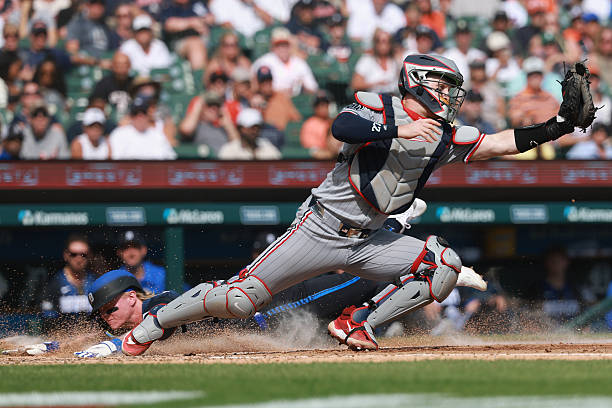
In a surprise move, Minnesota Twins’ catcher Ryan Jeffers agreed to a one-year $23.15 million contract on Tuesday to remain with the team. The universal wisdom was that Jeffers would pursue a longer-term free agent deal and forgo the team’s qualifying offer.
The consensus was that he was the top candidate available in a very thin free agent market at his position. Both the New York Yankees and Boston Red Sox had expressed interest in pursuing him. The Twins had identified Jeffers as a priority offseason re-sign and had even mentioned signing him to a long-term deal.
Then on Wednesday, in another move that surprised the baseball world, the Twins reunited with starting pitcher Sonny Gray. Minnesota inked the veteran righty to a two-year contract worth $55 million. Gray does have an opt-out clause in the contract that would kick in after Year 1.
Gray, 37, previously pitched for the Twins during the 2022 and 2023 seasons. The highlight of his previous stint in Minnesota was the 2023 campaign where he went 8-8, with a 2.79 ERA, 1.147 WHIP, and career-best 2.83 FIP. He also struck out 183 batters in 184 innings.
The Twins have remained active, and bringing Jeffers back was simply the first domino of theirs to fall. Let’s dive into what this means for him and the team moving forward.
Short-Term Advantages of the Jeffers Signing
With the Jeffers re-signing, the Twins have retained an experienced backstop and a solid middle-of-the-order hitter. In 92 games last season, he hit 14 home runs, drove in 56 runs, and had a slash line of .256/.353/.461. Although he is not a Gold Glover at his position, he manages pitching staffs well, and his Automated Ball-Strike (ABS) success rate of 61.1% was 10th best among all MLB catchers.
With Jeffers in the fold for another season, a potential weakness for the Twins remains a strength. Without his services, the team would have entered the 2027 season with only Victor Caratini as a returnee at the position. Caratini is a spotty hitter with some pop who is most valuable sliding between catcher, first base, and DH.
And although they have fewer funds to operate with, Jeffers’ signing allows Twins general manager Jeremy Zoll to concentrate on other offseason needs such as the team’s bullpen, a middle-of-the-order power hitter, and possibly another starting pitcher. Jeffers is a positive clubhouse personality and has terrific media presence. And that is a valuable combination for a team in need of an image overhaul.
What Does it Mean Long Term for Jeffers?
For Jeffers, it is a double-edged sword. If he has an injury-free, successful 2027 season, his value at this time next year may be higher. With other high-caliber catchers like Adley Rutschman and William Contreras potentially hitting the market this time next year, the competition for their services could drive up their acquisition prices.
On the other hand, if Jeffers again suffers injuries or has a significant falloff in production, his market value could go South, and he would be forced to accept a multi-year deal at a lower value. Also, if Rutschman, Contreras, or another top-notch catcher hit the market after next season, it could be a winners-and-losers scenario.
Jeffers will be 30 years old at the end of his current Twins contract in 2027. Still young enough to secure a healthy multi-year contract with a contending ball team. He is considered one of the most consistent hitting catchers in baseball and has improved his fielding significantly during his career.
How Does it Play Out for the Twins?
For the Twins, the Jeffers signing is mostly a win-win situation. Unless he misses considerable time due to injuries or has a down year at the plate, the team will once again send out an All-Star-caliber backstop as part of their lineup for 120+ games in 2027.
More importantly, it gives their talented crop of catching prospects additional time to develop at the minor league level. Heading this group is No. 32 on Just Baseball’s Top 100 MLB Prospects for 2026, Vahn Lackey. The Twins made Lackey the third overall selection in this year’s MLB Draft. He combines strong defensive skills with a rocket arm and power potential on offense.
Others waiting in Jeffers’ wings include this year’s second-round pick Carson Tinney and Khadim Diaw, whom the Twins selected with a third-round pick in the 2024 draft. Add to that Eduardo Tait and Enrique Jimenez, who were acquired in separate deals at the 2025 trade deadline, and it’s easy to see that Minnesota has an embarrassment of riches at the catching position.
Overall Picture
Of the eight MLB players who received qualifying offers from their teams when free agency started this year, Jeffers is only one of two players who accepted it, with the other being Yankees closer David Bednar.
Most experts predicted that there was very little chance that Jeffers would accept his offer. He is represented by legendary agent Scott Boras, who is renowned for driving a hard bargain and maximizing the value of his clients during contract negotiations. That factor and the dearth of potential starting catchers in this free agent class seemed to work against a Jeffers/Twins union.
But the Twins are extremely happy to have their starting catcher back in the fold. And Jeffers is equally happy to be under contract before the unknowns of the upcoming baseball lockout strike in less than a month.
Become a Member of Just Baseball
Subscribe and upgrade to go ad-free!
* Save 25% by subscribing annually.

Written by