
Top Landing Spots for Free Agent Ryan Jeffers
Jeffers is the top catcher on the market and will draw plenty of interest in a weak free agent class. Where could he go?

Ryan Jeffers enters the 2026-27 free agent market as the top catcher and one of MLB’s most consistent, underrated backstops.
Since his debut in 2020, Jeffers’ 111 wRC+ is tied for ninth among primary catchers, while his 82 home runs and 10.9 fWAR both rank 11th. His .814 OPS in 2026 was better than that of Adley Rutschman, Shea Langeliers, and William Contreras, to name a few.
Jeffers has decreased his K% every season since 2023, going from 27.8% to 17.9% in 2026. While striking out less, he’s walking more, up to a career-high 12.5% in 2026. His whiff rate was at a career low of 17.3%, and he posted a career-best xwOBA of .344 (excluding 2020). His consistency with the bat has made him into an above-average player and will certainly attract teams.
Ryan Jeffers Key Stats
| year | home runs | wrc+ | iso | fwar |
| 2022 | 7 | 86 | .156 | 0.8 |
| 2023 | 14 | 136 | .213 | 2.3 |
| 2024 | 21 | 106 | .206 | 1.6 |
| 2025 | 9 | 114 | .131 | 2.1 |
| 2026 | 14 | 128 | .205 | 2.6 |
A strong offensive catcher seems like a no-brainer for teams to want to go out and sign him, but a few factors do make Jeffers a slightly more complex free agent.
Jeffers’ defense is well below average. His arm is his weakest attribute, with his CS above average at -6 in 2026, tied for second-worst in MLB. His 1.96 pop time ranked in the 36th percentile, and his framing value of -1 ranked in the 37th. His neutral blocking value was his only major defensive statistic that wasn’t below average, and just barely.
He was great at ABS challenging, however, winning 61% of challenges and was tied for fourth among catchers with 2.8 runs above average. With this being the first free agency post-ABS integration, it’s yet to be known if teams will value that or, if so, how highly they will value it.
Jeffers will turn 30 in June of next season, meaning he could spend more time in a DH role while sharing duties at catcher. It’s unlikely to see him be a primary catcher due to his poor defense and aging.
The most interesting part of Jeffers’ free agency is that he’s been offered a qualifying offer by the Minnesota Twins. The one-year $23.15 million deal is on the table for Jeffers, and accepting it would make him the highest-paid catcher by AAV in 2027. He will have until November 17 at 4 p.m. EST to accept it.
Free Agent Profile: Ryan Jeffers
- Age in 2027: 30
- 2026 Stats: 92 G, .256/.353/.461, 14 HR, 56 RBI, 128 wRC+, 2.6 fWAR
- 2026 Salary: $6.7 million
- Qualifying Offer Received?: Yes
Contract Projection
- Contract Length Projection: 2-5 years
- Expected AAV: $12-18 million
It comes down to whether Jeffers and his agents believe that teams will have interest in offering a multi-year deal, and if he’d want to leave Minnesota. There’s plenty of potential landing spots for Jeffers around the league.
Free Agent Landing Spots for Ryan Jeffers
Minnesota Twins
Minnesota makes the most sense for Jeffers. He can cash in on a one-year deal, making him, by AAV, the highest-paid catcher in baseball. Then, for 2028 and beyond, he can look for a multi-year deal to stay with the Twins or head elsewhere.
Vahn Lackey, Just Baseball’s 32nd-ranked prospect, adds to the equation as well. Even though it’s extremely unlikely to see him in 2027, and a slight chance for 2028, his status does make giving Jeffers a long-term deal more complicated. But for 2027, staying in Minnesota still seems like a safe bet for Jeffers, and it seems like he’d want to stay.
In an interview with MLB.com’s Matthew Leach, Jeffers said, “When you spend seven years in an organization, or I guess eight years including the minors, you don’t want that chapter to end… I love the idea of a reunion.”
However, Jeffers, in that same interview, mentioned how he still wanted to test free agency.
“I also love the idea of going out there and seeing what else is out there. I’m excited for this. I’ve worked really hard for this moment, for free agency, and that doesn’t mean the chapter here has closed. We’ll just see where we go,” said Jeffers.
With these comments, it seems like he’ll potentially decline the QO and look around the market, but still leave the door wide open for a multi-year deal with Minnesota.
New York Yankees
If you compare Austin Wells and Jeffers, they appear to be opposites of each other. Jeffers has a great bat, but struggles defensively. Wells’ bat is very poor, but he is a much more defensively sound catcher. One thing they do share is a weak arm.
The Yankees could have Jeffers and Wells share time behind the plate. With Giancarlo Stanton’s health still in question, Jeffers could also spend time as the DH for New York, giving him ample playing time.
Wells struggles mightily against lefties, slashing .122/.192./.244 with a 19 wRC+ in 2026, while striking out 29.3% of the time. Jeffers is much better, slashing .267/.388/.414 with a 128 wRC+ this past season, striking out only 15.8% of the time.
Running it back with Wells likely won’t bode well for New York, as his awful 2026 offense was a decline from an already bad 2025 showing. If he follows this trend, having a dependable catcher like Jeffers will help.
The two have been linked before, most recently at this year’s trade deadline, before Minnesota decided to hold on to him.
Chicago Cubs
Key players Ian Happ, Seiya Suzuki, and catcher Carson Kelly have all hit the free agent market. With all of this offense potentially leaving, the Cubs will need to find replacements. It appears that Kelly is very likely to go, after he declined his option and posted what seemed like a goodbye message on Instagram. A solid choice for a Kelly replacement could be Jeffers.
Kelly and Miguel Amaya were one of the better backstop duos in MLB, with the Cubs’ catchers putting up 6.9 fWAR over the past two seasons. With Suzuki potentially leaving as well, Jeffers could find himself splitting his time catching and DHing.
Owen Ayers, Just Baseball’s 90th-ranked prospect, isn’t too far off from the majors. Jeffers can be signed as a bridge catcher and would provide the Cubs with much more reliable offense compared to Kelly. He’s also younger than Kelly and less likely to regress offensively.
Philadelphia Phillies
J.T. Realmuto is not the same catcher he once was. His 129 wRC+ in 2022, career best, has declined year after year, resulting in a career low of 68 in 2026. He’ll be entering his age-36 season in 2027, and it’s hard to believe that he won’t decline further.
Lessening his load behind the plate is something the Phillies will need to consider. Their backup, Rafael Marchán, while good defensively, doesn’t have a strong bat. Two unproductive offensive catchers for a team still competing for a World Series just isn’t going to get it done.
Bringing in Jeffers will give them the bat they need, while still keeping Realmuto present. It’s unlikely that Jeffers would want to sign somewhere to be a backup, but could the Phillies decide to significantly cut Realmuto’s playing time? He’s the second longest-tenured Phillie, but rolling out a 36-year-old starting catcher coming off a career-low year will be a challenge for a World Series hopeful team.

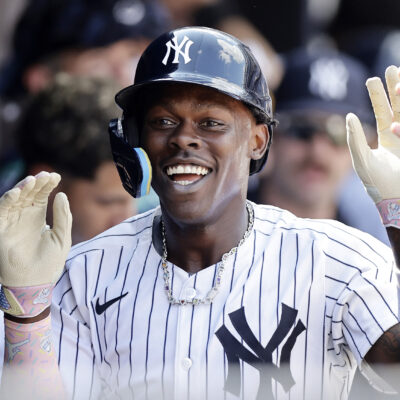
Los Angeles Angels
Maybe the biggest dark horse candidate for Jeffers is the Los Angeles Angels. The Angels’ offense was abysmal in 2026, scoring just 655 runs, the second-fewest in MLB. Any sort of help would be welcome in Los Angeles, and Jeffers can definitely be a major help.
The catching situation for the Angels isn’t great either. Logan O’Hoppe, once believed to be a cornerstone, especially after his great 2024 campaign, was moved this summer. Los Angeles acquired Moisés Ballesteros at the deadline, but he struggled in the second half. Ballesteros slashed .199/.260/.280 with three home runs in his 45 games with the Angels.
Ballesteros is still very young and has time to grow into a major league-level catcher. Bringing in Jeffers to lessen the load and mentor him could help his growth for a rebuilding Angels team. The Angels will have money to spend, with the Anthony Rendon contract finally off the books.
The biggest unknown of it all is whether Jeffers would want to go to a team that will likely be near the bottom of the standings during his time there.
Become a Member of Just Baseball
Subscribe and upgrade to go ad-free!
* Save 25% by subscribing annually.

Written by
Jackson Stafford is a Sports Journalism graduate of Husson University and a writer for Just Baseball. He covers the Boston Red Sox along with other general…