
How the Milwaukee Brewers Pitched Their Way to a World Series Title
A look inside the Milwaukee Brewers and how a dominant pitching staff fueled the historic run to their first World Series title.
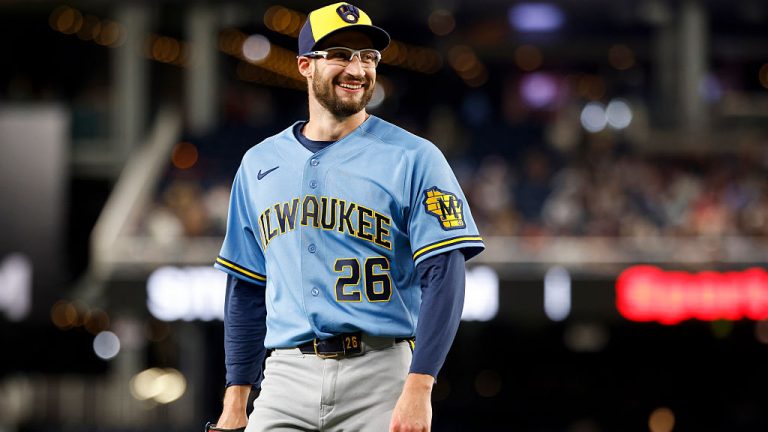
ST. PETERSBURG, Fla. — The Brewers felt like they were built to make a run in 2025. After all, they were the top-seeded team with a league-pacing 97 wins, taking down a familiar foe in the Cubs in a thrilling NLDS, which set them up for a date with the defending champion Dodgers.
The promising team was stopped dead in its tracks at the hands of a historic pitching postseason staff that saw its starting pitchers combine for the third-lowest ERA in playoff history through its first 10 games.
The Brewers—who were one of three teams to score 800 runs in the 2025 season—learned the hard way just how paralyzing an elite pitching staff can be as they were swept at the hands of the eventual back-to-back World Series champs.
“It’s only a failure if you don’t learn from it, and this team be damned if we didn’t come back after what we did last year and finish business,” Trevor Megill said.
A year later, the Brewers taught the same lesson to every team in their path. A red-hot Padres team, the aforementioned Dodgers and the AL-best Rays were all halted by the best postseason pitching staff of the 21st century.
Since 2000 (minimum 100 innings), the Brewers are the only team to pitch to an ERA below 2.00 in a postseason and the staff’s four homers allowed is half of the next lowest figure in that span.
Chandler Simpson’s Game Five, two-out, 9th inning double dropped the Brewers to second in WHIP, .007 behind the 2001 champion Arizona Diamondbacks. A pitching staff anchored by co-World Series MVPs Randy Johnson and Curt Schilling.
For the Brewers, it was the bullpen dominance in particular that set them apart, headlined by Aaron Ashby.
The 28-year-old set an MLB record with 18 consecutive scoreless innings, besting Andrew Miller’s mark a decade ago.
Despite exclusively pitching out of the bullpen, Ashby only trailed Jacob Misiorowski by one inning for the team lead in the postseason thanks to his ability to seemingly always be available while also providing length.
“Ashby never wants to come out of the game,” Brewers’ pitching coach Chris Hook said. “It’s like ‘Ash, sit down. You’re not pitching anymore.’ He’s really special.”
Ashby led the way for the bullpen, but it was a collective dominance that kept opponents from being able to catch their breath. In addition to Ashby, Abner Uribe, Trevor Megill, JoJo Romero and DL Hall combined for a 0.82 ERA over 54 2/3 innings.
“These guys are crazy. They all throw 100,” Brandon Woodruff said. “But we know how to pitch.”
Woodruff’s right: 18% of the pitches the Brewers have thrown this postseason have been at least 99 mph. No other team in the pitch-tracking era has registered more than eight percent only of their pitches at 99 mph or above, minimum 1,000 pitches.
While this may be the most talented group of arms the Brewers have had, Hook has overseen plenty of loaded pitching staffs in his eight years as the Brewers pitching coach, seven of which resulted in postseason appearances. To him, the separator between this group and others was not something that could be identified via TrackMan or high-speed cameras.
“They care about each other. You could tell it was different,” Hook said. “We knew that when the game’s on the line, somebody’s gonna step up.”
When NL Cy Young frontrunner Jacob Misiorowski and standout rookie starter Logan Henderson didn’t pitch to their standards early in the postseason, it was rookie southpaw Robert Gasser who stepped up with five shutout innings against the Dodgers in the NLCS, followed by six shutout innings in Game 3 of the World Series, and he did it without throwing a fastball north of 95 mph.
Rookies made 80 of the Brewers’ 162 regular-season starts, and they made more postseason starts than the rookies on any World Series-winning team in history.
“They don’t look like rookies…they have a maturity to them,” Hook said. “They’ve done a really good job of staying with their plan and their routines.”
If you ask the players, they point right back at Hook and pitching coordinator Jim Henderson. The work between starts or appearances is echoed by players and coaches as a key to the success and consistency of the pitching staff.
“[Chris Hook] is everything to me man. I don’t know that there’s anybody who sees the game and pitching the way he does in all of baseball,” Logan Henderson said. “Thank god he’s on our side.”
Nobody in the Brewers organization has been closer to Hook for the last decade than Brandon Woodruff. The two honed their craft somewhat in lockstep, with Hook serving as the Double-A Biloxi Shuckers pitching coach as Woodruff pitched there in 2016.
Woodruff would make his big league debut in the back half of the 2017 season while Hook became the roving minor league pitching coordinator for the Brewers in 2018, working with pitchers like Corbin Burnes, Devin Williams and Freddy Peralta.
Following the 2018 season, Hook was hired as the pitching coach of the Brewers and since then, the Brewers have been third in baseball in ERA, trailing only the Rays and Dodgers.
“He’s taken me from a Double-A kid that didn’t really know what he was doing. He’s seen me throw just about every pitch in the big leagues, and he’s seen the development for 10 years,” Woodruff said. “We’ve had our good times, we’ve had our rough times together in the big leagues, and that’s what makes it special.”
As Woodruff’s velocity cratered after major shoulder surgery and other injuries, he, Hook and Henderson had to go back to the drawing board and figure out different ways to get outs.
“I’ve had to adapt myself. I’m not the guy who throws hard anymore. I’ve had to learn how to do different things,” Woodruff said. “It’s been a journey.”
There was concern that Woodruff’s journey might come to a halt in July when it was announced that he would need surgery to repair a capsule tear in his shoulder, which would have been his second since 2023.
A routine, pre-operative scan revealed unexpected natural healing, and Woodruff quickly began throwing in hopes of being available to help the Brewers after missing the team’s last three postseasons due to injury.
Milwaukee’s resilience defined their World Series run—none more so than their longest-tenured veteran, who defied the odds just to make the roster before closing out Game 3.
“Whenever we get knocked down, we get back up, and that’s how you win baseball games,” Woodruff said.
He was speaking about the fight between the lines, but Woodruff’s impact on this immortalized Brewers team transcended his 45 1/3 regular-season innings or the three outs he notched in October.
“I don’t think we can clap enough or say enough or do enough to give [Woodruff] enough applause for what he’s brought to his organization,” Hook told the Milwaukee Journal Sentinel’s Curt Hogg.
Now, applause will be all he and his teammates hear as they parade down Wisconsin Avenue for the first time in franchise history.

Written by
Aram Leighton is the Co-Founder and Executive Editor for Just Baseball. A Syracuse University grad, Aram is one of the hosts of the Just Baseball Show…