
How a Weak Free Agent Market Can Impact Trades
Could this winter see more trades than the usual offseason?

All but one fan base has already turned its attention to reshaping its roster over the winter. For better or for worse, the offseason trade discussions and free agent signings are always conversations that every fan base wants to have, sharing their ideas on which players will surely take their team to the next level.
The process is rather simple. You watched your team for 162 games, identified their areas of need, Googled MLB free agents, and scrolled through the list. “Ah, yes! Let’s add these three guys, and we will be true contenders!” We’ve all been there before.
Even a more realistic and calculated fan will be able to find names who match the team’s historical spending trends and meet a certain threshold of “better” than the current guy. You could spend hours coming up with a list and the fits might be perfect.
However, we don’t know anything about the player’s true desires or if the team actually values the free agent the same as you do. A fun exercise nonetheless.
If you haven’t done this yet, I suggest finding your favorite websites that list free agents (like Just Baseball!) and scrolling through. I’ll warn you, it’s not as exciting as you might have hoped. Jake Bauers, Ty France, J.P. Crawford, Trevor Rogers, Tyler Mahle, and others are appearing near the top of the list, higher than you would have expected. Nice players, but not exactly the headline moves you have in mind.
But wait, I thought last year’s free agency class was weak? Yes, and this one, although it has a couple of big names, is also rather pedestrian.
Why the Free Agent Class Is Weak
Obviously, not every free agency class is going to be strong. You will have some random dud years mixed in with other seasons where there are several players who could get $30+ million. But after back-to-back offseasons with only a few stars at the top of the list, then more role players falling into the second tier, you have to wonder if this is a trend.
I believe that the two main factors driving the weaker free agency classes are pre-arb extensions and the increase in player options.
As of the writing of this article, according to Spotrac’s pre-arbitration contract data, there are 39 active players who are currently playing on a pre-arb extension. There are another 25 players who signed an extension during arbitration (give or take a few on these numbers). Below is a graph that will help demonstrate how many signings there have been each year over a 15-year span.
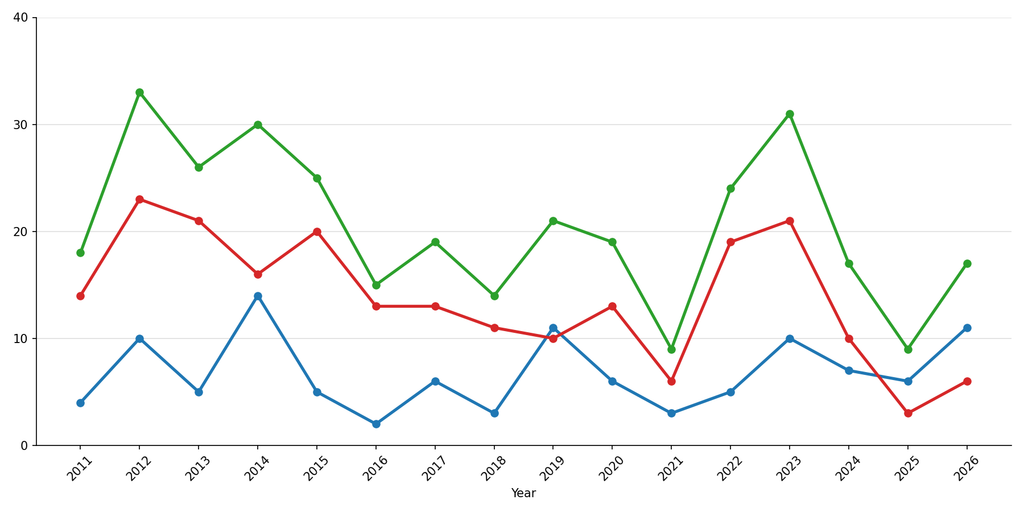
What you’re looking at is the total number of signings by category: pre-arbitration, arbitration, and both combined.
While the total number from “back in the day” is not necessarily less than now, there is a trend worth pointing out. Some of the worst free agent classes in recent memory were 2016 and 2017, only a couple of years after the jump in extensions. The 2025 and 2026 offseasons have been weak, and are also only a couple of years after a jump in extensions.
You could argue that the sheer number of contracts doesn’t vary enough for this data to be relevant, and you might have a point. COVID throwing a wrench into every team’s finances dropped the numbers in 2021, and the potential of a lockout might have played a role in more recent years.
Another factor outside of extensions has been options. There’s been a trend with more players signing shorter deals with player options attached to them, giving them the freedom to get out of the deal if they believe that their value increases.
While this data is harder to find, I did find a stat that 53 players had some variation of an option in 2022, while 72 players have an option in 2026. I would need more concrete data to back up those numbers, but they match the trend that I believe we have been seeing.
It doesn’t take that many players to impact a free agent market. Imagine if there were even four or five additional impact players to choose from.
Another angle making this free agency market complicated is the potential of a lockout. We’ll know more information as the offseason goes on. I don’t know, but it’s possible that certain teams are scared of the unknown and will lean more into trades than signings.
Could We See More Trades Than Usual?
If a team has a need, but there’s not a free agent that matches the need, the next best option is to resort to the trade market. Every season we see a flurry of moves during the offseason, usually peaking at the Winter Meetings. Several names that you would expect, a number of surprises, and plenty of prospects.
Could this winter see more trades than the usual offseason? Let’s first look at the weakest free agent positions.
- Catcher: Tyler Stephenson, Ryan Jeffers, Carson Kelly (pending option)
- First Base: Ty France, Jake Bauers, Alec Bohm (1B/3B)
- Shortstop: J.P. Crawford, Mauricio Dubón, Isiah Kiner-Falefa
- Third Base: Alec Bohm (1B/3B), Eugenio Suárez, Edmundo Sosa
- Outfield: Seiya Suzuki, Randy Arozarena, Ian Happ, Taylor Ward, Trent Grisham, Daulton Varsho
If you need an infielder, I hope it’s a second baseman. Most of the players listed above are fine role players and complementary pieces, but not exactly players who raise the ceiling of your team. Would you be better off signing one of these players or trading a 19-year-old for a better option?
The outfielders that are available aren’t much better. Suzuki and Arozarena returning to their prior teams makes a lot of sense, and they are still needed in their respective lineups. The well runs dry pretty quickly when it comes to bats.
The Astros and Giants are both headed into some variation of a rebuild and have established players who they would likely want to offload. Jeremy Peña, Isaac Paredes, even Yordan Alvarez? Willy Adames, Jung Hoo Lee, Matt Chapman, or even Rafael Devers?
We know the rumors surrounding Jarren Duran potentially being available. Otto Lopez has seen his name swirling in rumors along with Hunter Goodman. Zach Neto and CJ Abrams haven’t been ruled out either.
On the pitching side, you have Tarik Skubal, a bona fide ace, then a number of middle-of-the-rotation to back-end arms. Drew Rasmussen, Michael King, Nick Pivetta, Sandy Alcantara, Matthew Boyd, Nick Martinez, Clay Holmes, Luis Severino, Corbin Burnes, and others all have pending options. See, the options are playing a big role here.
Do you want to roll the dice on Freddy Peralta’s potential bounce back? Or buy into Tyler Mahle’s promising stint last season? 35-year-old Robbie Ray, often-injured Kric Bubic, or Foster Griffin’s breakout? We’ve yet to see how the qualifying offer plays into the list of free agents as well.
So, who all is available for trade? Joe Ryan, Sandy Alcantara, Spencer Strider, Shane McClanahan, Reid Detmers, and Michael Wacha, to name a few. We know the Rays aren’t afraid to trade a player once they get too expensive, and Rasmussen having a $20M club option could make him available, but probably not.
There is a non-zero chance we even see players like Logan Webb or Hunter Brown become available. Starting pitching has gotten so expensive on the free agent market, you have to wonder if it’s a bubble that could burst.
Naturally, teams trading away talent would likely want prospects in return. Let’s look at the top farm systems in baseball. The Dodgers, Rays, Brewers, Tigers, Mariners, Guardians, and White Sox all fall in the top half, with the Dodgers, Rays, and Brewers sitting at the top. That’s a lot of teams looking to contend with prospect capital to trade.
How about the worst farm systems in baseball? The Astros, Padres, Phillies, Diamondbacks, and Rangers, amongst others, could look to shed payroll, with some even turning towards a rebuild. Each of those teams has several players who would be very attractive on the trade market.
Final Thoughts
In my opinion, everything is pointing towards a number of serious trades going down this winter. How the potential lockout will impact the offseason is still unknown. I’m sure some teams won’t be bothered by it, while other teams will drastically change their plans. Time will tell.
I do think that the potential lockout will cause mid-market teams to be less active in free agency. There’s simply too much unknown about the future to invest important dollars. Or, they will take themselves out of the three- to five-year deal market, giving them more reason to swing a trade.
Buckle up. I think the lockout news won’t be the only headlines this winter.
Become a Member of Just Baseball
Subscribe and upgrade to go ad-free!
* Save 25% by subscribing annually.

Written by