
Elly De La Cruz Is a Superstar
De La Cruz isn't just baseball's most fascinating bundle of upside anymore. He's one of the game's biggest stars.
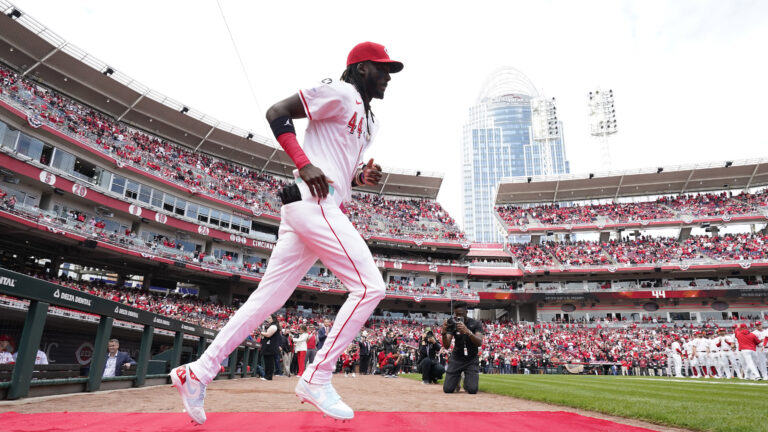
When Elly De La Cruz broke onto the scene in 2024 as a 22-year-old with 25 home runs, 67 stolen bases and a season worth more than six wins, he announced himself as one of the most exciting players in baseball.
A towering 6-foot-6, 200-pound switch-hitting shortstop, De La Cruz possesses a collection of tools usually reserved for video game characters. In 2024, he ranked in the 98th percentile in Outs Above Average and the 100th percentile in sprint speed while producing a maximum exit velocity of 114.7 mph.
Any one of those traits would be noteworthy for a 22-year-old. The combination of all three had people ready to make irresponsible comparisons.
That dreamt-on ceiling is part of what made his age-23 season feel strangely disappointing.
De La Cruz still produced 4.8 fWAR in 2025. He hit 22 home runs, stole 37 bases and remained one of the most physically gifted players in the sport. For almost any other 23-year-old shortstop, that would qualify as an exceptional season. For Elly, it somehow felt underwhelming.
Human nature had crept in. As a baseball-viewing public, we had become numb to the eye-popping abilities of the Reds shortstop.
A throw approaching 100 mph across the diamond began to feel normal. A home run leaving his bat at 117 mph became just another hard-hit ball. Thirty-seven stolen bases and 91st-percentile sprint speed began to feel like boxes checked rather than outrageous feats of athleticism.
We became accustomed to the extraordinary, and once the extraordinary became expected, the nitpicking began.
And there were nits to pick.
De La Cruz’s defense took a significant step backward in 2025. After ranking among baseball’s best defenders by Outs Above Average the year before, he finished at -3 OAA and -5 Defensive Runs Saved. The occasional lapse on a routine play became particularly glaring because of what we knew he was capable of doing on the difficult ones.
Those mistakes were frustrating precisely because De La Cruz has the physical ability to make plays almost nobody else can. But somewhere along the way, the conversation became disproportionately focused on what Elly wasn’t doing rather than what he already was.
There are almost never true 80-grade tools in baseball, and there is a reason for that. An 80 represents the extreme end of the scouting scale, a carrying tool that separates a player even among major leaguers. De La Cruz possesses that kind of arm strength at shortstop. Pair it with plus power and the speed and athleticism necessary to cover enormous amounts of ground, and his physical ceiling remains nearly unmatched.
The spectacular has never been the question with Elly De La Cruz. Few players in baseball can reach the heights he can on any individual play. What has changed in 2026 is that those heights are becoming less episodic.
At 24 years old, De La Cruz is beginning to pair the tools that made him a phenomenon with the consistency required to become something more: one of the game’s true superstars.
2026: The Leap
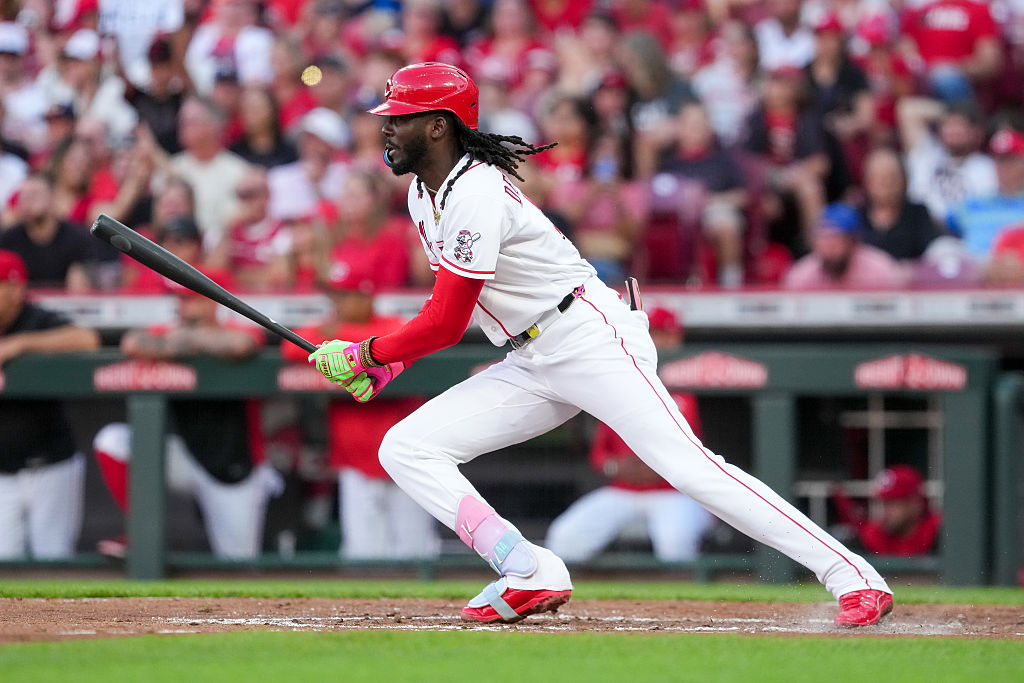
The most encouraging part of De La Cruz’s 2026 season isn’t that he has suddenly discovered another physical tool. There weren’t many left to find.
It’s that he has started sanding down the weaknesses that previously kept all of those tools from showing up consistently.
Some of that maturation has come through better swing decisions. De La Cruz has cut his chase rate while increasing his walk rate, the type of development that fellow 24-year-old Pete Crow-Armstrong has been lauded for during his own breakout season. Elly’s gains have not been quite as stark, but they have meaningfully changed the shape of his offensive profile.
The most important development, however, has come from the other batter’s box.
For most of De La Cruz’s career, there have effectively been two versions of him at the plate. From the left side, he looked like a potential superstar. From the right, he often looked like a different hitter altogether.
In 2024, De La Cruz produced just a .661 OPS and .354 slugging percentage from the right side. A year later, those numbers fell to .618 and .342. Compare that to slugging percentages of .523 and .486 as a left-handed hitter over the same two seasons, and the problem becomes obvious.
His right-handed swing wasn’t merely less productive. It was a legitimate weakness in an otherwise overwhelming offensive profile. At a certain point, it was fair to wonder whether switch-hitting was even helping him.
Then 2026 happened.
De La Cruz has produced an OPS north of 1.000 from the right side while slugging better than .600. Ten of his career-high 28 home runs have come as a right-handed hitter.
The side of the plate from which he produced almost no power for two consecutive seasons has become one of the most dangerous parts of his offensive game. And that change hasn’t happened by accident.
De La Cruz has closed his stance while widening his base, changes that have helped quiet the operation and put him in a better position to do damage. His bat speed from the right side has also climbed meaningfully, from 73.9 mph in 2025 to 76.2 mph this season.
The mechanical adjustments and increased bat speed have paid off.
The right-handed breakthrough is the most dramatic part of the story, but it is hardly the only one. Across both sides of the plate, De La Cruz has improved his quality of contact substantially.
His average exit velocity has jumped roughly four miles per hour. His hard-hit rate has increased by almost 10 percentage points. His barrel rate is up six points. His average launch angle has climbed roughly two degrees.
There is still swing-and-miss here. There probably always will be. De La Cruz is a 6-foot-6 hitter generating enormous bat speed with long levers. Strikeouts are part of the tradeoff that comes with accessing that kind of power.
The important development isn’t that the strikeouts have vanished. It’s that his improved swing decisions have helped mitigate the concern, while the quality of contact he produces when he does connect is capable of erasing much of the rest.
Those underlying improvements have translated directly to the box score. De La Cruz owns a career-best 138 wRC+, a career-best slugging percentage above .500 and an OPS approaching .880, placing him among the most productive hitters in baseball.
When De La Cruz connects, very few hitters in baseball can match the violence of the contact. His raw power belongs in the same general universe as the game’s most fearsome sluggers. Yordan Alvarez. Shohei Ohtani. Aaron Judge.
The difference is that De La Cruz also happens to be a shortstop capable of Gold Glove-caliber defense who can steal 30 bases in essentially any healthy season.
And the defense has returned.
After falling from elite territory in 2024 to negative defensive value by Outs Above Average last season, De La Cruz is once again among the game’s better shortstops by Statcast’s range-based metrics. He has eight Outs Above Average, placing him near the top of the league, even as Defensive Runs Saved remains more skeptical because of the occasional routine mistake.
The errors haven’t disappeared entirely. That tension may always be part of the experience. De La Cruz can make the impossible look routine, then occasionally make the routine look unnecessarily difficult. But that shouldn’t obscure his overall value.
Put everything together and 2026 is comfortably the most complete season of his career. The counting stats alone don’t necessarily scream transformation. What’s different is how few holes remain.
His former platoon weakness has become a strength. His quality of contact has taken a massive step forward. His plate discipline has improved. His defense has rebounded. His speed remains an impact tool.
And he is doing all of this at 24 years old.
De La Cruz is on pace to post the second six-win season of his career before his 25th birthday. Since 2010, the group of players who have produced multiple seasons of that caliber at such a young age reads like a snapshot of a generation of baseball: Mike Trout, Mookie Betts, Juan Soto, Bobby Witt Jr., Francisco Lindor, José Ramírez, Manny Machado, Alex Bregman and Kris Bryant among them.
There are different career arcs represented there. Nothing about joining that group guarantees what comes next. But it tells you something about the level of player Cincinnati already has.
For years, the conversation surrounding Elly De La Cruz centered on what he might become if he ever figured everything out. He’s only 24, and that question is already beginning to feel outdated.
Team success has not followed. But individually, De La Cruz has turned one of baseball’s most extraordinary collections of physical tools into one of its most complete players.
Elly De La Cruz isn’t just baseball’s most fascinating bundle of upside anymore. He’s one of its superstars.
What Do the Reds Do With a Superstar?
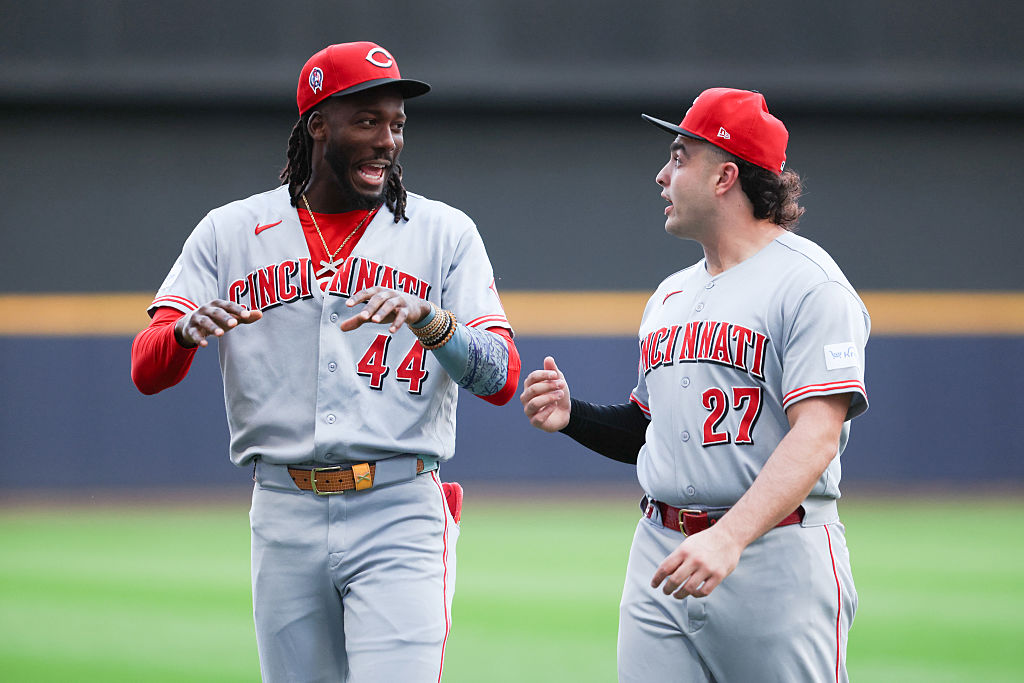
As sensational as De La Cruz has become, baseball has a way of reminding us that even a superstar gets only one spot in the lineup.
After squeaking into the postseason last season, Cincinnati has taken a significant step backward in 2026 and is staring down a sub-80-win finish. There have been injuries. There has been inconsistency. There have been individual performances that have moved in the wrong direction.
But with De La Cruz entering his first year of arbitration eligibility in 2027 and only three guaranteed seasons of team control remaining, the more important question is what Cincinnati actually has around him.
There are building blocks. Sal Stewart has emphatically established himself as one of them. The rookie has surpassed 30 home runs and 100 RBI and should finish near the top of the National League Rookie of the Year voting.
A peek under the hood paints a slightly less overwhelming picture than the traditional counting numbers — a 119 wRC+, 2.6 fWAR and roughly 40% hard-hit rate with more ordinary bat speed — but that’s hardly an indictment of a rookie hitter producing well above league average.
After De La Cruz and Stewart, things get thin quickly. Only a handful of other Cincinnati hitters sit above a 100 wRC+, and none is higher than 104.
To put it kindly, this is a lineup that lacks length. There is considerably more reason for optimism on the mound.
A healthy Chase Burns-Hunter Greene combination would give Cincinnati the type of one-two punch capable of changing a short playoff series. Burns is already proving that the stuff that made him one of the most decorated pitching prospects in baseball translates against major league hitters.
Andrew Abbott has struggled in 2026, but he was one of the most effective left-handed starters in the sport a year ago. Rhett Lowder has been up and down, but the former first-round pick has flashed enough to remain part of Cincinnati’s long-term rotation picture.
There are the makings of a high-level rotation here. There is also a significant problem with projecting it forward.
Greene underwent Tommy John surgery in August. Even with an optimistic rehabilitation timeline, Cincinnati is unlikely to receive meaningful innings from him in 2027, and a normal workload may not return until 2028.
Burns is a force by himself. But if he doesn’t have a running mate of Greene’s caliber, asking the pitching staff to drag an otherwise underwhelming lineup into October becomes increasingly difficult.
That’s what puts Cincinnati’s front office in such an uncomfortable position. Can the Reds build a legitimate contender during the three seasons of team control they have remaining with De La Cruz?
The answer may have to come largely from within.
Cincinnati is unlikely to suddenly transform into one of baseball’s most aggressive free-agent spenders. The Reds have already attempted to buy out some of De La Cruz’s future, and Scott Boras has given little indication that his client is eager to surrender the opportunity to establish his value on the open market.
That makes the next wave of Reds prospects especially important.
At the front of it is Alfredo Duno, an explosive 20-year-old catcher who combines power with advanced control of the strike zone and surprising athleticism for the position. He is the rare catching prospect with impact offensive potential, and he could eventually provide exactly the kind of middle-of-the-order presence this lineup needs.
Behind him is an intriguing group that requires considerably more projection.
Cincinnati’s 2026 first-round pick Justin Lebron demolished his small High-A sample after signing, hitting eight home runs in 23 games. Second-rounder Eric Becker brings a polished college bat and defensive versatility that could allow him to move relatively quickly through the system.
The Reds have also taken upside swings on athletes such as Tyson Lewis and Steele Hall in recent drafts. Both are the kinds of players whose tools make it easy to dream on a future breakout.
Those are good names to have in a farm system. They aren’t yet answers to a major-league lineup problem.
Outside of Duno, much of Cincinnati’s next wave exists more in theory than as concrete major-league building blocks. Expecting significant contributions from that group before the middle of 2028 would be aggressive. And that creates the uncomfortable flip side of the conversation.
What would Elly De La Cruz be worth in a trade?

The question sounds absurd on its face. Why would anyone trade a 24-year-old shortstop who appears to be establishing himself on a Hall of Fame-caliber early-career trajectory?
Then look again at some of the names De La Cruz has begun keeping company with. Juan Soto was traded while under team control. So were Francisco Lindor, Mookie Betts and Manny Machado. All were established stars. All were moved by the organizations that developed them before reaching free agency.
The situations weren’t identical, and the circumstances surrounding each trade mattered. But the broader point remains: Even generational talents can reach a point where the organization holding their rights has to weigh the value of the player against the value of the remaining control.
Soto is the most instructive example. Washington moved him with multiple years remaining before free agency and received one of the largest prospect packages in recent memory. Players with that combination of star-level production, youth and control almost never become available.
De La Cruz would enter a potential trade market with three full seasons before free agency. That doesn’t mean Cincinnati should trade him. It means no one should simply dismiss the question as irrational.
In fact, trading De La Cruz would be difficult precisely because his value extends beyond WAR calculations and prospect valuations.
Cincinnati would almost certainly struggle to receive a player as good as the one it was giving away. Teams trading generational talent usually do.
Then there is everything that doesn’t fit neatly into a transaction simulator.
De La Cruz makes baseball fun. There is something infectious about the way he plays. The arm, the speed, the violence of the contact, the possibility that any ordinary groundball, stolen base attempt or swing could suddenly turn into something you’ve never seen before.
Players like that connect a franchise to its fan base in a way that is difficult to quantify. There is an incalculable loss that comes with trading one.
There is also logic to understanding when that player’s trade value is at its highest. Baseball’s financial landscape beyond 2026 carries plenty of uncertainty, and there is no guarantee Cincinnati would ever be among the highest bidders if De La Cruz reaches the open market following his age-27 season.
If the Reds believe they can supplement De La Cruz, Stewart and Burns quickly enough to build a legitimate contender, then the next three years provide an obvious window in which to try.
Spend more aggressively. Turn prospect capital into major-league offense. Give De La Cruz the lineup protection and pitching infrastructure necessary to play meaningful baseball deep into October. Build around one of the rarest players in the sport while you are guaranteed to have him.
But if Cincinnati doesn’t believe that roster is coming soon enough, the calculus becomes much more uncomfortable. De La Cruz’s remaining years of control are exactly what would make him so valuable to another organization, and every season Cincinnati waits reduces the amount of that control it could sell.
There is no painless choice.
Keep De La Cruz and fail to build around him, and the Reds risk spending three years watching one of baseball’s great talents perform on mediocre teams before entering free agency. Trade him early, and Cincinnati would surrender the most electrifying player the franchise has produced in years while accepting the very real possibility that no return ever adequately replaces him.
Neither path comes with certainty. For now, though, the Reds can still look out at shortstop every night and see one of the most extraordinary players in baseball wearing their uniform.
The question surrounding Elly De La Cruz is no longer whether he is good enough to build a franchise around. It’s whether Cincinnati can build one around him quickly enough.
Become a Member of Just Baseball
Subscribe and upgrade to go ad-free!
* Save 25% by subscribing annually.

Written by