
Nationals Have a 1-2 Punch to Build Their Rotation Around
Cade Cavalli and Andrew Alvarez have emerged as building blocks of the Washington Nationals' starting rotation.
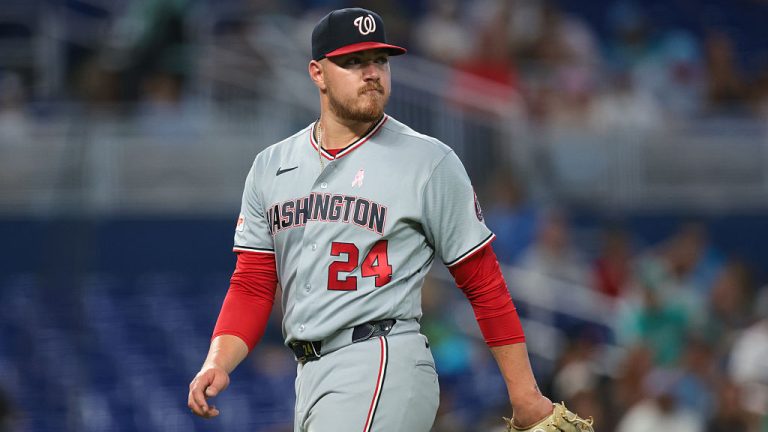
It has been quite some time since the Washington Nationals have been relevant when it comes to discussing teams that could genuinely contend for a playoff spot, even with the added benefit of another Wild Card spot. Believe it or not, the 70 wins they have entering September 15 are one shy of tying the most wins they’ve had since the 2019 season, excluding the COVID-shortened 2020 season, when they won the World Series.
Despite falling short yet again this year, a change in the front office has sparked a light in an organization that the nation’s capital has been longing for. After trading their former face-of-the-franchise player and having no clear “leader” on the roster, it looks as if they have a head. That comes from the current 1-2 punch at the top of their rotation, which looks to be building blocks for the future.
It’s no secret that the Nationals’ pitching staff as a whole has created a lot of grey hairs in the organization and fan base. We still have a couple of weeks left in the MLB season, but the Nationals have already broken the record for the most blown saves in a single season, recording their 38th on September 8.
As a whole, the pitching staff has currently allowed the fourth-most runs in all of baseball, with 769. I think it goes without saying that many of those have come from the struggles of the bullpen. Their starting rotation as a whole has pitched more around league average, with a staff ERA sitting just above 4.30. Much of the heavy lifting has come from young right-hander Cade Cavalli and left-handed starter Andrew Alvarez.
Who Are They?
Cade Cavalli
Let’s kick this off by breaking down who Cade Cavalli is and just how he got here.
Taken with the 22nd overall pick in the 2020 draft, the Nationals were hoping they were taking a future top-of-the-rotation arm with the youngster out of Oklahoma. However, with just how demented the game of baseball can be at times, the start to Cavalli’s career was a rollercoaster.
Since there was no Minor League season in 2020, Cavalli had to wait until 2021 to make his professional debut for the Nationals. After pitching across three different levels in his first season, even with the struggles in Triple-A at the end of the year, his numbers as a whole were quite impressive.
In 24 games, he had a 3.36 ERA over 123.1 innings pitched, kept the ball in the yard incredibly well by allowing only five home runs, and struck out 175 batters. He limited opponents to a .213 batting average.
Then came the 2022 season. The Nationals felt as if, despite the 7.30 ERA in six starts to end the 2021 season, Triple-A was going to be where he would begin the season. They were right to do so. In 97 innings pitched across 20 starts, he posted a 3.71 ERA and continued his ways of striking out over a hitter per inning. He would also go on to make his Major League debut this season as well; it just did not go well.
Cavalli got his first taste of the big leagues with a spot start for the Nationals. In his one start, he pitched 4.1 innings, allowing seven earned runs against the Cincinnati Reds. He would also go on to hit three batters in this outing. That would unfortunately be the last time we would see Cade Cavalli for a while, after he underwent Tommy John surgery and missed all of the 2023 season.
What makes his journey even more interesting is that he truthfully was not all that good after he returned. He made three starts in 2024 that only amounted to 8.1 innings pitched, and then he returned in 2025, pitching 74 innings and posting an ERA over five in 17 starts in the minors, followed by another 48.2 innings in the majors.
His biggest bugaboo was actually the home run ball, which he had done so well at limiting before the injury. But credit to the Nationals, who disregarded that and gave him the chance to start in the big leagues this year.
So far this season, Cade Cavalli has started 31 games. In the 164.2 innings he has pitched, he has a 3.12 ERA, striking out nearly 11 hitters per nine innings, and has accumulated a 3.5 bWAR. He has given up his fair share of home runs, but he is mitigating that with a 50.8% ground-ball rate.
Most of his success, even with a four-seam fastball sitting a tick under 97 MPH, is coming from his breaking ball, which, per FanGraphs, has generated a total of 19.4 run value split between his slider and knuckle-curve. Those two pitches are also generating a Stuff+ above 100, with his slider at 111 and the curve at 112.
As the kids say, it’s just gross. Watching him pitch every fifth day has been a ton of fun.
Andrew Alvarez
Now we have the second cog in the future of this rotation in Andrew Alvarez.
Unlike Cavalli, Alvarez had to wait all the way until pick 352 before he had his name called on draft day. The Cal Poly product was coming off a senior season in which he pitched to a 4.08 ERA across the 16 games he appeared in.
It took him just under five full seasons before he got his first taste of Major League Baseball. Alvarez was called up for a cup of coffee last season. He appeared in five games, posting a 2.31 ERA while limiting opponents to a .184 batting average. Alvarez isn’t someone who is going to light up the scoreboard, but he will fit into the traditional lefty stereotype of being a pitch-to-contact “merchant” and finding a considerable amount of success in doing so.
To this point in the season, Alvarez is holding hitters to a Hard-Hit percentage right under 30%, per FanGraphs, and generating a ground-ball rate of 49.6%. In my opinion, what makes his success all the more impressive is that he is limiting the damage from hitters all while they are swinging at pitches in the zone darn near 62% of the time. That is a true testament to just how deceptive he has been with his pitches when he’s on the mound.
This is also a hat tip to just how good he has been at executing his pitches at any point in an at-bat.
Andrew Alvarez is another example of how sometimes boring works!
Are They Enough to Build Around?
As I stated previously, the Nationals have been trying to dig themselves out of the hole they dug themselves into just five years ago. That World Series season was the last time they were perceived as a threat around the league.
When you look around the roster, you’re seeing a lot of young players who are trying to establish themselves as Major League players. It becomes even more prevalent when you look at a recent article posted by Yahoo Sports depicting just how young the roster is, highlighting the fact that, at the time of the article, there wasn’t a single player over the age of 30 on their active roster.
To be honest, that’s what a team in their current situation should be doing: giving young players a chance to get reps on a daily basis. If they stuck to the more “traditional” route and tried to incorporate a veteran here and there, then you wouldn’t have two emerging building blocks like Cade Cavalli and Andrew Alvarez taking their opportunities by the horns and penciling themselves in as core pieces of the future roster.
The offensive side of the ball isn’t devoid of talent either. James Wood and CJ Abrams are two players who have shown they have what it takes to be locked into this team’s future. However, there are multiple teams in the league that have youngsters performing for them but have a revolving door in their rotation, trying to find a core of starters to build a rotation around.
With the progression that Cade Cavalli has shown this year, flashing signs of being an ace if he continues at this pace, and the stability that Andrew Alvarez provides behind him, the Nationals have positioned themselves in a spot where they look to be making progress toward reverting to a playoff-caliber roster and competing in a National League East that is proving to be a division that produces multiple postseason teams yearly.
Become a Member of Just Baseball
Subscribe and upgrade to go ad-free!
* Save 25% by subscribing annually.

Written by
Cristian has been at Just Baseball since 2021, when he first started writing about prospects. He spent eight years working in Major League Baseball with the…