
Josh Hader Is Reclaiming His Throne as MLB’s Best Reliever
Josh Hader may be in the midst of an injury-altered season, but he's also returned to the top of the pecking order amongst MLB's relievers.
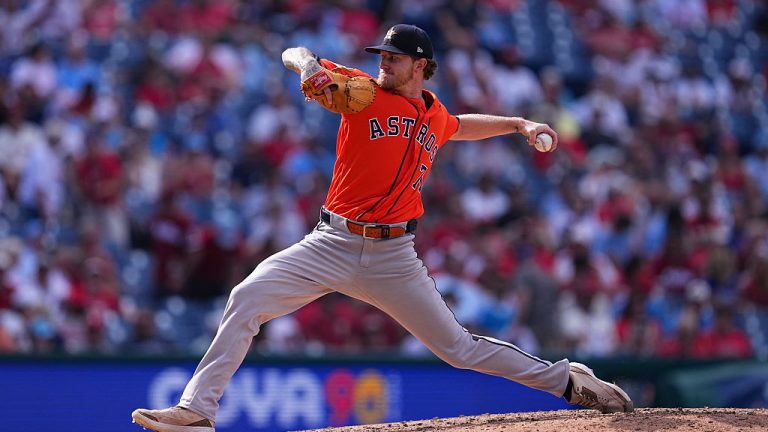
Amidst the inconsistency of the Houston Astros 2026 season, left-handed closer Josh Hader‘s sustained dominance has them at the top of the American League West.
Being a reliever is highly volatile. It’s a testament to one’s ability to hold up year-over-year. Only generationally great relievers tend to avoid a blowup year. But even the likes of left-hander Aroldis Chapman, or right-handers Kenley Jansen and Craig Kimbrel, arms on the Cooperstown track, have blowups.
Hader’s had a couple: a 5.22 ERA in 2022 and a 3.80 in 2024. Sure, the latter is a very good year for many, but not for one of the highest-paid relievers counted on for high leverage outs.
After a strong, albeit injury-altered 2025 campaign, the 32-year-old southpaw’s had a stronger, albeit also injury-altered 2026 campaign. Through 42 appearances, he has a 0.87 ERA, a 28.5% strikeout rate, and his 2.0 fWAR is his highest since the 2021 season.
The Astros are conceptually a decent ballclub, but injuries and inconsistent play have them at a pedestrian 75-75 record. In the 2026 AL West, that’s good enough to lead the division, so they control their own destiny. With that in mind, it’s good to know the ninth inning is under control should they enter with a lead.
Hader is 25-for-25 in save chances, with one earned run allowed since July 20. His dominance anchors an Astros bullpen that’s 18th in ERA and 20th in FIP.
What about Hader explains his return to the top of league’s pecking order for relievers?
Keeping the Ball in the Ballpark
As is often the case with dominant arms, stacking hits is borderline impossible. The only way to beat someone like Hader is to pounce on the rare mistake a change the score.
In 2026, that’s not happening.
Despite a career-worst 35.8% strikeout rate, Hader’s got a career-best .114 batting average against. He’s notoriously someone with a flyball-heavy batted ball profile against. While still the case, this year he has the second lowest of his career at 47.7 percent.
Combine that with a career-high groundball rate of 39.5% and you’ve got a profile conducive to avoiding the home run ball.
That said, when he does give up fly balls, they’re not leaving the year. Last year, he gave up homers on 12.3% of fly balls, giving up fly balls on 60.2% of batted balls. This year, only 2.4% of his fly balls are homers. Generally, that’s some wildly good luck, hence why his expected FIP is nearly two full runs above his ERA, but there’s a logical explanation for why those aren’t going for damage.
Masterful Contact Manipulation
It’s not that Hader has ever had an issue giving up loud contact on average, but this year he’s been elite at avoiding it.
Among the 177 relievers with at least 40 innings, Hader is tied for 24th in hard-hit rate. He’s also tied for 13th in average exit velocity (85.9 mph), tied for 11th in 90th percentile exit velocity (102.0 mph), and tied for fifth in max exit velocity (108.2 mph).
Opponents are hitting .083 on 24 fly balls against Hader this year, with an average exit velocity of 92.4 mph. Six of those 24 batted balls are barrels, and none of those are the one home run he’s given up.
Hader’s never been a bottom-of-the-barrel reliever in terms of giving up hard contact, but there’s definitely correlation in either barrel rate or hard-hit rate in his blowup years.
Refined Command
Not striking guys out at as high a rate means more balls in play. Because of this, it greater exemplifies the need to avoid giving up free passes. Hader is a career 3.4 walks-per-nine guy, but this year it’s 2.4. That mark is the second-best of his career, and his best since 2019.
His strikeout rate, though still elite, is the worst of his career with two weeks to go. However, that 7.3% walk rate keeps the separation around what it’s been since 2024. He’s walked just 11, without hitting a single batter, in 41.1 innings pitched. Additionally, he’s allowed just one home run.
But command is more than simply strike-throwing; the quality of strikes matters just as much. Hader has elite-level stuff — always has. However, the location can get even the elite of the elite into trouble. His sinker lives middle-in to lefties and top rail. A high velocity heater thrown top-rail is always a tough pitch for a hitter to get on top of, but nailing the inner third to lefties makes it almost impossible for same-handed hitters to get the barrel to.
Moreover, it’s darting away from the barrel of a righty batter.
His slider is also living beneath the strike zone. It tends to leak on the down-and-in part of the zone to lefties, which can be a problem if not for the fact opposing managers ideally stack righties against Hader. Those backdoor sliders, especially when sitting on his 94th percentile average fastball velocity, makes the at-bat uncomfortable for all batters.
Though Houston isn’t as dominant as recent years, it’s going to be a tough out should it get to October because there’s nearly zero breathing room late in games when No. 71 comes in.
Become a Member of Just Baseball
Subscribe and upgrade to go ad-free!
* Save 25% by subscribing annually.

Written by