
Live Look Overview – 2026 East Coast Pro
Breaking down the top prospects and performers from the 2026 East Coast Pro Showcase.
 | |
| | 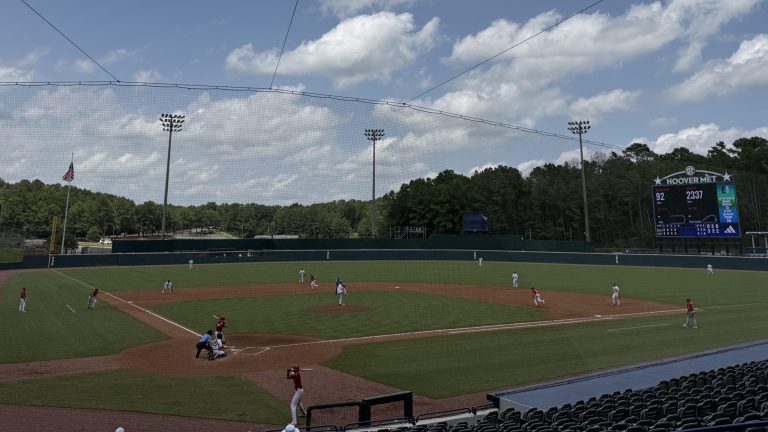
After four long, hot days at the Hoover Met, the 2026 East Coast Pro Showcase is in the books.
This is one of the biggest events within the prep circuit every summer, and how convenient that our draft team has two members who live five and 20 minutes away from the event, respectively.
Countless names stood out over the four-day stretch, but we had to narrow it down at least a little, so here are 27 of our favorite standout performers in our live looks from this year’s ECP.
Samir Mohammed | RHP
| IP | STRIKE % | BF | H | K |
| 3 | 69.44 | 10 | 1 | 4 |
Perhaps the best starting pitcher over the four-day showcase was Samir Mohammed, who went three shutout frames on Sunday.
Working a four-pitch arsenal, Mohammed went after hitters with his fastball/changeup tandem. Displaying two different types of heaters in the upper-90s (up to 98 mph), he spins both of them really well, with the sinker holding more run/ride traits. Locating them on both sides of the dish, he was able to spot either wherever he desired from start to finish.
Mohammed holds one of the premier changeups across the 2027 high school crop, a low-80s offering that just dives off the table and produced literally a 100% whiff rate across his three innings of work.
Rounding out his arsenal is an 86-89 mph cutter with bullet shape and a low-80s slider that has downward tilt with sweep. LSU Commit. – Peyton S.
Malachi Butler | SS
| AVG | AB | TB | RBI | OBP |
| .333 | 9 | 5 | 0 | .333 |
With such loud tools, there’s a reason Malachi Butler is viewed so highly in the scouting industry.
Though he has an unorthodox hand setup pre-load, the lefty showed great barrel feel and an innate ability to get the bat on the ball. The hit tool will be the headliner of his offensive profile, anchored by elite contact rates and true discipline at the dish. And although the power potential might be a concern for Butler, he managed to pop EVs over 90 mph on all three of his hits this weekend.
He’s a premier athlete overall, despite the fringe-average foot speed we clocked, with a clear future at shortstop due to a smooth glove and lateral actions.
The floor on this profile is seemingly high, and it’d frankly be a shock if he ended up on campus for 2028. – Josh C.
Connor Salerno | LHP
| IP | STRIKE % | BF | H | K |
| 3 | 77.78 | 14 | 4 | 5 |
A two-time East Coast Pro participant, Salerno dazzled again in last week’s event.
Salerno went after opponents with his heater, and they had no answer for it. Living 92-95 (up to 96 mph) while averaging nearly 2,450 rpm and thrown for nearly 80% strikes.
His primary offspeed weapon over his start was a low-80s slider holding short action. Another high-spin pitch, Connor was able to locate it often down in the zone against both lefties and righties. Rounding out his arsenal is a mid-80s cambio, an offering thrown primarily against right-handers he has good feel for.
A quick worker that toes and goes (several 1.1-1.15 times to plate with runners on). Arguably the best prep left-hander in the upcoming draft. Mississippi State commit. – Peyton S.
John Hucko | OF
| AVG | AB | TB | RBI | OBP |
| .231 | 13 | 9 | 3 | .286 |
Don’t let the batting average fool you, John Hucko was one of the bigger winners coming out of this year’s East Coast Pro.
Hucko collected five exit velocities that were 94 mph or higher over the showcase period, including a double on day two as well as two triples (100 & 105 EVs respectively) in Sunday’s contest.
An athletic outfielder who displays plus range by covering significant ground with clean angles and defensive instincts. Recorded multiple sub-4.30 home-to-first times while posting an official 3.63 30-yard sprint time and 6.47 60-yard sprint time. Auburn commit. – Peyton S.
Brennan Neal | TWP
| IP | STRIKE % | BF | H | K |
| 2 | 66.67 | 6 | 0 | 3 |
The best two-way performance belonged to Brennan Neal, who pitched two perfect innings while finding a few barrels in the box.
Brennan came into relief on day three and put up some diabolical stuff. Fastball was sitting 95-97 mph, featuring really good ride up in the zone, missing barrels while nearly averaging 2,500 rpm.
To complement the heater, Neal blended in two different offspeed weapons. First, a mid-80s slider with some depth and late action. Last, a 90 mph changeup thrown to left-handers getting really good offset and tumble throughout its trajectory.
| AVG | AB | TB | RBI | OBP |
| .667 | 3 | 5 | 3 | .750 |
Neal had one of the louder swings on day one with a three-run backside blast (103 EV/363 FT).
Rounded out day four with a barrel against a tough right-handed arm good for a base-knock (94 EV). Posted a 4.20 home-to-first sprint time as well as a 6.54 official 60-yard sprint time.
Only four total plate appearances across the four days, but absolutely made the most of his opportunities. Really intriguing athlete that’s well-rounded and tooled up. Auburn commit. – Peyton S.
Jake Cueto | OF
| AVG | AB | TB | RBI | OBP |
| .250 | 8 | 2 | 0 | .455 |
One of the guys who caught my attention very early in the weekend was Miami commit Jake Cueto.
The athlete jumped off the page immediately, and he backed that up with a professional look at the plate. He stands with a wide base from the left side, and his patient approach became noticeable throughout the weekend, as he walked three times.
When he does decide to offer at pitches, though, the swing itself is very connected. He’s proven to be a bat-to-ball demon, and even tapped into some juice last weekend by going backside for a 102 EV single.
Cueto clearly profiles as a lead-off/center field staple long-term, and is a prime candidate to make seven figures in the draft next July. – Josh C.
Chase Fuller | TWP
| IP | STRIKE % | BF | H | K |
| 1 | 56.25 | 3 | 0 | 1 |
Closing out day three, Chase Fuller mowed down the three batters he faced in dominant fashion.
Chase primarily threw his heater across the relief appearance, living 96-98 while hitting 99 mph more than once. A run/ride fastball, Fuller spins it really well, averaging 2,500 rpm, often landing it within the upper third of the zone, giving hitters fits.
Mixed in two offspeed pitches thrown sparingly, though neither was needed that much. Fuller went after left-handers with an 86-88 mph changeup presenting really good tumble, while throwing a mid-80s slider against righties averaging 2,400 rpm that gets good sweep traits.
| AVG | AB | TB | RBI | OBP |
| .111 | 9 | 3 | 0 | .200 |
Again, don’t let the batting average fool you; Fuller took some quality at-bats and ran into some tough luck.
He collected a 91 EV base hit in a 3-2 count as well as a 94 EV lineout against a really good right-handed fastball.
Overall, it’s a powerful athlete with advanced upper/lower body strength. Fuller has the talent to hit or pitch at the next level. Time will tell which it is. Florida State commit. – Peyton S.
Landon Green | RHP
| IP | STRIKE % | BF | H | K |
| 3 | 55.10 | 12 | 0 | 3 |
Taking the ball on day one, Landon Green settled in as his outing went on and threw three scoreless innings.
A fastball/slider profile, Landon worked north/south in his start. His four-seam, for the most part, was 91-94 (up to 96 mph), velocity sort of dipped as his outing commenced but presents plus ride and spin traits. As for the slider, working 78-81 mph, holding bullet shape, and generating plenty of swing-and-miss.
Worth noting Green also threw a two-seam at 94 mph, generating more arm-side action.
A really athletic body, gets downhill well coupled with lively arm action. All three punchouts went down looking; Green controlled the run game well given his three walks allowed. Florida commit. – Peyton S.
Jalen Bowman | OF
| AVG | AB | TB | RBI | OBP |
| .231 | 13 | 3 | 1 | .333 |
Jalen Bowman’s calling card is pure, jaw-dropping speed, and there’s no denying it.
We’re talking literal 80-grade home-to-first and 60-yard dash times, the kind of number that makes you do a double-take (I say this as someone who had to do a double-take multiple times).
That run tool alone makes him a weapon, and it shows up in the field too, where he covers a ton of ground and looks the part of a true center fielder long-term. The bat is a bit more of a mixed bag right now.
He racked up plenty of loud outs over the weekend, so the contact quality is clearly there, but the swing gets a little slashy and the swing-and-miss creeps in more than you’d like. If he can tighten that up even a little, the speed + impact combo gives him a real shot to be an everyday outfielder down the line.
For now, Bowman is a classic tools-over-production case, but the tools in question are about as loud as it gets. – Josh C.
Frank Thomas III | 1B
| AVG | AB | TB | RBI | OBP |
| .300 | 10 | 4 | 2 | .364 |
Frankie Thomas definitely has a polarizing profile, but there’s no denying the kid can hit. The praise was high coming out of USA 18U, and it translated flawlessly to East Coast Pro.
As you could’ve probably inferred by the name and commitment, the lefty is the son of Hall of Famer Frank Thomas, hence why he plays first base. He covers the area well and has shown the ability to pick well, but I’ve said that I believe he has the range and potentially even the arm to play second or third base, and I really wish he’d give it a shot to help increase his value a tad.
The reason it’s a polarizing profile is because of how narrow he gets at the point of contact, but the bat-to-ball is outrageous, and there’s more pop behind the swing than those mechanics would imply. He employs a really athletic frame, and despite the fact that he might be a below-average runner, the versatility and presence of big tools is evident.
If you ignore the controversial lower half in his operation at the plate, there’s an extremely solid chance he finds his way off the board within the first two or three rounds next July.
If not, Auburn might truly give Frankie Thomas a record-breaking NIL deal for a high school baseball player (no particular reason why, obviously). – Josh C.
Drake McClurg | OF
| AVG | AB | TB | RBI | OBP |
| .400 | 5 | 2 | 0 | .500 |
What Drake McClurg doesn’t have in size, he makes up for in athleticism.
He’s been known to have the upside of a plus runner, and we clocked him as just that on Saturday. At the plate, he brings a fluid swing from both sides, one that helped him reach base in half of his plate appearances over the weekend. In the outfield, his top-notch glove was on display with a diving grab in center on Monday, he has all the tools to stay there long-term.
Prep prospects are typically an interesting case study, because sometimes you’re just banking on the tools translating to results down the line. Other times, you have a guy like McClurg, where the tools are already producing those results, so you can only imagine how high he can fly. – Josh C.
Calum Andersen | RHP
| IP | STRIKE % | BF | H | K |
| 2 | 57.14 | 6 | 1 | 3 |
Calum Andersen came into this weekend widely regarded as the top prospect from our neighbors up north, and his performance did nothing to change that.
It’s a fun profile: a 6-foot-5 athletic frame paired with a long operation that passes the eye test. Beyond the mechanics, his underlying metrics tell an equally positive story. He’s a three-pitch arm built around a mid-90s cut-ride fastball with extreme outlier carry. His secondaries, a low-80s curveball and mid-80s changeup, round out the mix, with the curveball being the more impactful of the two.
If he makes it to campus, Andersen would immediately play a big role for the defending champs, who’ve already shown no hesitation to throw freshman arms right into the fire. – Josh C.
Isaiah Snavely | INF
| AVG | AB | TB | RBI | OBP |
| .571 | 7 | 9 | 3 | .625 |
Isaiah Snavely had the loudest start you could have offensively, beginning his performance with a two-run blast (96 EV/363 FT) on day two.
Grabbed another 94 E, though it didn’t turn out to be a hit in the books. However, collected an RBI double down the RF line (89 EV) along with an 88 EV base knock off of a 94 mph heater.
Defensively, Snavely provided good looks on the dirt, mixing in at second, short, and third. He’ll stick on the left side at the next level, really intriguing offensive profile. Texas A&M commit. – Peyton S.
Greyson Parker | RHP
| IP | STRIKE % | BF | H | K |
| 2 | 62.86 | 9 | 0 | 3 |
Greyson Parker started the second game for the Rangers on Sunday and turned in two great innings.
Despite some tough defensive miscues, Parker didn’t let that get to him. His heater was quality, a 91-94 (up to 95 mph) possessing intriguing ride through the zone while averaging nearly 2,500 rpm.
He incorporated two different offspeed pitches across his performance. Most often, a low-80s slider with late glove-side break thrown more often to right-handers, which he has plus feel for. Rounding out the arsenal is an 85-87 mph changeup holding plus tumble, creating plenty of chase against left-handed bats.
Starter profile with room to grow in his 6-foot-1 frame. Ole Miss commit. – Peyton S.
Jordin Griffin | OF
| AVG | AB | TB | RBI | OBP |
| .500 | 2 | 0 | 0 | .857 |
Don’t care that Jordin Griffin only collected one hit in Hoover. He walked five times and was one of the defensive standouts across the four-day showcase.
His only knock was a single, but he found another barrel good for a 93 EV on day three (lineout). Stole a couple of bases in the four-game period while showing off plus range in various outfield spots, including two diving catches.
Profile leaks athleticism and balanced tools while being one of the better runners in the class; 3.68 unofficial first-to-second stolen base time along with a 6.60 official 60-yard sprint time. LSU commit. – Peyton S.
Demarcus Lowery | OF
| AVG | AB | TB | RBI | OBP |
| .714 | 7 | 6 | 3 | .714 |
Collecting a hit in all three games played, including multi-hit performances in two, Demarcus Lowery left East Coast Pro with an up arrow.
Across his five hits, four traveled off the bat 89 mph or harder, notably maxing out with a 96 EV (single) while also collecting a 92 EV (backside double).
It’s worth noting all five base hits were off offspeed pitches.
Strong wrist in the box coupled with advanced range in the outfield. 4.21 unofficial home-to-first sprint time as well as a 6.65 official 60-yard sprint time. Louisville commit. – Peyton S.
Kohen Poplin | RHP
| IP | STRIKE % | BF | H | K |
| 2 | 63.33 | 7 | 0 | 2 |
Although he was one of the youngest guys at the event, Kohen Poplin was on the short list for most impactful arm of the weekend.
The Phillies’ Saturday starter worked with a four-pitch arsenal throughout his two innings on the bump and demonstrated real feel for each and every one. He heavily utilized a mid-90s four-seamer that topped out at 97 mph with good carry and notable run/ride qualities.
Beyond that, he featured a premium slider that lived in the 85-87 mph range with beyond-plus spin traits, inducing a swing-and-miss every single time it left the righty’s hand. There were also an upper-80s changeup and a low-80s curveball with big depth, each tossed a couple times.
It might’ve just been a couple innings of work I had the pleasure of watching, but it’s easy to see Round 1 upside for this kid 23 months from now. He’s a fluid mover with feel for the zone at a young age, and there’s a clear high ceiling here. – Josh C.
Derek Vazquez | SS
| AVG | AB | TB | RBI | OBP |
| .500 | 4 | 5 | 2 | .500 |
One of the few 2028s appearing in Hoover last weekend, Derek Vazquez didn’t look out of place with the older group.
His best batted ball came on the last day: a 101 EV/410 foot blast opposite field, the farthest home run across the event. In addition, Vazquez collected two other 94 EVs (reached on error and a single, respectively).
Even at 16, it’s clear as day that Derek is an easy day one name come 2028. Possessing a sweet left-handed stroke that picks up velocity well and understands when to shorten up while being a fluid mover on the dirt with easy arm strength. Vazquez is a shortstop for years to come. Uncommitted. – Peyton S.
Isaac Vidal | RHP
| IP | STRIKE % | BF | H | K |
| 2 | 67.74 | 8 | 1 | 2 |
I don’t know where his consensus draft stock is gonna go over the next 11 months, but I want to take this time to make my claim as first to the punch for Isaac Vidal.
Honestly, there isn’t much not to like. In his outing on the bump last weekend, he threw two scoreless innings with over 65% strikes while flashing five (!) different pitches, not something you see out of prepsters too often at this point. There were two different fastball shapes: a mid-90s four-seam with 20″ of ride that blew past hitters all day, and a low-90s two-seam that played off its counterpart well and induced ground balls.
He also came at lefties with an upper-80s changeup that looked exactly like his two-seam out of hand but kept batters off-balance with its drop in velo. As for breaking balls, it was mostly an 81-85 slider with plus spin traits and big sweep, though it lacked depth. Speaking of sweep, he flashed an 80 mph sweeper at 2700 rpm once too, getting a whiff on the offering in its only appearance.
There’s legit extension, it’s a composed operation, he generated nearly 50% whiffs here, and the frame has him built to start at the next level. We’re a ways out from the draft next summer, but I’m already putting my stamp on Vidal as one of my guys. – Josh C.
Devlan Daniel | OF
| AVG | AB | TB | RBI | OBP |
| .600 | 5 | 7 | 3 | .714 |
Devlan Daniel showed a lot to like over his three games played, reaching base in all three while tallying two extra-base hits and stealing a pair of bases.
Daniel smashed a 98 EV/368 pull-side homer as a lefty and then later connected with a 94 EV good for a double from the right side.
His third base knock was a single, translating to a 92 EV also on day two.
Holds swift hands and an adjustable barrel through the zone, while showing off plus speed in-game both on offense and defense.
Ran an official 6.79 60-yard sprint time. Mississippi State commit. – Peyton S.
RJ Shields | RHP
| IP | STRIKE % | BF | H | K |
| 3 | 56.25 | 10 | 0 | 5 |
Arguably putting together the best relief performance, RJ Shields went three scoreless innings while facing only one batter over the minimum.
A three-pitch mix, Shields most often relied on his fastball and slider to get outs. His four-seam was a dandy, operating 91-94 (up to 96 mph) and generating over 2,550 rpm on average that worked well on both sides of the plate. The slider was just as nutty, an 80-83 mph offering with short action and missing plenty of barrels.
Rounding out his arsenal was an upper-80s changeup, thrown exclusively to left-handers. A pitch he’s able to turn over fairly well, generating tumble down in the zone.
Two-way prospect but stood out more on the bump. 6-foot-2 body that gets down the slope easily with plus extension. Mississippi State commit. – Peyton S.
CJ Wall | C-CIF
| AVG | AB | TB | RBI | OBP |
| .571 | 7 | 5 | 1 | .625 |
CJ Wall wrapped up his summer continuing to mash, finding the barrel all across gameplay.
Such a slick left-handed swing. Wall gets synced up easily while creating torque and plus bat speed.
Caught four barrels throughout East Coast Pro, maxing out at a 103 EV translating into an RBI single. Along with this, another 99 EV single, a 95 EV flyout, and a backside double off the wall.
Moves really well for his 6-foot-1 frame, posting a 6.98 official 60-yard sprint time. Primarily was behind the dish defensively, though a shift to a corner infield spot at the next level is in the cards.
One of the personal favorites in the class, dude just hits wherever he’s at. Arkansas commit. – Peyton S.
Trent Lutz | RHP
| IP | STRIKE % | BF | H | K |
| 2 | 64.87 | 10 | 4 | 4 |
Getting the nod to start day two, Lutz was overall very intriguing despite being BABIP’d along with some early errors.
A four-pitch mix, Trent was primarily fastball/slider. The four-seam was working 91-94 mph, creating plus hop through the zone with ability to get up to the top rail. His 83-87 mph slider was the pitch of the outing, thrown for strikes at an absurd clip featuring tight shape and plenty of whiff.
Trent also worked in a mid-80s splitter, hovering around 1,000 rpm and a weapon to left-handed bats. Wrapping up his arsenal is an upper-70s breaking ball with some sweep, locating it often down in-zone to create weak contact.
A starter profile that stands 6-foot-5 with four pitches, three that he’s comfortable using often. It’s a low-effort delivery that pounds the zone. Wake Forest commit. – Peyton S.
Chris Grasso | RHP
| IP | STRIKE % | BF | H | K |
| 2 | 72.73 | 7 | 1 | 3 |
Apparently I’ve got a thing for Miami commits, and Chris Grasso is next in line.
I loved what I saw from him on Saturday. He’s got a 6-foot-5 frame with body control and a clean operation from the right side. Out of an extremely low three-quarters arm slot, he’s primarily a fastball/slider guy, with the latter being the most relied-upon of the two. His heater is a mid-90s offering that gets ground balls consistently and has the ingredients to hold big arm-side run in the future.
The flashier pitch here is the slider, a low-80s breaking ball with true double-plus spin and real sweeper traits, located surprisingly well on a consistent basis. On occasion, a mid-80s splitter is used as well. If he could develop better feel for it, that could become a real weapon, considering he got a whiff on it the one time it was thrown in Hoover, and the spin + movement separation off his fastball was jarring.
On top of all that, his big stuff was located for a cumulative 73% strikes between both innings on the mound.
Grasso performed well at Area Codes this year too, and our guy Tyler Jennings seemed to notice.
I’d like to get as many people on the Chris Grasso hype train as possible, so I welcome the sentiment. All aboard, folks. – Josh C.
Teagan Leach | 1B
| AVG | AB | TB | RBI | OBP |
| .555 | 9 | 7 | 0 | .636 |
Teagan Leach was all over the barrel in just about all of his at-bats. There perhaps may not have been a better hitter last weekend.
In fact, he connected with a 95 EV or higher on four occasions: two doubles (105 and 99 EV, respectively), a single (96 EV), and a flyout (101 EV).
Hardly whiffed over the course of East Coast Pro. Tallied a pair of walks as well as scoring four times.
A powerful left-handed stroke, he has some swing and positional mechanics to clean up, sure, but the swing decisions and contact quality make him an appealing prospect. Virginia Tech commit. – Peyton S.
Cam Boehm | RHP
| IP | STRIKE % | BF | H | K |
| 2 | 67.50 | 10 | 2 | 4 |
Coming into relief on day two, Cam Boehm came after hitters with serious stuff.
A three-pitch arsenal in our look, Boehm showed off two different fastballs and a 12/6 curveball.
Boehm threw his four-seam much more often, a 91-94 mph pitch that gets plus ride to which he can sometimes really cut. He works in a sinker as well within the same velocity, generating more run/ride traits.
Cam’s curveball really stood out; it was a hammer. A weapon working in the upper-70s velocity, it possesses real bite and drop throughout its trajectory.
He commanded all three pitches well while working as a north/south pitcher. Controls the run game and a quicker mover to the plate (posted 1.15-1.25 home-to-plate times in stretch). Ole Miss commit. – Peyton S.
Caden Borcherding | C
| AVG | AB | TB | RBI | OBP |
| .200 | 5 | 1 | 2 | .429 |
Caden Borcherding might not have lit up the stat sheet this weekend, but his tools flashed nonetheless.
He’s got a plus arm behind the dish, and it’s easy to squint and see him sticking at catcher long-term because of it. At the plate, the swing is a little flat, but he still finds a way to get loft when he connects, and he found the barrel well on multiple occasions last weekend.
Where things get a little dicey is the run game, and he’s probably a below-average runner, though that matters less for a guy whose value is going to be tied to the glove and arm anyway.
I’d say Borcherding profiles as a solid two-way catching option with more sneaky feel for the barrel than his output last weekend would suggest. I’ll be surprised if he makes it to Clemson at this point. – Josh C.
Become a Member of Just Baseball
Subscribe and upgrade to go ad-free!
* Save 25% by subscribing annually.