
Perfect All-Star Ballot: Who Should Start in the NL?
The fan ballot doesn't usually lead to a perfect starting lineup. Here are the players we think deserve to start for the NL All-Stars.
Every season, the Major League Baseball All-Star voting process is a major talking point. And for good reason.
Contract incentives are at stake and, for some players, that extra Midsummer Classic recognition pads a potential Hall of Fame case. It’s a major recognition, one often muddied by the fan-voting system.
The interactivity gives the often powerless individual, fans, an opportunity to reward their favorite players for having great seasons.
However, fans are human. Oftentimes, their own feelings toward their team’s performance dictate their willingness to even participate, let alone vote for players on their team. On the flip side, a team having a great season will see players receive a massive influx of votes, whether deserved or not.
Numbers make the case for the player, but how much do you weigh what’s under the hood? Is punishing a player with gaudy exit velocities but poor results fair?
While MLB shows a brief rundown of players’ stats on the ballot, it’s something designed to be quick. Therefore, constructing the “perfect” ballot is incredibly difficult. That said, it can be done.
Here’s what the perfect ballot looks like for the National League.
Statistics updated prior to games on June 17.
Who Should Start for the NL All-Stars?
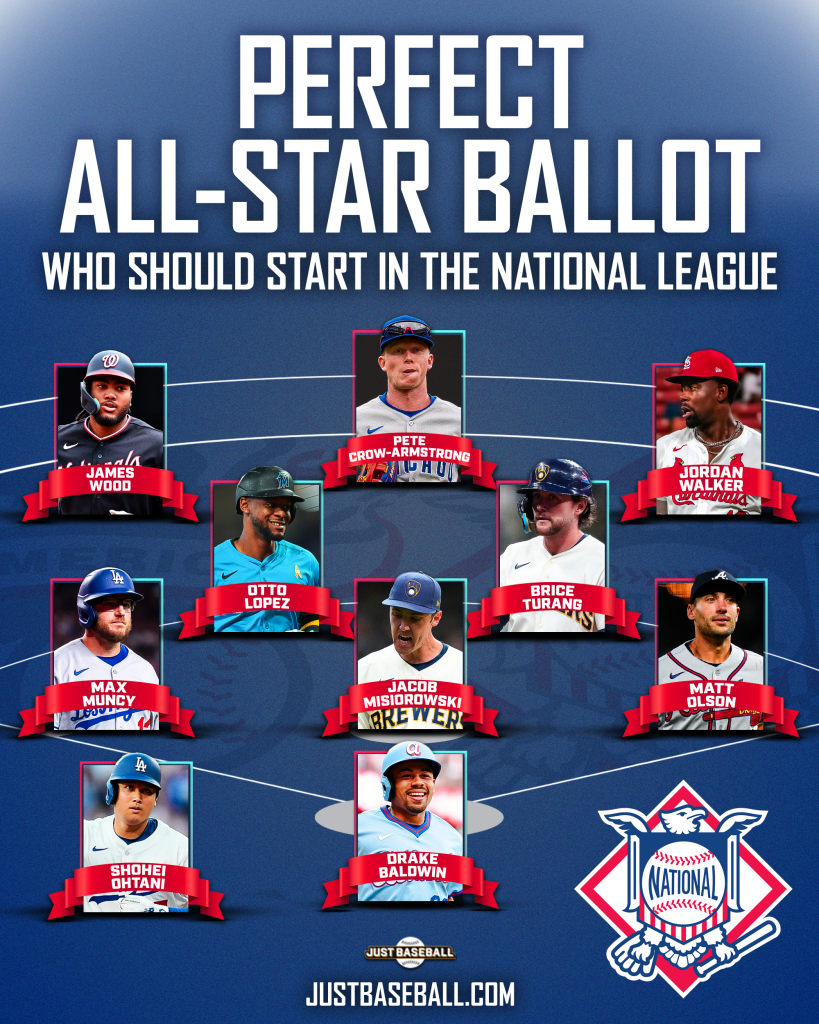
C: Drake Baldwin, Atlanta Braves
Time and time again, we see players have tremendous rookie seasons and either stagnate or even regress in year two. A sophomore slump, if you will.
That’s not at all the case with the Braves’ starting catcher. He’s exploded in his second season, anchoring a top-five offense.
Baldwin, still just 25 years old, entered play Wednesday sporting a triple slash of .307/.392/.561. He’s also added five home runs through 49 games after hitting 19 across 129 in 2025. Though he doesn’t have enough plate appearances to qualify, he’s third among MLB catchers with 2.3 fWAR, and first in the National League.
He’s also third among NL catchers with 39 runs batted in, fourth in home runs, and has a 28-point lead for the top wRC+. He’s putting forth such production despite ranking 21st in games played among catchers.
Fans are rewarding Baldwin despite his lack of playing time thus far. When the first voting update dropped on June 15, he had a stranglehold on the top spot with nearly one million votes.
1B: Matt Olson, Atlanta Braves
First base is a race to watch as the All-Star Game draws closer. It’s become a battle of two: the former mainstay of the Braves, Freddie Freeman, and his replacement, Olson.
As of June 15, Freeman held the lead in voting, but Olson’s having the more valuable season. Entering play Wednesday, Olson edges Freeman in fWAR by 0.4, wRC+ by seven points, home runs by nine — Freeman cut it to eight on Wednesday — and runs batted in by double digits.
It’s not often a team loses a Hall of Famer and doesn’t bat an eye, but Olson made life easy for Braves fans. That transition was seamless, and still is. He led the league with 54 home runs in 2023, then had a down year in 2024. Since then, he’s the second-most valuable first baseman in baseball with 7.2 fWAR.
Olson is a monster at the dish, and far from a slouch at first base. Defensively, he’s got six outs above average and defensive runs saved apiece.
The race for starting first baseman is tight, but the edge should go to Olson. Time will tell if that’s rewarded, or even if it holds up, as Freeman’s been on a heater for the past six weeks.
2B: Brice Turang, Milwaukee Brewers
Not only is Turang not leading this position in voting, but he’s nearly as close to fourth as he is to second.
After seeing a major uptick in offensive production last year, there were questions about whether it might be a mirage. It wasn’t.
He’s seen another surge in power production thus far, just seven home runs shy of tying his career-high 18 from a season ago. His isolated power — the difference between his slugging percentage and batting average — is up nearly 59 points.
He’s walking more, remains a productive baserunner, and is back to being a plus defender.
The Brewers’ second baseman is 0.2 fWAR behind JJ Wetherholt of the St. Louis Cardinals for the top spot in MLB, but he’s not even trailing him in All-Star voting. Ozzie Albies, who is nearly a full win worse, holds the top spot. Second is Bryson Stott, who has an 89 wRC+ and 0.9 fWAR.
Here’s how those three compare in 2026, entering Wednesday:
| Player | fWAR | wRC+ | HR | xwOBA |
| Turang | 2.7 | 139 | 11 | .364 |
| Albies | 1.8 | 113 | 10 | .311 |
| Stott | 0.9 | 89 | 6 | .314 |
Turang is disadvantaged, playing for a small-market team in Milwaukee. A team that, despite consistently being the best in the NL Central, often fizzles out come October. But the reputation of the Brewers shouldn’t hold fans back from rewarding Turang for being great.
Unfortunately, at least through the vote count on June 15, it has.
SS: Otto Lopez, Miami Marlins
What in the world has gotten into Lopez this season?
After emerging as a defense-first middle infielder for the Marlins, the 27-year-old is now taking the shortstop position by storm on both sides of the ball in 2026. His .336 average, even after an 0-for-5 Wednesday, is tops in MLB. He’s already set a new career-high for fWAR — subject to change as the season wears on — with 2.9.
This is what the All-Star Game should be all about: rewarding players for dynamite first halves. Voting shouldn’t be contingent on reputation, but it’s certainly hindered Lopez. He’s not only not leading NL shortstops in votes, but he’s not even close to being on the podium. His 230,286 votes rank fifth among his peers, more than 300,000 shy of Los Angeles Dodgers shortstop Mookie Betts.
Betts has had a tremendous career, one that’ll assuredly earn him a plaque in Cooperstown when it’s over. However, he’s having a dismal year at the plate. His 76 wRC+ is by far the worst of his career, and he’s played at a 1.5 fWAR per 150 games pace.
The leader, Washington Nationals shortstop CJ Abrams, at least has tremendous offensive metrics. His leading isn’t surprising, as players usually aren’t punished for poor defensive metrics. However, he’s been more than half a win less valuable than Lopez so far this year.
3B: Max Muncy, Los Angeles Dodgers
After tapering off in 2022 and 2023, Muncy has returned to form as one of the steadiest producers at third base in all of baseball.
This year, it’s like he’s caught a second wind as a breakout candidate at 35 years old. His 148 wRC+ is his best since 2018, and his .265 average would be a career-best as well.
Rightfully so, he’s lapping the field of National League third basemen in voting. This race isn’t remotely close, nor should it be, really.
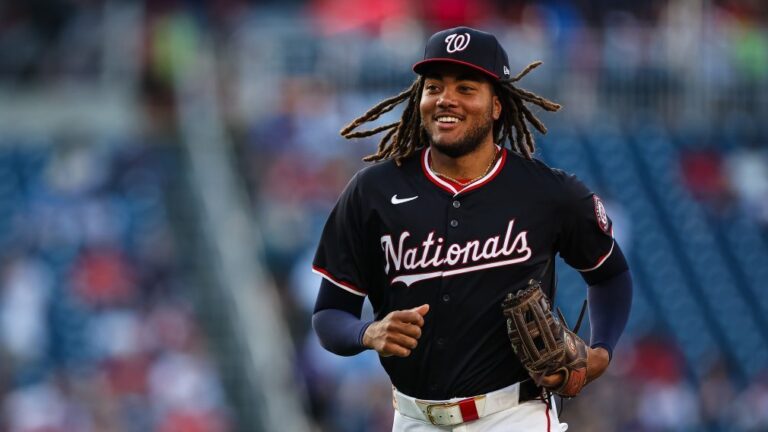
OF: James Wood, Washington Nationals
It’s hard to believe Wood is still just 23 years old. The headlining piece of the Juan Soto trade with the San Diego Padres, Wood is tormenting opposing pitchers in 2026.
Entering Wednesday, he’s slashing .281/.412/.555 with a 166 wRC+. Across the board, far and away all career-highs. He’s also slightly cut his strikeouts down, seen his walk rate jump to over 17 percent, all while becoming a more potent power producer.
He hit 31 homers last year, but already has 20 this season. His .274 ISO is ninth in MLB, he’s tied for fourth in home runs, and he’s anchoring a Nationals offense — along with Abrams — that’s third in the majors with a 108 wRC+.
Despite that, he’s seventh in voting among NL outfielders, and closer to the ninth-place Soto than he is to the top three.
OF: Pete Crow-Armstrong, Chicago Cubs
If not for Shohei Ohtani’s dominance on the mound, Crow-Armstrong realistically could be the frontrunner for NL Most Valuable Player this year.
After getting off to a slow start, the Cubs center fielder is already at 4.0 fWAR. Since May 1, he’s hitting over .300 with a 166 wRC+ and 23 extra-base hits. During that span, he’s leading position players with 3.1 fWAR, a full win above the second-most in the NL.
This goes back to the talk about reputation. Last year, Crow-Armstrong made his first All-Star Game. However, he sputtered drastically in the second half. After hitting 25 homers in the first half, he had just 22 extra-base hits in the second. His walk rate dropped to 4.5 percent, he wasn’t hitting the ball with much authority, and he really tanked his standing amongst MLB outfielders.
He’s also a polarizing figure in the game. We’ve seen him get into it with fans, most notably the instance in the game against the crosstown rival Chicago White Sox. He’s overall not a popular person in baseball, let alone as a player. But his numbers are what they are, and they scream All-Star worthy.
However, he’s not even in the top nine for NL outfielders in votes.
OF: Jordan Walker, St. Louis Cardinals
The St. Louis Cardinals appeared destined for a year of disappointment in 2026. Thanks to Walker, they look like potential contenders.
After a so-so rookie season, the 6-foot-6 outfielder spent time as both a part-time player and a part-time big leaguer in 2024 and 2025. This year, he’s shown precisely why he used to be a top prospect. His 145 wRC+ is 16th among MLB qualifiers regardless of position. Narrow the scope to outfielders, he’s sixth.
He’s still a work in progress defensively, but that typically doesn’t matter when it comes to All-Star voting. Again, refer to Abrams leading the voting pool for shortstops.
You’d think that playing for a franchise as historic as the Cardinals, with many memorable moments in the first half, he’d almost see a surge in voting that would put him as a definitive starter. Yet, he sits outside the top five after the first voting update.
It would be fun to see him in the Home Run Derby, as he’s already a batted ball data darling. But he should also be in the All-Star Game itself. Thankfully, fan voting doesn’t determine the entire roster. The downside, though, is he might not get to start.
DH: Shohei Ohtani, Los Angeles Dodgers
Remember when Ohtani got off to a fairly quiet start by his standards? He’s now sporting a 164 wRC+, so nature is healing.
He’s hitting .296, improved from last year, and his on-base is .418, the highest of his career. The slug hasn’t been there as much so far, but since May 6, it’s over .600 with a wRC+ over 200.
He’s ridiculous. Just when it seems he may be human, he ascends back to the demigod he’s been since his first major breakout campaign as a two-way player, with the Los Angeles Angels in 2021.
SP: Jacob Misiorowski, Milwaukee Brewers
Fans don’t vote on the starting pitcher, but it’d be silly if anybody but Misiorowski starts this game on the NL side. It felt rather gimmicky seeing him get selected in 2025. However, his performance since then, especially this year, invalidates the idea that it was a gimmick.
Even if it was, *shrugs*, you know what I mean?
The Lineup
Now for the really fun part, constructing this lineup:
- Shohei Ohtani
- Drake Baldwin
- James Wood
- Jordan Walker
- Matt Olson
- Pete Crow-Armstrong
- Max Muncy
- Otto Lopez
- Brice Turang
- SP: Jacob Misiorowski
There isn’t really a way to go wrong constructing an All-Star lineup, but the idea of giving a bunch of young players a crack at starting for the National League feels like a great move for baseball’s future. After Ohtani, who’d obviously lead off, this lineup then has three consecutive players 25 and younger.
Baldwin, Wood, and Walker could potentially put on an early show. Baldwin’s hit tool is among the best in baseball, then Wood and Walker would provide must-watch at-bats. The power-versus-power creates early tension in this exhibition affair, which really draws eyeballs to the early part of the game.
After the top four, it becomes fairly interchangeable. That said, you go from the must-watch guys to the steady producer in Olson, then fiery guys like Crow-Armstrong and Muncy, who both feed off of crowd energy.
Rounding out the order, you get the guys who live off line drives and creating chaos. Lopez breaks up the string of lefties, then Turang flips the order back around to Ohtani as essentially a second lead-off hitter batting ninth.
Then, of course, Misiorowski gets the start against, ideally, the three best hitters in the American League lineup.
Become a Member of Just Baseball
Subscribe and upgrade to go ad-free!
* Save 25% by subscribing annually.

Written by