
Roki Sasaki’s Turnaround Has Been Huge for the Dodgers
With the return of his premium velocity, Sasaki has positioned himself to be a fixture in the Dodgers' rotation for years to come.
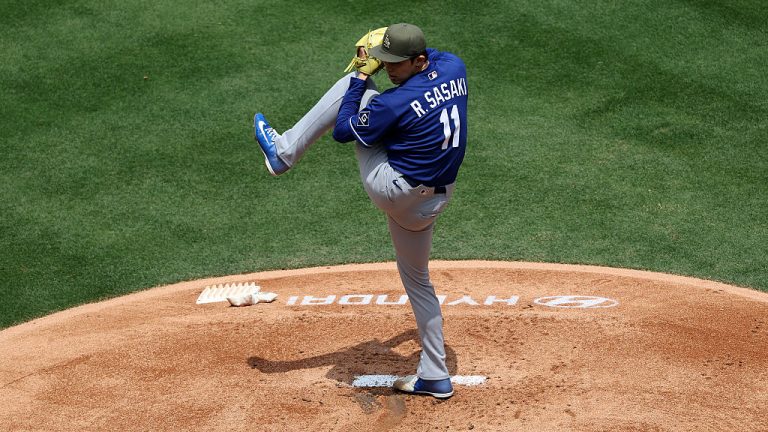
Coming into 2026, Roki Sasaki already carried the label of a “bust” after a shortened rookie season, which he spent the majority of on the injured list.
These allegations carried some weight on the surface, especially when considering the monumental, and practically unattainable, expectations.
Dubbed the “Monster of the Reiwa Era,” the time period coinciding with the year he was drafted in NPB, Sasaki was the number one overall pick for the Chiba Lotte Marines. The then 17-year-old broke the Japanese high school velocity record previously held by Shohei Ohtani, registering 101 mph.
Following a fantastic rookie season, a start in 2022 would place Sasaki into the national spotlight: nine innings, zero hits, zero walks, 19 strikeouts on April 10 against the would-be champion Orix Buffaloes. He followed up this game with eight more perfect innings in his next start.
The following spring is what would make Sasaki a heavily coveted name amongst fans across the United States. Sasaki carried his electrifying stuff to the national stage with Samurai Japan in the World Baseball Classic.
Sasaki struck out 11 over 7.2 innings, averaging over 100 mph through two starts, holding triple-digits all the way through his outings. Off the fastball, he went to a 90 mph knuckling splitter and an upper-80s slider. Outlier velocity and elite pitch shapes.
He continued his stretch of dominance in the next two seasons, leading up to his posting in late 2024, concluding his NPB career with a 2.10 ERA and 505 strikeouts in 394.2 innings.
His free agency itself was polarizing, with its fair share of rumors and storylines looming, before he ultimately settled with the Los Angeles Dodgers.
Stateside Debut
Sasaki saw a dip in velocity, spin rates, and command in his final NPB year, dealing with a shoulder injury, and the deficiencies persisted in his jump to MLB.
Through his first eight starts, Sasaki averaged 96 mph on his four-seam fastball with just 14 inches of induced vertical break and a 2,080 spin rate. It garnered whiffs just 10.1% of the time with a hard-hit rate of 52.2%. The pitch sat squarley in the “dead zone,” and without triple-digit velocity to lean on, it was a well-below-average offering.
Since forkballs are generally not in-zone pitches, and his sweeper was below-average in both spin rate and velocity, he had to rely heavily on his fastball. Really, he was lucky to come out of that stretch with a 4.72 ERA, striking out just two more batters than he walked. Following his eighth start, he was placed on the injured list with a shoulder impingement.
He returned in September out of the bullpen, where he would find success, cracking the postseason roster as a relief pitcher. While the shapes did not improve, he saw an increase in velocity, sitting 98.9 throughout the postseason and locking down a high-leverage role.
Sasaki gave up just one run over 10.2 innings in the eighth and ninth innings of tight ballgames.
With the stark contrast in performance between his short-inning spurts and starts, questions were raised as to whether Sasaki could be a starting pitcher long-term.
The 2026 Season Begins
The first five starts of 2026 seemed to confirm fans’ and analysts’ suspicions, as Sasaki sported a 6.35 ERA with the same middling spin rates and command that existed last season.
His arsenal remained widely the same, with the exception of a reinvented slider, taking a deathball shape. Featuring gyro spin, depth, and little arm-side movement, the deathball has become an effective offering amongst arms with low spin capacity, namely Logan Gilbert, Kumar Rocker, and Lucas Erceg.
While the slider yielded excellent results, emerging as his best-performing offering by run value, it wasn’t enough to forego his fastball quality and command issues.
On April 25, though he gave up four runs and seven hits against the Cubs, it was a revolutionary start for Sasaki with the introduction of a new splitter.
It sat over five ticks harder than his forkball at 90.8 mph, hovering around 1,000 rpm. The new splitter proved to be a much-improved in-zone offering; he landed it in the zone at a 41.7% clip, compared to the forkball’s 29.2% rate at the time. The shape mirrored a more conventional splitter, averaging positive vertical break and more arm-side run, though it still graded out as an elite offering.
Getting the Secondaries Dialled In
In his following start on May 2, Sasaki would mix in both his new splitter and familiar forkball, resulting in his best start to date. It was a quality start, spanning six innings. He gave up three runs on five hits and two walks, striking out five.
He tossed the fastball-splitter combo 84% of the time, working the tunnel well, managing a 19% whiff rate on the four-seam and 35% on the splitter.
The next start saw continued progress, as he earned a 67% splitter whiff rate and worked in more sliders off the fastball.
The next week, against the Angels, Sasaki upped his slider usage to 27%, with the splitter and forkball following suit. He would pitch a career-high seven innings with eight punchouts and just one run allowed, also the first time he would not walk a single batter in a start.
Just as a result of three quality secondaries to go to, his fastball registered a 23% whiff rate, allowing him to trust it and establish it early in counts.
The Fastball Makes Its Return
May 23, against the Brewers, marked the first start that Sasaki would average over 17 inches of induced vertical break on his fastball, where it sat during the World Baseball Classic in 2023. It also sat over 100 rpm north of his previous career average.
The fastball would make its complete return, velocity and all, on May 30 against the Phillies. He averaged 98.5 mph, touching triple-digits for the first time in 2026, generating misses at a 32% clip.
His first start of June was the culmination of all the work he’s put in until now. A masterpiece: seven innings, two hits, no runs, two walks, and a career high 10 strikeouts against the Angels.
His entire four-pitch mix was firing on all cylinders. He established the fastball early and often, touching 100 twice and holding 98 mph throughout the game. The secondaries were diving off the fastball, generating chase and whiff at an elite rate.
It was a masterclass in execution, a line you’d be shocked to hear about a Sasaki start just a month ago.
Who Can Roki Sasaki Be Going Forward?
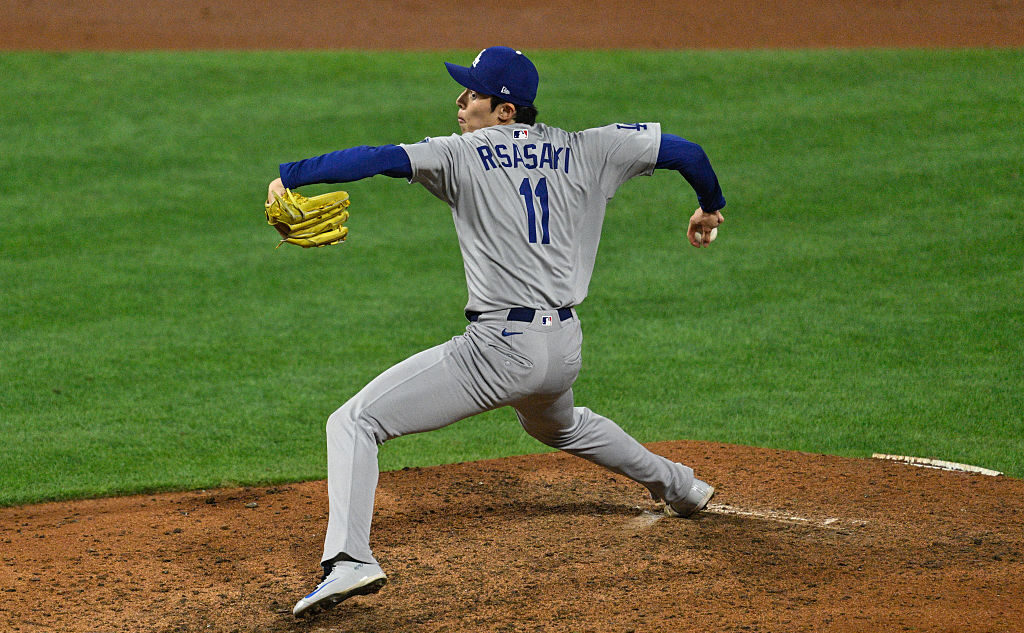
With the return of his premium velocity and emerging trust in his arsenal, Sasaki has positioned himself to be a fixture in the Dodgers’ rotation for years to come. This is the version of Roki Sasaki the Dodgers were promised, and despite the turbulence, they’ve stuck with him, and their faith is finally coming to fruition.
There are still setbacks to be expected throughout his career as he continues to develop his craft and find who he is as a pitcher, but the talent is undoubtedly there, and he’s finally beginning to show it.
Become a Member of Just Baseball
Subscribe and upgrade to go ad-free!
* Save 25% by subscribing annually.

Written by
Landon is a recent high school graduate, currently 17 years old going to study Media at UC Riverside next fall. He excels with data analysis inside…