
Five Top Double-A Prospects to Watch in the Eastern League
Double-A is filled with talented young prospects that are worth a follow. Here's a look at some of the most exciting in the Eastern League.
Every year, the Eastern League is a hotbed for some of the best young talent Minor League Baseball has to offer. At last year’s end, both Konnor Griffin and Kevin McGonigle finished with their respective Double-A clubs and proceeded to make the leap to the big league club early in 2026.
While those two are special cases as the consensus top two prospects in baseball, they demonstrate the growing talent level around the baseball sphere.
In 2026, the Eastern League is as filled to the brim with burgeoning talent as ever. It’s a crop that’s already seen promotions from top 100 prospects, AJ Ewing, Angel Genao, and George Lombard Jr.
It’s a group that won’t last long sitting in Double-A, so keep track of them while you can. These five Eastern League prospects are worth a watch with their potent tools, eye-popping statistics, and exciting upside.
It was be a major oversight not to mention Franklin Arias, who has been the clear best player in the Eastern League thus far as the youngest regular at the level, but he’s gained a ton of notoriety this season. He’s all the way up to number three on our top 100 prospects list.
Stats taken prior to play on June 4
RHP Anthony Eyanson—Boston Red Sox
This is not the Anthony Eyanson we saw at LSU last spring. Boston’s third-round pick was sitting in the low-90s just a year ago, and has now been clocked in the triple-digits, settling in the mid-90s. Not only is the velocity up, but the stuff is sharper, and he’s generating more whiff against professional hitters than he ever did in college.
His stint in High-A was nothing short of dominant, posting a 0.44 ERA in 20.1 innings, striking out 47.9% of batters. Eyanson hasn’t lost his touch following his promotion, rocking a 2.00 ERA and 38.7% strikeout rate through his first four starts.
Eyanson boasts some unique traits to go along with his electric arsenal. The 6-foot-2 right-hander generates solid extension and delivers from a high slot, giving him a release height three inches taller than his own stature.
To go along with the steep delivery, Eyanson carries a heavy supination bias, generating some cutting action on his four-seam, with a cutter, slider, and curveball working down the same tunnel. It’s an extreme north-to-south profile, akin to that of Tyler Glasnow.
The slider has long been his best offering, featuring gyro spin and depth, which up into the mid-80s, a few ticks harder than in college. Eyanson creates a larger 12-6 curveball shape in the low-80s. A low-90s cutter bridges the fastball and breakers, a new addition this season.
Eyanson has worked to add a changeup in the past, though his current four-pitch arsenal may be enough to forego the need for an offspeed pitch. A sinker could benefit him, though, as Glasnow has seen enhanced results with an uptick in usage.
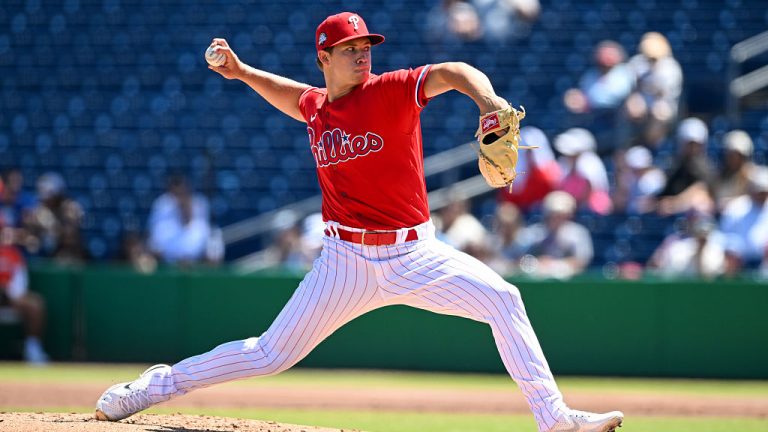
RHP Gage Wood—Philadelphia Phillies
A fellow 2025 draft selection, Wood found himself in the first round after a generational performance in Omaha, hurling a 19-strikeout no-hitter on the biggest stage in college baseball.
Wood’s stuff was some of the best college baseball had to offer, and it’s immediately translated to pro ball. He started in Low-A for an eight-start stretch to begin the year, posting a 3.14 FIP in 28.1 innings. The performance was enough for the Phillies to decide to have Wood skip Jersey Shore and go straight to Double-A with the Fightin Phils.
It’s a smaller 6-foot frame, but Wood really leverages his lower half with electric arm speed, sitting in the mid-90s and peaking at 99 mph. Wood averages nearly seven feet of extension, paired with his shorter stature, which gives him a well-below-average release height, creating that heavily sought-after flat approach fastball.
He works a pair of breaking balls off his fastball. The slider has some variance, adding and subtracting depth and sweep at times, sitting in the mid-to-upper 80s. His curveball was the popular pitch amongst scouts in his time at Arkansas, generating nearly 20 inches of depth on average in the mid-80s, though the shape and velocity have taken a step back thus far. At its best, it’s a 70-grade offering.
He’s also tinkered with a changeup, which has the makings of a fine fourth offering.
Wood’s frame and velocity are reasonably maxed out, but his status as a quick riser with his present stuff and command remains. Wood is an arm that could see big league innings towards the end of the season, and potentially contribute to a Phillies playoff run should they be in the race.
SS Arjun Nimmala—Toronto Blue Jays
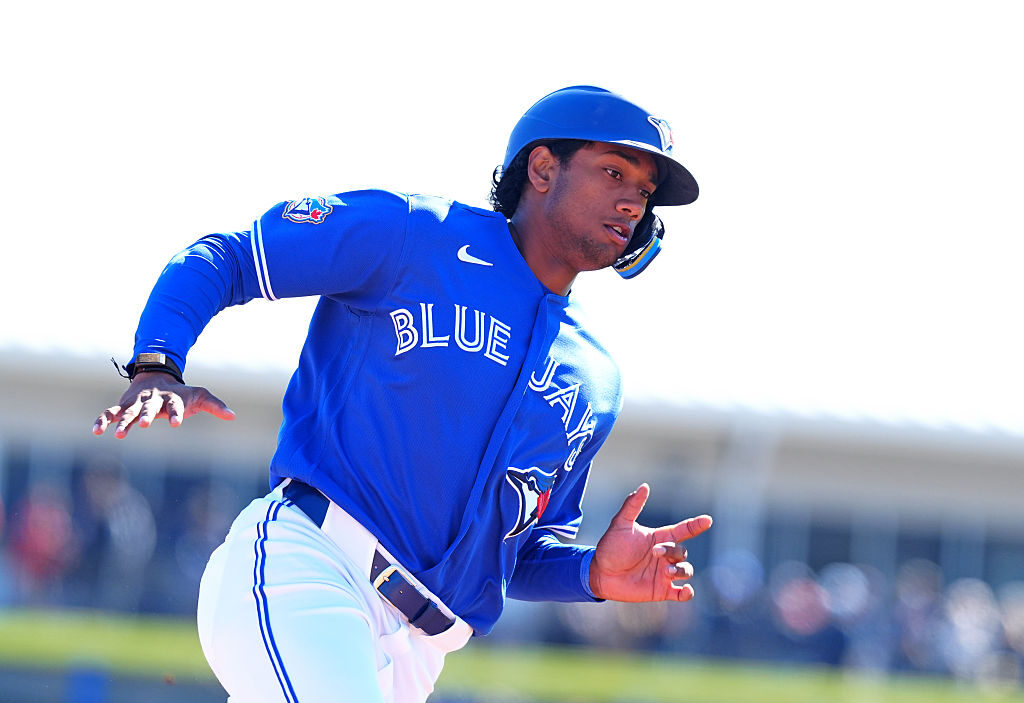
It’s been a tumultuous ride for the former 20th overall pick. In his first full crack at pro ball, Nimmala batted just .167 while striking out 34.4% of the time, leading to a placement on the Development List. Nimmala worked at refining his swing, parlaying his adjustments into a .265/.331/.564 slashline. While he was still striking out at a near 30% clip, it was clear that there was a tangible adjustment made.
Flash forward to 2025, Nimmala was able to slash his whiff and strikeout rates while adjusting to High-A pitching.
| 2024 (a) | 2025 (A+) | |
| K% | 31.3% | 21.4% |
| Contact% | 69.9% | 73.6% |
| swstr% | 13.8% | 11.5% |
What didn’t quite translate in 2025 was his contact quality, posting a 39% hard-hit rate, good for just a .381 slugging percentage, well short of his plus power potential.
Nimmala started 2026 repeating High-A, and we finally caught a glimpse of what the complete package could look like. In 105 plate appearances, Nimmala slugged four home runs while slashing .241/.362/.483, walking 16 times while striking out 24. This performance led to a promotion to Double-A for the 20-year-old, currently the second youngest starting batter in the Eastern League.
The young shortstop has gotten off to a solid start for the Fisher Cats. If Nimmala can continue developing, there’s a legitimate 30-home run, 20-stolen base big league caliber defender here.
OF Bo Davidson—San Francisco Giants
A former undrafted free agent out of junior college, Davidson burst onto the scene with a 171 wRC+ in his first year on Low-A, then followed it up with a 153 wRC+ in a half-season in High-A the next season. He slowed a bit upon his promotion to Double-A, but still managed to finish with 18 long balls and 19 stolen bases.
In 2026, he’s abandoned one of his appealing qualities, that being his plate discipline. Prior to this season, he owned a career 13.8% walk rate, which is down to just 7.4% this year. Davidson is swinging 53.6% of the time, up from 48.1% last season.
The increase in swing rate hasn’t come at the expense of his hit tool, as he’s actually making more contact and striking out less this year than in his Double-A stint last year, but it has come with a dip in results without the walks to fall back on.
There’s a path towards a 30/30 season in the big leagues for Davidson, but he’ll need to find a way to balance his newfound approach and continue pushing towards more game power.
RHP Matt Ager—Pittsburgh Pirates
A sixth round pick out of UC Santa Barbara in 2024, Ager saw mellow results in a full Low-A season, pitching to a 5.64 FIP and a 0.8% K-BB%. 2026 has come with an uptick it stuff, velocity, and command, striking out 29.6% of batters thus far across High-A and Double-A.
It was easy to envision a velocity uptick with his 6-foot-6, 225-pound frame and athletic delivery. Ager sat just 90.4 mph last season, now operating in the low-to-mid 90s.
Ager utilizes the three fastball approach, tossing a four-seam with slight cutting action, a sinker, and a cutter. He gets solid carry and above-average extension, allowing the average velocity to play up a bit.
Ager can throw his slider and changeup to both handedness. He adds and subtracts depth and sweep from the slider shape in the low-to-mid 80s. On average there’s some lift and nice lateral tilt. Ager altered his changeup to kill more spin and add more vertical separation off the fastball, which is much improved from his shape last year. There’s also a curveball which rounds out the six-pitch mix.
A command artist in his sophomore year with the Gauchos, the strike-throwing took a step back in his draft-eligible season, carrying into last year, but he’s back to walking just seven percent of batters this season.
There’s definitive starter traits with Ager’s frame, arsenal, and command, profiling well as a solid five-starter with mid-rotation upside.
Become a Member of Just Baseball
Subscribe and upgrade to go ad-free!
* Save 25% by subscribing annually.

Written by
Landon is a recent high school graduate, currently 18 years old, studying Media and Cultural Studies at UC Riverside. He excels with data analysis inside baseball…