
Walbert Ureña Is Giving the Angels Something To Believe In
Walbert Ureña's early-season success is more than just a flash in the pan. He has the makings of being a rotation building block.
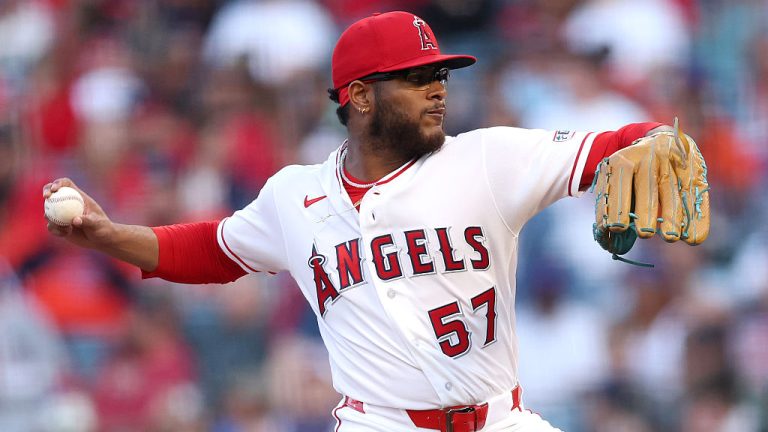
The Los Angeles Angels have spent too much of the last decade searching for pitching answers that never quite arrived. The names have changed, the front offices have changed, and the timelines have shifted. But the central problem has remained: Anaheim has rarely had enough young, controllable starting pitching to build something sustainable.
That is what makes Walbert Ureña so interesting.
Ureña was not supposed to be the obvious answer. He was not a consensus top prospect with a pristine minor league résumé, gaudy strikeout rates, and an easy projection as a future rotation piece. His path was messier than that.
The walk totals were too high, the strikeout rates were not loud enough, and the run prevention was more solid than spectacular. For most pitchers with that background, a major league debut at 22 would look more like a depth opportunity than the beginning of something real.
But Ureña’s early big-league performance has forced a different question. What if the version of him now taking the ball for the Angels is materially different from the one who spent years battling command issues in the minors? What if the traits underneath the uneven stat line were better than the results suggested?
The answer starts with how he got here.
How Ureña Got Here
The Angels signed Ureña out of the Dominican Republic, and he made his professional debut at the complex level in 2022. As an 18-year-old, he held his own, throwing 37.1 innings with a 3.86 ERA. From there, though, the surface-level results never quite pushed him into the center of prospect conversations.
He spent the next two seasons climbing through Low-A and High-A, posting a 5.66 ERA in 2023 and a 4.19 ERA in 2024. The arm strength was there, and so was the ability to generate ground balls, but the overall profile came with enough volatility to keep evaluators cautious.
The biggest issue was command. Ureña walked more than five batters per nine innings in each of his first three professional seasons, and his strikeout-minus-walk rate remained below 10% every year of his minor league career. That combination is difficult to sell.
Pitchers with elevated walk rates can survive if they miss bats at an overwhelming level. Contact-oriented arms can survive if they consistently flood the zone. Ureña lived somewhere in between: too many free passes, not enough punchouts, and a run-prevention profile that depended heavily on keeping the ball on the ground.
Still, the Angels continued to push him. In 2025, Ureña spent most of the season at Double-A Rocket City, where he threw to a 4.39 ERA before making a brief cameo at Triple-A. More importantly, he handled by far the largest workload of his career, finishing the year with 141 innings.
For a pitcher who had previously been defined more by raw ingredients than polished production, that volume mattered. It gave the Angels a longer look at the durability, ground-ball tendencies, and arsenal traits that made him interesting beneath the uneven stat line.
That is what makes his major league arrival at 22 so intriguing. Ureña was not a top-of-the-list pitching prospect with overpowering strikeout numbers and a clean statistical résumé. He was a young arm with real physical traits, a history of command issues, and a run-prevention profile that did not obviously project to the highest level.
But the early major league look has introduced a different question: what if the ingredients underneath the minor league line were better than the results suggested?
Under the Hood: What the Data Says
The biggest difference between the minor league version of Walbert Ureña and the pitcher currently getting major league outs is velocity. The jump is not subtle.
His four-seam fastball has climbed from 91.9 mph in 2025 to 97.8 mph in 2026. His sinker has gone from 94.8 to 97.2. The sweeper is up from 84 to 86, and the changeup has made the most dramatic jump, climbing from 86 to 91.
That velocity spike has coincided with a dramatically different pitch mix. In 2025, Ureña leaned almost entirely on his sinker, throwing it roughly 65% of the time. His sweeper was the clear secondary pitch at about 19%, while the four-seamer and changeup were more occasional wrinkles, neither clearing 8% usage.
This season, the arsenal looks completely different. The changeup is now his most-used pitch at roughly 36%, the sinker remains a major part of the profile at about 30%, the four-seamer has climbed to 21%, and the sweeper still gives him a fourth look around 14%.
The changeup is the separator. Ureña threw it just 3.9% of the time overall in 2025, but he is now throwing it 45% of the time to left-handed hitters. It has become less of a show-me pitch and more of a foundational weapon. The pitch rips arm-side, tunnels cleanly off the sinker, and gives Ureña a second offering built to live in the same movement family while creating a different outcome band.
The sinker and changeup both work toward ground-ball contact, but the slight velocity separation and fading action give the changeup more bat-missing utility. In the Pitch+ model, the changeup grades as a plus pitch at 110.6, with the highest projected whiff rate in his arsenal.
The sinker is still a heavy usage pitch. It grades as Ureña’s best pitch by Pitch+ at 120.1, driven by elite raw traits and a 157.9 Stuff+ mark. That matters because the sinker is not just a contact-management pitch in this version of the arsenal. At 97 mph, with arm-side movement and enough separation from the four-seamer, it gives Ureña a pitch that can miss barrels, force ground balls, and set up the rest of the mix.
The four-seamer is the most interesting piece because it is not an elite pitch in isolation. Pitch+ has it below average at 92.9, largely because the shape itself is not overpowering. But its value is contextual.
For a pitcher whose best weapons are a sinker and changeup moving arm-side, the four-seamer changes eye level and gives hitters a different fastball look. The added velocity also raises the margin for error. A 92-mph four-seamer with ordinary shape is difficult to build around. A 98-mph four-seamer that plays off a plus sinker/changeup foundation is a much more useful piece.
That is the real story underneath Ureña’s emergence. Pitch+ sees two clear plus pitches in the sinker and changeup, another playable offering in the sweeper at 104.7, and a four-seamer whose value comes less from standalone dominance and more from how it complements the rest of the arsenal.
The minor league version of Ureña looked like a ground-ball arm with command concerns and limited bat-missing upside. The current version looks like a power sinker-changeup starter whose new velocity has allowed the entire mix to play up.
Outlook Going Forward
The Angels are off to another forgettable start. Through roughly 50 games, they are buried in the AL West and sitting at the bottom of the sport. For an organization searching for signs of life, Ureña has been one of the few legitimate reasons for optimism.
That matters because this is not a short-term patchwork arm. Ureña is 22 years old, under team control well beyond 2026, and giving the Angels something they have lacked too often in recent seasons: a young starter with real physical traits and a sustainable major league weapon.
His early MLB line still shows the tension in the profile. The run prevention has been excellent, but the walk rate remains high relative to the swing-and-miss production. Ureña is not yet blowing hitters away in the way frontline starters typically do, and the command questions that followed him through the minors have not disappeared.
Still, the shape of the profile is encouraging. Ureña and José Soriano have been two of the few bright spots in Anaheim, and both bring a ground-ball-heavy foundation that gives the Angels a potential identity on the mound.
The difference is organizational timeline. Soriano is already into arbitration and is scheduled to reach free agency after the 2028 season, while Ureña is just beginning his major league clock.
That creates a fascinating fork in the road. If the Angels try to build around the current group, Ureña and Soriano could form the foundation of the next competitive rotation, with volatile but talented arms like George Klassen and 2025 No. 2 overall pick Tyler Bremner giving the system more upside behind them.
If the Angels continue to slide, there is also a world where Soriano becomes a trade chip to restock the farm system, which would push Ureña even closer to the center of the organization’s pitching plans.
Final Thoughts
The risk is obvious. Ureña is still not missing bats at an overwhelming rate, and his walk rate leaves less margin for error than the ERA suggests. But this no longer looks like a smoke-and-mirrors profile.
The arsenal stays off the barrel, the sinker-changeup foundation gives him real weapons against both left-handed and right-handed hitters, and Pitch+ supports the idea that the improvement is being driven by legitimate pitch quality rather than early-season noise.
For the Angels, that is the type of development that matters. A lost season can still produce useful answers if the organization finds players who can be part of the next good team. Ureña is beginning to look like one of those answers.
He is not a finished product. He is not suddenly an ace because of a strong first look. But the version of Ureña currently taking the mound in Anaheim is meaningfully different from the one his minor league stat line suggested. The velocity is up, the pitch mix is sharper, the changeup has become a real weapon, and the sinker gives him a carrying trait that should translate beyond a small-sample stretch.
The Angels have spent years searching for controllable starting pitching with enough stuff to dream on and enough present performance to justify patience. In Walbert Ureña, they may have found exactly that: not just a young arm surviving in the majors, but one whose underlying arsenal points toward sustainable middle-rotation upside for a good team.
Become a Member of Just Baseball
Subscribe and upgrade to go ad-free!
* Save 25% by subscribing annually.

Written by