
Roki Sasaki Is One of MLB’s Top Unsolved Mysteries
Roki Sasaki’s dominant performance in the Freeway Series turned heads, but a deeper look at his analytical profile shows a pitcher who remains a fascinating, volatile work in progress.
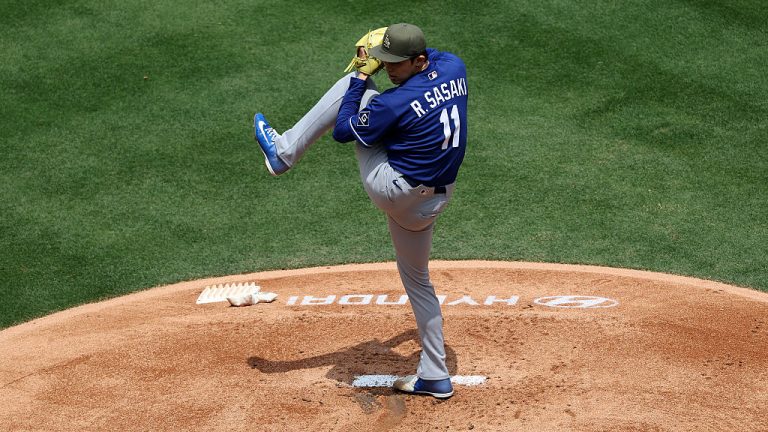
Roki Sasaki just had his finest outing of the 2026 season on Sunday, but it came against the MLB-worst Los Angeles Angels. While it is entirely fair to remain optimistic about Sasaki’s elite raw talent and sky-high ceiling, pointing to this single game as a surefire sign that he has permanently turned a corner would be a misstep.
We can praise what the young right-hander accomplished over the weekend while tapping the brakes and admitting the truth: he remains one of Major League Baseball’s top unsolved mysteries.
The 24-year-old starting pitcher’s profile has been well chronicled across baseball media. Last year, before an injury cost him the majority of his rookie season, we broke down his initial signing and closely monitored the topsy-turvy nature of his first five career starts.
Now, we find ourselves in mid-May of year two, once again trying to decipher exactly what the Los Angeles Dodgers have in their enigmatic young arm.
The 2025 Backstory
To understand where Sasaki stands today, we have to look back at his turbulent rookie campaign. In mid-May of 2025, Sasaki was placed on the Injured List after just eight career starts due to a right shoulder impingement.
He didn’t make his return to a big-league mound until September 24, appearing in just two one-inning relief outings before the regular season concluded. He looked elite in that microscopic sample size, allowing just one hit while striking out four over those two frames.
Then came October. Sasaki made a massive dent in the Dodgers’ eventual World Series run, shoring up the bullpen as a premier high-leverage weapon and occasional closer.
In case you need a reminder, here’s what that run looked like for the young right-hander:
10.2 Innings pitched | 0.84 ERA | 3 Saves | 2 Holds
Building on that dominant postseason run, getting fully healthy over the winter, and intentionally skipping the World Baseball Classic to focus entirely on his physical preparation for the 2026 regular season, it felt like the sky was the limit for him this year.
2026: The Rollercoaster Ride Continues
Sasaki opened his 2026 campaign on March 30 with a fine but tempered home outing against the Cleveland Guardians, throwing 78 pitches over four innings while surrendering one earned run on four hits, walking two, and striking out four.
Then April arrived, and things got incredibly ugly. In four starts last month, Sasaki tossed just 18.2 innings, getting battered for 15 runs on 24 hits, including seven home runs, while walking 11 batters. He failed to complete more than five innings in any of those outings, stumbling through the month with a dismal 7.23 ERA.
Through three starts in May, however, the surface-level results have begun to stabilize:
- At St. Louis: 6.0 IP, 5 H, 3 ER, 2 BB, 4 K
- Vs. San Francisco: 5.0 IP, 6 H, 3 ER, 1 BB, 5 K
- At LA Angels (Sunday): 7.0 IP, 4 H, 1 ER, 0 BB, 8 K
It took until his 16th career Major League start, but Sasaki finally managed an appearance without issuing a single free pass. His eight strikeouts also established a new career-high, eclipsing his previous high mark (6) set against the Rangers earlier this year.
Pumping the Brakes
There is no denying that Sunday gives Sasaki a baseline to build upon, but the performance requires context. For starters, the Dodgers’ offense exploded for a 7-0 lead within the first four innings, completely erasing pressure from the young pitcher’s shoulders.
Furthermore, the Angels entered Sunday completely spiraling, having lost five straight and seven of their last eight games while failing to score more than two runs in any of those defeats.
The matchup also shielded Sasaki from his biggest Achilles’ heel this season: left-handed hitters. The Angels’ lineup featured just four lefties on Sunday, none of whom entered play batting above .260 or carrying an OPS north of .700.
Yet, even in a dominant outing, three of those four lefties account for the hits Sasaki allowed. Nolan Schanuel logged a multi-hit day, and Yoan Moncada drove in the Halos’ lone run with an RBI knock.
Sasaki’s severe platoon splits remain a glaring issue in 2026:
Sasaki vs. Left-Handed Hitters (2026)
- At-Bats: 92
- Batting Average Against: .293
- OPS Against: .869
- RBIs Allowed: 16
- K/BB Ratio: 21:11
The Analytics
Even when you factor in his brilliant Sunday performance, Sasaki’s Baseball Savant page looks remarkably dire. His 5.09 xERA sits in the bottom 20th percentile of the league, though it does perfectly mirror his actual 5.09 ERA.
Roki Sasaki 2026 Statcast Percentiles
| Metric | Value | Percentile |
| Pitching Run Value | -7 | 6th |
| Fastball Run Value | -6 | 5th |
| Breaking Run Value | 0 | 42nd |
| Offspeed Run Value | -1 | 27th |
| Fastball Velocity | 97.0 mph | 87th |
| Average Exit Velocity | 91.0 mph | 13th |
| Hard-Hit % | 46.7% | 12th |
| Barrel % | 11.5% | 14th |
| Whiff % | 29.0% | 76th |
| Extension | 7.1 ft | 94th |
Sasaki has significantly altered his pitch arsenal in 2026, a transition that often requires an adjustment period. He has broken away from his 2025 approach to deploy a more varied four-pitch mix:
- 2026 Pitch Usage: Four-Seam Fastball (43%), Slider (20%), Forkball (19%), Splitter (18%)
- 2025 Pitch Usage: Four-Seam Fastball (50%), Forkball (33%), Sweeper (16%)
While his fastball velocity has experienced a slight tick up (averaging 97 mph compared to 96 mph last season), big-league hitters are teeing off on it when he throws it. Opponents are blasting his four-seamer to the tune of a .342 AVG (.355 xBA) and a .605 slugging percentage, entirely eclipsing the resistance he found with the pitch last year.
Furthermore, his signature forkball is operating with entirely different shape. It is averaging 2.9 inches of vertical drop and 3.2 inches of horizontal tail this season, a stark contrast from the 3.9 inches of drop and 1.1 inches of tail it featured in 2025.
Though his strikeout rate is up and his walk rate has decreased, the overall quality of contact against him has regressed across the board compared to his rookie year:
- Barrel Rate: Up to 11.5% (from 11.1% in 2025)
- Average Exit Velocity: Up to 91.0 mph (from 90.6 mph)
- Expected Batting Average (xBA): Up to .262 (from .243)
- Hard-Hit Rate: Up to 46.7% (from 45.4%)
The silver lining here is that his groundball rate has climbed from 38.9% last year to 41.8% in 2026, showing that when he does locate at the bottom of the zone, he can still generate weak, downward contact.
Long-Term Starter or October Weapon?
The Dodgers’ front office and coaching staff remain adamant that they view Sasaki as a long-term starting pitcher. Perhaps this recent stretch in May is evidence that his mechanical and arsenal adjustments are finally beginning to click.
However, looking at his game-to-game volatility and his clear struggles to maintain consistency over longer, multi-inning starter workloads, it is impossible not to daydream about shifting him back into that high-leverage bullpen role when October rolls around. His stuff plays up beautifully in short bursts, and we already know he possesses the postseason DNA to close out tight ballgames.
Ultimately, it is vital to remember that Sasaki is still just a 24-year-old kid. He is navigating a demanding developmental curve at the sport’s highest level, all while managing a massive life transition thousands of miles away from home. When you watch him on the mound, you can tell he is very much a human being, not a pitching machine.
He still has an extensive mental and tactical journey ahead of him to consistently live up to the generational billing he carried across the Pacific.
Become a Member of Just Baseball
Subscribe and upgrade to go ad-free!
* Save 25% by subscribing annually.

Written by