
Revisiting My 2026 Omaha Predictions
With conference tournament action and regional baseball coming up, now is the perfect time to revisit some preseason Omaha predictions.
It’s been a little while. Life, a.k.a. work, has gotten in the way of writing, but rest assured, I’m still in tune with the college baseball landscape. With conference tournament action and regional baseball right around the corner, now feels like the perfect time to revisit my preseason Omaha predictions and see where things stand.
For starters, here is my preseason Omaha eight (alphabetized, of course):
- Arkansas
- East Carolina
- Georgia
- Georgia Tech
- LSU
- Mississippi State
- Texas A&M
- UCLA
On the outside, I’m actually quite satisfied with most of these picks. But as one knows, college baseball is so unpredictable, and the road to Omaha can be unexpected and bumpy.
Some of these teams have looked every bit like Omaha contenders throughout the spring. Others have shown flashes of dominance while also exposing a few weaknesses that could become problematic once regional play begins. Let’s unpack each school.
Statistics as of Sunday, May 17.
Arkansas
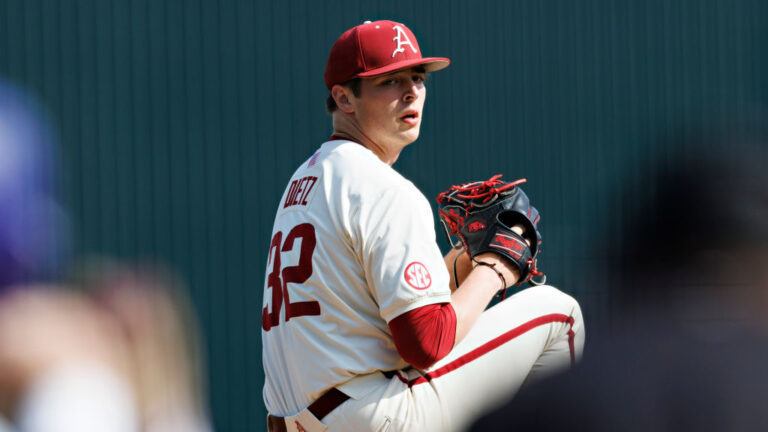
The Razorbacks finished the regular season 36-19 and 17-13 in SEC play. At times, this club has looked like one of the best teams in the country. At other points, they’ve lost six of seven.
Hunter Dietz leads a very strong pitching staff; the left-hander posted a 3.32 ERA over 78.2 innings, striking out 117. The staff is powerful, with additional weapons, Gabe Gaeckle, and Parker Coil. Arkansas has tallied a whopping 545 punchouts over 475 innings as a team, yet still finds itself in the middle of the pack in terms of SEC ERA (4.64) and has shown a tendency to give up the long ball, surrendering 80 home runs in 2026.
Dave Van Horn’s offense grades out as average to slightly below average compared to the rest of the SEC, but big bats like Damian Ruiz, Camden Kozeal, Ryder Helfrick, Kuhio Aloy, and TJ Pompey bring loads of experience and quick scoring potential. Freshman Carter Rutenbar has also emerged as a key contributor, batting .305 with nine doubles across 33 starts, and may ultimately become an x-factor once postseason play begins.
The ceiling for Arkansas is obvious. When the pitching staff is commanding the zone and the offense is producing timely power, the Razorbacks look every bit like a national title contender. The concern, however, is consistency. Extended offensive droughts and occasional struggles limiting home runs have created some unnecessary turbulence throughout SEC play.
This team looked like a sure-fire Omaha contender this winter, and still does in May.
East Carolina
Perhaps my boldest preseason Omaha pick, I had to throw in a mid-major for realism. East Carolina finished the regular season 33-21-1 and 17-10 in American Conference play, tied atop the league standings with a strong UTSA club.
Jack Herring has been the catalyst offensively, hitting .364 with a 1.087 OPS and 15 doubles. Interestingly enough, the Pirates lack the overwhelming power numbers often associated with Omaha-caliber offenses. No ECU hitter reached double digits in home runs or surpassed 50 RBIs during the regular season. Davin Whitaker leads the team with just nine long balls.
If that doesn’t tell you East Carolina is a pitching-first club, I’m not sure what does.
As anticipated entering the season, Ethan Norby has carried much of the load atop the rotation, logging a team-leading 75.2 innings. However, his 4.52 ERA and 82 hits allowed have left some room for improvement compared to the high expectations surrounding him entering the spring.
Fortunately for Cliff Godwin’s group, the Pirates have impressive depth on the mound. Joseph Webb, Ryan Towers, Gavin Marley, Ethan Rose, and Gavin Van Kempen have all thrown at least 29 innings while posting sub-4.00 ERAs, giving ECU multiple reliable options behind Norby heading into postseason play.
That depth could be the deciding factor in whether the Pirates finally break through. East Carolina may not bludgeon opponents offensively, but they consistently pitch and play fundamentally clean baseball. Still, everything will need to go right for them to have a shot at reaching Omaha.
Georgia
With lofty preseason expectations after a stacked transfer portal class stepped foot on campus, Georgia had massive shoes to fill and somehow exceeded them. The Bulldogs finished the regular season 43-12 overall and 23-7 in SEC play, firmly cementing themselves among the sport’s elite heading into postseason action.
Few players in the country have elevated their stock more than Daniel Jackson. After batting just .218 with 29 hits in 2025, Jackson has exploded into arguably the frontrunner for the Golden Spikes Award in 2026. The outfielder launched 27 home runs, swiped 28 bags, and hit .387 across 58 contests, putting together a remarkable 25/25 campaign that should vault him into the upper portion of the upcoming MLB Draft.
The Bulldogs enter postseason SEC play with a jaw-dropping 1.062 team OPS, a number that hardly feels real considering the level of competition they’ve faced week in and week out in the nation’s top conference. Tre Phelps, Rylan Lujo, Henry Allen, Kolby Branch, Michael O’Shaughnessy, Brennan Hudson, and Ryan Winn all own OPS marks north of 1.000, and that doesn’t even include electric two-way star Kenny Ishikawa.
Their pitching staff compiled a less impressive 5.05 team ERA in 2026, yet the Bulldogs still possess plenty of talent on the mound. Georgia features legitimate high-level starting options in Joey Volchko, Caden Aoki, and Dylan Vigue, while Justin Byrd and Matt Scott provide quality bullpen weapons capable of shutting games down late.
With one of the best lineups in the country and a pitching staff with real swing and miss, anything other than an Omaha appearance would be a letdown at this point.
Georgia Tech
Another dominant club from the Peach State, Georgia Tech, finished 45-9 overall and 25-5 in ACC play entering conference tournament week. The Yellow Jackets have firmly established themselves among the nation’s elite, and the race for the ACC crown should be an absolute battle with North Carolina and Florida State both looming as major threats.
Coming off a road sweep of No. 23 Boston College, Georgia Tech has been one of the hottest teams in the country down the stretch. The Jackets especially thrived at home this season, posting an incredible 30-4 record at Russ Chandler Stadium and turning Atlanta into one of the toughest places to play in college baseball.
Much like their in-state counterpart in Athens, Georgia Tech has completely terrorized their conference pitching throughout the spring. The Yellow Jackets led or sat near the top of the ACC in virtually every meaningful offensive category, blasting 114 home runs, collecting 141 doubles, batting .358 as a team, and posting a staggering 1.099 OPS. Firmly speaking, they flat-out rake.
With names like Vahn Lackey, Drew Burress, Jarren Advincula, Alex Hernandez, Ryan Schmidt, and Ryan Zuckerman, this isn’t very surprising.
Pitching is ultimately what’s going to make or break this Georgia Tech squad, and it’s the area that may separate the Yellow Jackets from conference powers like North Carolina and Florida State, both of whom possess more dominant and proven staffs on the mound.
Even so, Georgia Tech is absolutely capable of making Omaha. Few teams nationally possess this kind of offensive ceiling, and if the pitching staff catches momentum at the right time, the Yellow Jackets could become one of the toughest outs in the entire field. Jackson Blakely, the ball is in your court.
LSU
Man. The Tigers looked absolutely reloaded to repeat as national champions entering the season. Between the returning talent, portal additions, and the expectation that comes with playing in Baton Rouge, it felt impossible to leave LSU out of a preseason Omaha prediction.
LSU enters postseason play at just 29-27 overall and 9-21 in SEC action, a stunning mark considering the talent level on the roster. Rather than preparing for another Omaha run, Jay Johnson’s club is simply fighting to keep its season alive. The Tigers will enter the SEC Tournament as the No. 14 seed and likely need to make serious noise in Hoover just to secure an NCAA Tournament bid.
Losers of six straight, LSU’s three-headed offensive core of Derek Curiel, Cade Arrambide, and Jake Brown will need to be the spark if this team has any chance of turning its season around. Steven Milam remains the ultimate wild card, capable of changing a game at any moment, but also prone to the same volatility that has defined flashes of this LSU team.
The inconsistency, the untimely collapses, and the string of head-scratching losses throughout 2026 have all piled up to create a season that feels far removed from preseason expectations. It’s been a real disappointment, as they finished dead last in the SEC’s team ERA race at 5.86.
Still, it is LSU, so you can never count them out. Having a healthy Cooper Moore would certainly help, though.
Mississippi State
At 39-16 overall and 16-14 in SEC play, Mississippi State finds itself right in the thick of the conference pack. It’s the kind of profile that can either end in an early regional exit or a surprise deep June run, depending on which version of the Bulldogs shows up.
Ace Reese has been the centerpiece of the lineup and one of the best hitters in the nation, posting a .332 average with 20 home runs, 21 doubles, and a .705 slugging percentage. He’s a true middle-of-the-order force and an anchor for Brian O’Connor.
Around him, the supporting cast has been steady and productive. Jacob Parker, Reed Stallman, Gehrig Frei, and Bryce Chance round out a really good lineup. The Bulldogs were first in the SEC in doubles, right behind Georgia in batting average, and total bases. To that account, they can just about hang with anybody in terms of hitting the baseball.
Mississippi State’s team ERA of 4.34 actually tells a more encouraging story than the mid-pack conference finish might suggest, ranking fifth in SEC play and sitting ahead of several teams mentioned here, including Georgia and Arkansas.
At the top of the rotation, Tomas Valincius and Duke Stone have provided stability and experience, combining for 144.2 innings of work and giving Mississippi State a dependable foundation on weekends. Behind them, Maddox Miller and Ryan McPherson add another layer of high-stress work.
Overall, this club is very balanced. Do not count them out.
Texas A&M
2025 was a total letdown. But at 39-13 overall with an 18-11 SEC mark in 2026, Texas A&M has looked much more like the program many expected a year ago.
Early’s club is loaded and battle-tested. Household college baseball names like Chris Hacopian, Caden Sorrell, and Gavin Grahovac headline a lineup with legitimate thunder from top to bottom.
The Aggies mashed 114 home runs as a team this season, with only seven different players accounting for 95 of them. There are no easy outs in this order, and opposing pitching staffs rarely get a breather.
What makes this group especially dangerous is the balance. The Aggies are not just relying on one or two stars to carry the offense. Power production comes in waves, and the depth of the lineup forces pitchers into constant high-leverage situations. Nico Partida, Bear Harrison, Jorian Wilson, and Blake Binderup can jump the yard at any given moment as well.
The pitching staff is where things become a little less convincing, but there is still enough proven production to believe the Aggies can make an Omaha run. Aiden Sims has been steady at the front of the rotation with a 3.84 ERA, while Gavin Lyons has continued to find ways to win despite a shakier 5.31 ERA. Together, the duo has combined for a 17-1 record on the mound, a testament both to their competitiveness and the support behind them.
Out of the bullpen, Clayton Freshcorn has emerged as the clear “dude.” The junior right-hander owns a 2.42 ERA with 50 strikeouts across 44.2 innings, giving the Aggies a reliable late-game option capable of missing bats in high-pressure scenarios.
Texas A&M does not need to be dominant on the mound to win games. With the way this lineup swings it, simply getting quality starts may be enough to carry the Aggies deep into June.
UCLA
Last, but certainly not least, UCLA finished its year 48-6 and 28-2 in Big Ten play. There really is not much more to say here. The Bruins entered the preseason as the No. 1 team in the country and finished the regular season in the same spot.
Roch Cholowsky concluded his campaign with 21 home runs, a .330 batting average, and a 1.149 OPS. Barring anything drastic, he will most likely go first overall to the Chicago White Sox in July.
Roman Martin, Mulivai Levu, Will Gasparino, Dean West, Payton Brennan, and Cashel Dugger round out a lineup that is as good as any in the country.
Both Wylan Moss and Logan Reddemann hold sub-three ERAs and have each thrown more than 55 innings. Easton Hawk and Ian May continue to provide consistent, clutch innings out of the bullpen. It is genuinely difficult to find flaws with a club that has spent nearly the entire season steamrolling the competition.
At this point, the only real question surrounding UCLA is whether anyone can slow them down once postseason pressure ramps up. The Bruins have star power, depth, experience, elite pitching, and as complete a roster as anyone in the nation. Anything short of a trip to Omaha would feel shocking, and they are the team to beat once the tournament begins.
No matter how these predictions ultimately age, one thing remains true: the road to Omaha is never clean or forgiving. That’s what makes this sport so compelling in May and June. A regional hot streak, one heroic pitching performance, a timely swing, a bad error, or a coaching blunder can completely reshape the national picture overnight. We see it every year.
Become a Member of Just Baseball
Subscribe and upgrade to go ad-free!
* Save 25% by subscribing annually.

Written by
College Baseball & MLB Draft writer for Just Baseball! St. Lawrence Baseball alum 2025. Follow me on X @DiscussBaseball for more content!