
This Is the Xander Bogaerts the Padres Paid For
So far this season, Bogaerts has made the necessary adjustments to get back to the player he was when the Padres signed him from Boston.
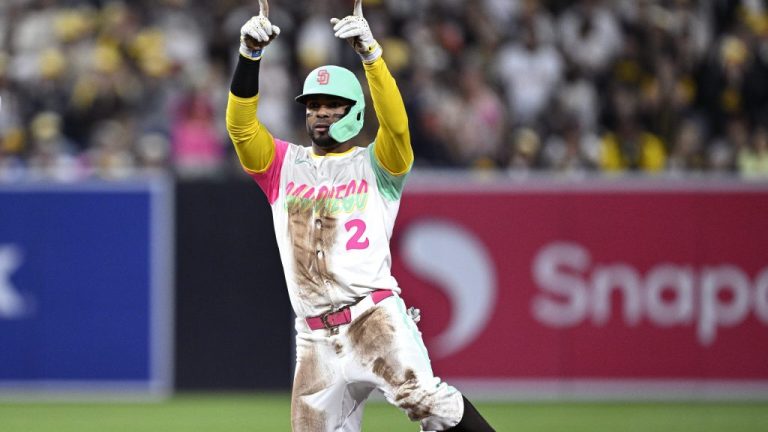
Few players across the league faced more scrutiny than Xander Bogaerts during his early tenure in San Diego.
After signing an 11-year, $280 million contract in December 2022, expectations were that Bogaerts would continue the All-Star-level production he showed with the Boston Red Sox. As we all know, that wasn’t the case.
Through his first two seasons with the San Diego Padres, Bogaerts slashed .276/.333/.415 with a 106 OPS+ and averaged 2.7 WAR. That’s a noticeable drop from his final two years in Boston, when he hit .301/.374/.474 with a 130 OPS+ while averaging 5.4 WAR.
For a player brought in to anchor the middle of the lineup, the dip was hard to ignore, and his contract quickly became a talking point across the league.
Fast forward to this season, though, and the narrative has started to shift. Bogaerts has worked his way out of “worst contract in baseball” conversations and back into being a reliable bat in the heart of the Padres’ order.
Since July 1, 2025, he’s hitting .286 with a 134 wRC+, putting him ahead of names like Bobby Witt Jr., Zach Neto, and Trea Turner over that stretch. That’s the Bogaerts that San Diego paid for.
Stats were taken prior to play on May 1.
What Has Changed This Season?
At first glance, you notice that Bogaerts’ expected batting average (xBA) and his expected slug (xSLG) have risen substantially. His underlying profile looks sharper overall, the red spots are redder and the blue spots are less blue.
Bogaerts has tightened his approach at the plate. His strikeout rate is down 3.4%, while his walk rate has climbed 2.7%, pointing to better pitch recognition and more disciplined at-bats. At the same time, his chase rate, whiff rate, and squared-up rate all sit comfortably within his normal ranges.
The biggest jump has been his production in the power department. Bogaerts is currently on pace to surpass 20 home runs, something he hasn’t done since arriving in San Diego. What makes that jump interesting is that his overall quality of contact hasn’t dramatically improved on paper.
As mentioned earlier, with his strikeout and walk rates improving, Bogaerts has cleaned up his approach. He has made a clear effort to pull the ball in the air, posting a 22.5% pull-air rate, easily a career high. By focusing on pitches he can turn on, he’s putting himself in better positions to do damage as opposed to simply putting the ball in play.
That approach shows up in his swing decisions. Bogaerts is attacking pitches in his wheelhouse far more aggressively; he’s swinging at pitches up and in 85% of the time (a 23% increase), 83% at pitches down the middle (up 20%), and over 60% on pitches middle-in and down-and-in.
The result is loud contact — he’s averaging around 94 mph exit velocity on pitches in those zones.
The change has been especially prominent against fastballs. After hitting just .248 against all fastball types last season, Bogaerts is now batting .309. His run value against four-seam fastballs has flipped from -9 to +4, and he’s also improved significantly against sinkers.
On top of that, his hard-hit rate has climbed to 50% against four-seamers and 45.5% against sinkers, reinforcing the idea that he’s doing more damage when he gets the pitch he wants.
Just as important, he hasn’t sacrificed his ability to handle offspeed pitches. Bogaerts has maintained steady production against most secondary offerings, posting a negative run value only against curveballs. His ability to balance between crushing fastballs and adjusting has made his approach have few holes.
What’s most interesting about Bogaerts’ improvement is that his bat speed has dropped from last season. Its a subtle difference, less than one mph, but for some players, that’s enough to lead them to a drop in production.
In Bogaerts’ case, it hasn’t mattered. If anything, it highlights how much of his resurgence is tied to approach rather than relying on his tools.


Final Thoughts
Bogaerts’ resurgence has been a major boost for the Padres and a key factor in their early success this season. While his defense has taken a slight step back, there’s reason to believe it will stabilize. Over the past two seasons, he’s graded in the 88th percentile or better defensively, suggesting the track record is still there.
More than anything, this stretch feels like a reset, for both the player and the perception around him. For Padres fans, it’s a reminder of why the organization made such a significant investment in the first place. And for Bogaerts, it’s validation. He’s been open about needing to be better, and this season, he’s backed that up with real adjustments and real results.
Become a Member of Just Baseball
Subscribe and upgrade to go ad-free!
* Save 25% by subscribing annually.

Written by
Ethan is an aspiring sports analyst who has a passion for all sports. He was a collegiate baseball player and is a recent San Diego State…