
Chandler Simpson Is Making His Old-School Skill Set Work
Simpson has made the most of a skill set not often seen in the 2020s. Here's how he's pulling it off.
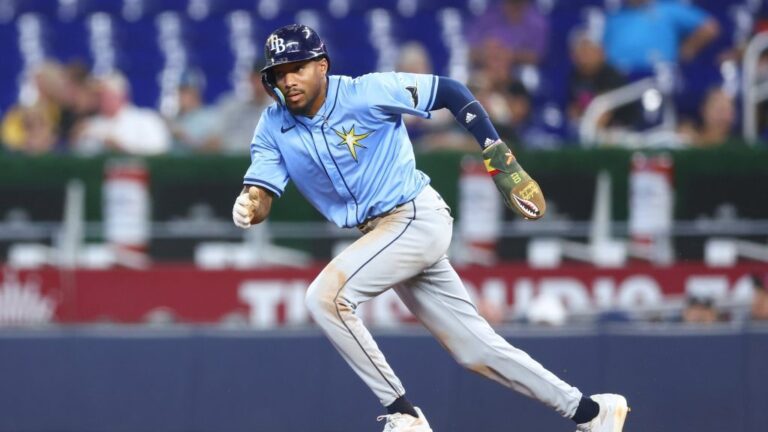
Since the start of the 2025 season, baseball fans around the country – especially those of a more traditional mindset – have fantasized about the idea of a successful season from Chandler Simpson. In an age defined by showstopping power and an acceptance of strikeouts, Simpson represented something different.
The 25-year-old Tampa Bay Rays outfielder entered the league with virtually zero power, with his last over-the-fence home run coming in 2022 at Georgia Tech against Gardner-Webb (minus a home run in spring training earlier this year). In 2024, he stole 104 bases between the High-A and Double-A levels, leading all minor leaguers.
There are players with below-average power that are successful. Simpson brings this to a new level. Even Luis Arraez’s Gwynn-like bat-to-ball abilities are undermined by his putrid defense and lackluster baserunning skills.
For these reasons, a nice development from Simpson would be a blast from the past. And so far, we’re seeing it.
Through 21 games, Simpson is slashing .333/.356/.381/.737 for a 111 wRC+. His 0.7 fWAR is tied for 17th among major league outfielders. On the other side of the ball, his +3 Outs Above Average lead all left fielders. Completing his skill set, he has two triples and seven steals.
In the true nature of his zero-power approach, he ranks in the first percentile with an 82.5 mph average exit velocity and a 64.2 mph average bat speed. He has yet to barrel up a ball.
The questions now are: “Can this continue?” and “What does this success look like over a full season?” It turns out, the answers lie in the slightest of adjustments.
Moving Up
Two inches. It can be argued that two inches have made the difference between Simpson’s 88 wRC+ in 2025 and his 111 wRC+ so far this year.
As a speedster that’s hardly capable of hitting the ball into the seats, Simpson is one of a few select hitters who should prioritize groundballs and line drives over fly balls.
He’s done exactly that on 89.6% of his batted balls so far this year – that’s a 62.3% groundball rate and 27.3% line drive rate. It’s the highest groundball plus line drive rate among the 131 hitters with at least 50 batted balls. But what’s changed for Simpson is the direction of those grounders:
| Season | Pull % | Straightaway % | Opposite % |
|---|---|---|---|
| 2025 | 33.0% | 45.4% | 21.6% |
| 2026 | 22.9% | 41.7% | 35.4% |
Simpson has taken one-third of his pulled groundballs, and some of his straightaway hits, and pushed them into left field. 22.1% of his total batted balls have been grounders to the opposite field, the second highest rate among all qualified hitters.
This is important because it serves Simpson’s best interests to maximize this approach. In 2025, left-handed hitters across Major League Baseball posted a .488 BABIP on groundballs to the opposite field, much better than their .169 BABIP on pulled groundballs. For a lefty, a groundball was nearly three times more likely to be a hit if it went the other way.
With Simpson’s speed, it’s a no-brainer to try to hit as many opposite-field grounders as possible, so that’s what he set out to do.
Attempting to be late on the ball, Simpson has moved up two feet in the box compared to 2025. 27.2 inches last year, 25.5 inches this year. Naturally, his average point of contact in front of his body went down three inches, allowing him to shoot the ball to left field.
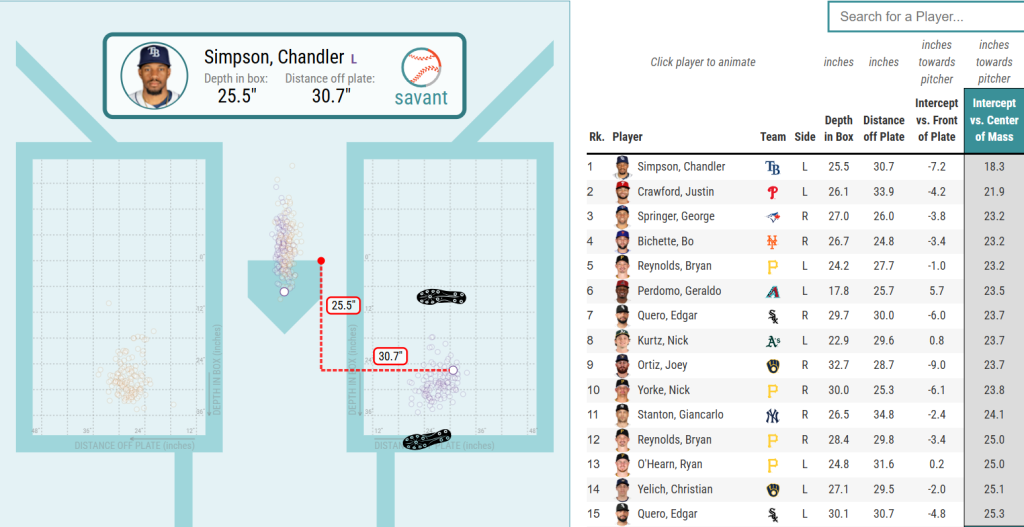
Thanks to this change, Simpson’s pull rate has shrunk by 6.5 points over last year to just 19.5%, the seventh lowest among all qualifiers. Perhaps to your surprise, Simpson’s BABIP on opposite field groundballs sits at .357, well below the league average.
Despite his best efforts, it actually appears Simpson hasn’t yet fully seen the fruits of these changes. If he continues with this batted ball profile, it’s likely he’ll actually perform better going forward than he has to this point.
Even if it hasn’t paid off quite yet, moving up in the box could be a revolutionary change for the quick left fielder.
Defensive Improvements
To say Simpson needed to improve his defense over his performance last year would be an understatement. In his 873 innings spent in the outfield, he tallied -5 Outs Above Average and -9 Defensive Runs Saved. But this year, things look different. He actually looks like a solid defender.
Despite having to make more difficult plays, Simpson has looked like a completely different player gliding the Tropicana Field left field corner. He joins Pete Crow-Armstrong and Cam Smith as the only outfielders with +3 or more OAA.
Against the odds of an 84% expected success rate, Simpson has converted 91% of his potential plays. His +7% added success ranks top five among all fielders.
Simpson’s Outs Above Average
| Seson | In | To Player’s Left | To Player’s Right | Back | Total |
|---|---|---|---|---|---|
| 2025 | -2 | -1 | -3 | 1 | -5 |
| 2026 | 1 | 3 | -1 | 0 | 3 |
Simpson is doing better on virtually every type of play compared to last year. He’s also converting a higher rate of easier plays and harder ones.
In just 168 outfield innings this year, he’s already hit on a trio of four- and five-star catches in the outfield, the same amount that he converted in all of 2025. His 92% catch rate on one- to three-star plays is a major upgrade over his 78% rate from last year.
Perhaps the most notable improvement in Simpson’s defense literally starts at step one. In 2026, his average jump on fly balls has covered 5.3 feet more than the average fielder, allowing him to get to balls most can’t. It’s the best jump of any outfielder in baseball. In 2025, he was only averaging half a foot of jump compared to the average fielder.
It’s evident that these early steps have turned him from one of the worst fielders in the league to one of the best. With a skill set that can only get you so far on offense, being a great defender can change the conversation of what someone like Simpson brings to the field each day.
Simpson’s Outlook
If Simpson can maintain or even increase his already high .364 BABIP and stay an elite defender, we may be looking at a season that earns him some MVP vote shares at year’s end.
FanGraphs currently has Simpson on pace for a 6.4-win season by the end of September. While that seems a bit ambitious, even with the way he’s played, a 4.5-5.0-win season doesn’t seem out of the picture.
A few subtle changes – moving up in the batter’s box and taking better first steps on defense – have transformed Simpson as a player. The opposite field groundballs have benefited him, and the numbers say they should do so even more as the season goes on.
It’s been since Lance Johnson in 1993 that we’ve seen someone post an above-average OPS+ in a qualifying season without a home run. It’s a difficult feat to accomplish, especially because just one home run is disqualifying, but Simpson could be among the best chances at this we’ve ever seen.
Is it possible? Sure. Is it the only mark of success for him? Absolutely not. If he’s going to be the elite defender that we’ve seen, anything north of a 90 wRC+ could change the outlook of what the Rays have on their hands.
Become a Member of Just Baseball
Subscribe and upgrade to go ad-free!
* Save 25% by subscribing annually.

Written by
Daniel Curren is a writer with Just Baseball. He loves sabermetrics, baseball history, and the Hall of Fame.