
X-factors for the 2026 MLB Season: NL Central
Here are the biggest X-factors for each team in the National League Central heading into the 2026 MLB season.
As the calendar turns to March and we come to the final stages of the offseason, the Just Baseball Show has been going division by division and previewing each team ahead of the 2026 season.
On top of breaking down each team’s lineup, rotation, and bullpen, the division previews include X-factor predictions for the upcoming year.
Predicting each team’s X-factors is one of the most exciting exercises of the offseason. It’s a time where fans can call their shot on a player they think highly of heading into the new campaign, and these are often players who can change the trajectory of the season if things pan out.
Today, we set our focus on the National League Central. On last week’s episode of the Just Baseball Show, Aram Leighton and Peter Appel broke down the division and selected X-factors for each team heading into 2026.
The article below highlights the chosen X-factors for each team from the show and breaks down why exactly these names were chosen. You’ll also be able to find links to each team’s individual breakdown throughout the article.
Here are the Just Baseball Show’s X-factors for each team in the National League Central for 2026.
Milwaukee Brewers
X-factors: 1B Andrew Vaughn and SS Joey Ortiz
The Milwaukee Brewers have a myriad of players who could be considered an X-factor in 2026, but the two biggest reside in the lineup.
Andrew Vaughn took the league by storm last season once he joined the Brewers. After posting -1.8 bWAR and slashing .189/.218/.314 in 48 games with the White Sox, Vaughn was traded to Milwaukee and had a career resurgence.
After being called up to the big-league roster on July 7, Vaughn slashed .308/.375/.493 for an .869 OPS and 1.3 bWAR in his 64 games with the Brewers. Vaughn supplanted Rhys Hoskins at first base and never looked back, becoming a focal point of the offense down the stretch.
Prior to July 7, the Brewers’ offense was middle of the pack, ranking 15th in wRC+ (98), 16th in batting average (.247) and wOBA (.309), and 19th in OPS (.703). From July 7 onward, the Brewers had the second-best wRC+ in baseball (118) while ranking second in batting average (.272), third in wOBA (.338), and fifth in OPS (.775).
When hot, Vaughn showed an ability to carry the offense. But Vaughn has been a below-average bat more often than not throughout his MLB career. So, it’s yet to be seen which version the Brewers will get in 2026, which makes him a great X-factor selection.
Joey Ortiz was the second selected X-factor. Coming off a dreadful 2025 season, Ortiz has a lot to prove in 2026. But there’s no denying the impact he has on the lineup if he’s playing to his full potential.
Among qualified hitters, Ortiz ranked dead last in OPS (.593) and wOBA (.263) in 2025 to go with the third-lowest wRC+ (67) in MLB. While the Brewers certainly value his elite defense at shortstop, that type of offensive production simply isn’t going to cut it for a team looking to contend for a championship.
However, Ortiz is a far more talented hitter than his 2025 numbers would indicate. Brewers fans saw that in 2024 when he was a 3.2-fwar player, posting a 105 wRC+ and .726 OPS as a rookie. If he can be even a league-average bat, he can be a walking three-win player thanks to the value he brings with his glove alone.
If he has another season at the plate like he did in 2025, the Brewers have a difficult decision ahead of them regarding how they want to structure their infield. Ortiz is likely playing for his job in 2026; the ability is in there, but whether or not he can get back to the hitter he was in 2024 is yet to be seen.
Chicago Cubs
X-factor: OF Pete Crow-Armstrong
As Aram and Peter said on the show, the Cubs’ X-factor almost seems too obvious: it’s Pete Crow-Armstrong.
Heading into 2026, PCA can influence the trajectory of the Cubs’ season more than anybody else on the roster. Cubs fans saw that first hand in 2025.
Up until the All-Star break, PCA had the fourth-highest fWAR in all of MLB (4.6) and was an MVP candidate, slashing .265/.302/.544 with 25 homers and 27 steals in the first 95 games of the season. Heading into the break, the Cubs sat at 57-39, holding the third-best record in MLB and a one-game lead over the Brewers in the NL Central.
Then, things cratered in the second half of the season for PCA. In 62 games post-All-Star break, he slashed .216/.262/.372 for a 72 wRC+ (ninth-lowest mark in MLB among qualified hitters) and a .634 OPS. The Cubs slid down the NL standings, going 35-31 the rest of the way and surrendering the division lead to Milwaukee.
Were there a lot of factors that led to Chicago’s second-half drop-off? Sure. But Crow-Armstrong’s impact, or lack thereof, was at the top of the list of reasons why things went south. In the first half of the year, the Cubs had the third-best offense by wRC+ (115) while ranking fourth in OPS (.771) and second second in runs scored.
After the Midsummer Classic, Chicago fell to 15th in wRC+ (102), 16th in OPS (.720), and 20th in runs scored.
Aram put it best on the show: “If the Cubs are going to win the World Series, it’s because PCA was first-half PCA.”
When he’s going right, he’s an MVP candidate and the Cubs are one of the best teams in MLB. When he’s struggling, he’s a glove-first, below-league-average hitter, and that has a massive impact on the Cubs’ performance. Not only is he the Cubs’ X-factor, but he’s one of the biggest X-factors in all of MLB.
Honorable Mention: RHP Edward Cabrera
Aram and Peter both settled on Crow-Armstrong as the Cubs’ X-factor, but Edward Cabrera was mentioned as an honorable mention.
Cabrera, 27, was acquired for top prospect Owen Caissie this offseason, and RosterResource has him slotted as the No. 2 in the rotation behind Matthew Boyd.
Cabrera is a fireballer whose calling hard is his 94-mph changeup (yes, you read that correctly). His stuff is incredible, and his ceiling might be higher than anybody else in the rotation. What’s more, he’s coming off a career year, throwing to a 3.53 ERA across a career-high 137.2 innings.
Health will be key for Cabrera, as he’s struggled to stay on the mound throughout his professional career. Likewise, control has been his great undoing, as he sports a career 4.50 walks per nine across 87 career big-league starts.
But if the Cubs can get him to reach his potential and stay on the field, he provides upside at the top of the rotation that Chicago desperately needs.
Cincinnati Reds
X-factors: 1B Sal Stewart and RHP Chase Burns
Two X-factors were selected on the show, one from the lineup and one from the starting rotation.
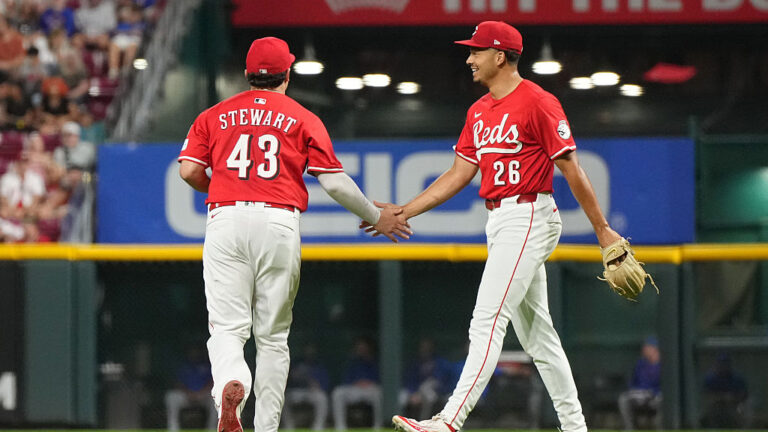
Starting on the offensive side of things, Sal Stewart was Aram’s X-factor. Stewart, who recently checked in as Just Baseball’s No. 15 prospect in baseball, brings a well-rounded skillset to the table that the Reds desperately need in the heart of the order.
Demonstrating an impressive ability to hit for both contact and power, Stewart’s knack for driving in runs could put the Reds’ offense over the top this coming season. The top half of Cincinnati’s lineup has a lot of potential, but it also features tons of volatility.
Matt McLain, while plenty talented, is coming off a year in which he posted a 77 wRC+ in 147 games. Elly De La Crus has MVP upside, but his profile is a volatile one offensively. And there is no denying the pop that Eugenio Suárez brings to the table, but he is pretty much a homer-or-bust hitter at this point in his career.
Point being, with Stewart projected to hit behind that trio of names, if he hits the ground running the way many believe he can, his well-rounded offensive profile could be an enormous stabilizer in the heart of Cincy’s lineup.
The 22-year-old is coming off a year in which he slashed .309/.383/.524 for a 152 wRC+ in 118 games across Double-A and Triple-A. He performed well in his 18-game MLB sample last year, too, so if he can translate his skills to the show, watch out for this Reds offense.
On the pitching side of things, Chase Burns might be the most popular breakout pick in all of Major League Baseball heading into 2026. Burns’ talent and pure stuff is off the charts, featuring a rising, near-100-mph four-seam at the top of the zone paired with a sharp slider that held MLB hitters at bay in 2025.
Don’t let his 4.57 ERA from a season ago fool you. Across his final seven appearances of the season (two starts), he pitched to a 1.69 ERA and 1.95 FIP across 16 innings. Though it’s a small sample, he started to settle in after a rough few outings to begin his MLB career.
Overall, Burns managed to punch out nearly 14 hitters per nine innings across his 43.1 innings last season, an absurd mark for a player getting his feet underneath him at the highest level.
Selected second overall in the 2024 MLB draft, 2025 was Burns’ first taste of big-league action. He climbed all the way from High-A to MLB over the course of the year, which is a testament to his development at such a young age.
If Burns takes a step forward and fully breaks out in 2025, he creates arguably the most lethal one-two punch in MLB with Hunter Greene at the top. Moreover, should he take over as the No. 2, it would move arms like Andrew Abbott, who was an All-Star in 2025, and Nick Lodolo to the No. 3 and No. 4 spot in the rotation, creating one of the deepest rotations in the sport.
Burns’ potential impact is enormous, and that makes him a prime X-factor for Cincinnati heading into 2026.
St. Louis Cardinals
X-factors: OF Jordan Walker and RHP Dustin May
Once a top prospect in baseball, Jordan Walker‘s big-league career to this point has been nothing short of a disaster. This is a player who, as he climbed through the ranks of St. Louis’ system, looked like the Cardinals’ next-best up-and-coming lineup focal point.
The MLB results have been anything but, as he is slashing .240/.302/.378 for an 89 wRC+, .680 OPS, and -0.9 fWAR in 279 career MLB games.
That said, believe it or not, Walker is still just 23 years old. To put that into context, he’s just a few months older than Cardinals top prospect JJ Wetherholt. He’s younger than several names on Just Baseball’s Top 100 Prospects List, and he’s still maturing as a hitter after being thrown into the fire back in 2023 as a 21-year-old.
Walker’s 31.8% punchout rate from a season ago is the crux of the issue. His most productive stint as a big leaguer came back in 2023 as a rookie when he was striking out only 22.4% of the time. Walker hit .276 with a .445 slugging percentage that year to go with a 116 wRC+ and 16 homers in 117 games.
Since then, his strikeout rate has ballooned, and his productivity at the plate has cratered as a result. Fans have seen flashes of the upside throughout his professional career, and with this team heading in a new direction, there’s reason to believe he still has the ability to reach that potential and establish himself as a cornerstone of this lineup.
Switching over to the rotation, newcomer Dustin May was Aram’s X-factor for the Cardinals in 2026. It’s been a fall from grace for May, who was once considered one of the best up-and-coming arms in the Dodgers’ rotation a few years back.
But that drop-off is largely due to injuries; despite playing in six MLB seasons, May has only 324 career big-league innings under his belt. Prior to his career-high 132.1 innings in 2025, his previous career high in innings pitched for a season was 56 back in 2020.
The Cardinals took a flier on May this offseason, brining in the 28-year-old on a one-year, $12.5 million contract. May enters the new year with easily the highest ceiling of any arm in the rotation, and should he get back to form, he could provide a lot of value for the Cardinals in more ways than one.
While the Cardinals enter 2026 with one of the lowest win totals in MLB, if May throws well this coming year and is the rotation anchor that St. Louis needs, they have the roster pieces to play spoiler in the National League.
Alternatively, May could net the Cardinals a sizable return at the trade deadline if he posts strong first-half results and the Cardinals fall out of the playoff picture by August. Either way, May’s performance in 2026 will be significant one way or another for the Cardinals.
Pittsburgh Pirates
X-factors: RHP Jared Jones and RHP Bubba Chandler
The Pittsburgh Pirates haven’t made the postseason since 2015. Is 2026 the year they take the step forward into playoff contention? If so, it’s going to be the starting rotation that gets them there.
Both Aram and Peter’s X-factors for Pittsburgh reside in the rotation. Starting with Jared Jones, he looked the part of being the Robin to Paul Skenes’ Batman in 2024 before going down with an injury to his UCL that required an internal brace procedure ahead of the 2025 season.
Though it was just a 4.14 ERA for Jones in 2024, his pure stuff was on full display from the get-go. Jones’ four-seamer, which sat at 97.3 mph and averaged over 17 inches of induced vertical break with over eight inches of arm-side movement, blew hitters away. Paired with his 88.8 mph slider that garnered a whiff 37.3% of the time, it’s a combination of pitches that gives Jones frontline upside.
With Jones set to return to the bump in 2026, how he looks post-surgery will be quite significant for Pittsburgh’s chances at making a postseason run. Should he pick up where he left off in 2024, the combination of Skenes and Jones at the top of the rotation would be up there with any in the National League.
A very similar argument can be made for Bubba Chandler, who has frontline upside himself.
Chandler, Just Baseball’s No. 12 prospect in baseball, got a taste of the big leagues in 2025 and performed well all things considered.
He was tagged for nine runs in his first ever MLB start (fourth overall appearance), which greatly inflates his year-end ERA (4.02). However, he was sharp outside of that one appearance, and he only allowed two runs while striking out 19 and walking nobody across his final three starts of the year.
Chandler also features a high-velocity, high-vert four-seamer, and his changeup generated a batting average against of just .080 last season with a 39.6% whiff rate. Add in a slider that yielded an .087 batting average and slugging percentage against, and it’s an arsenal that has frontline upside.
Being able to learn and progress underneath Skenes is a major advantage for Chandler, as he heads into his first full MLB season with sky-high expectations.
Should one of Jones or Chandler break out in 2026, it would create a devastating one-two punch at the top of the rotation. If both were to reach their potential, then all of a sudden the Pirates have a trio of young arms that rivals any in MLB.
The performance of Jones and Chandler could be the key in the Pirates getting over the hump and back to October baseball.
Become a Member of Just Baseball
Subscribe and upgrade to go ad-free!
* Save 25% by subscribing annually.

Written by
Joey Peterson is a graduate of the University of Wisconsin-Madison and an editor for Just Baseball. Joey covers the Milwaukee Brewers, along with general MLB topics…