
A Team in Transition: How the Tampa Bay Rays Could Shape the 2026 Season
The Rays may enter 2026 as postseason longshots, but they might be one of the most influential teams in baseball. They're holding cards that other postseason longshots dream of.
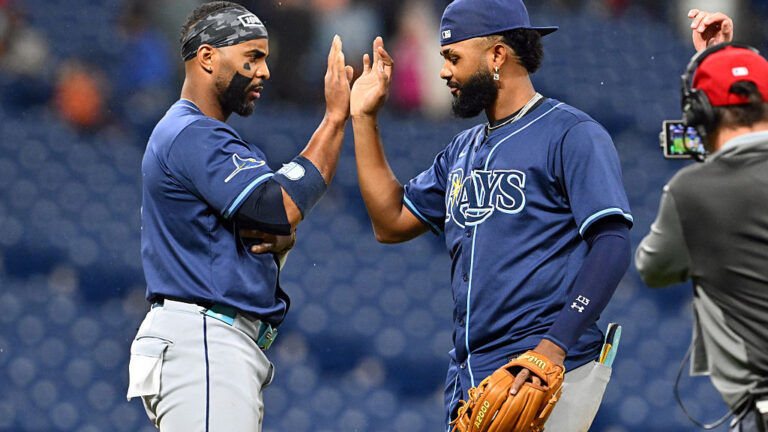
The Tampa Bay Rays are living in between eras.
The 2020 club that stormed to the World Series feels distant now — a group defined by overwhelming pitching depth, matchup advantages, and structural edge. The current iteration is different. It is younger, thinner, and predicated on exciting young position player talent as opposed to overwhelming run prevention.
That in-between space creates tension. It presents a challenge in the American League East, where half-measures rarely survive. But for an organization that has been as adept as any at pivoting from one competitive version of itself to the next, limbo is not paralysis. It is leverage.
An Unorthodox but Talented Core
The position-player core gives real reason for optimism.
It starts with All-Star third baseman Junior Caminero, coming off a 45-homer season in his age-22 campaign. Caminero pairs elite bat speed (78.5 mph, 100th percentile) with strong bat-to-ball ability (83% zone contact, 76% overall contact), allowing his prodigious minor-league power to translate against major league velocity. Caminero punished heaters in 2025, posting a gaudy 65.1% hard-hit rate against four-seam fastballs. When he elevates, the ball leaves. His 24.6% HR/FB rate in 2025 underscores how his raw power translates to games in a major way.
And yet, there is another level available. Caminero’s relatively flat path led to a 47% groundball rate, slightly muting the offensive efficiency his raw power should unlock. His 6.3% walk rate and 32.2% chase rate hint at approach refinement still to come. Despite 45 home runs, he finished with a 129 wRC+. For a player with this kind of thunder, 29% above league average almost feels conservative. Even now, he profiles as a top-five third baseman in baseball — third at the position for us at Just Baseball. If the swing decisions sharpen, the ceiling expands dramatically.
Jonathan Aranda offers a different form of impact. Long an analytics favorite, Aranda elevates at an above-average rate (37% groundball rate), hits the ball hard (54.5% hard-hit rate), and does so at ideal angles, including a 24.5% air-pull rate. In 106 games — a career high — he posted a 146 wRC+ and 2.5 fWAR. On a per-plate appearance basis, he was one of the American League’s most efficient bats.
The question is durability. If Aranda pushes toward 550 plate appearances, the Rays have a legitimate middle-of-the-order anchor. If availability again becomes an issue, the lineup thins quickly.
Chandler Simpson rounds out the trio and could not be more stylistically different. First percentile in bat speed and hard-hit rate, Simpson derives value through contact and speed rather than impact. He swiped 44 bases in 109 games and posted a 92.5% zone contact rate, placing him among the league’s elite bat-to-ball hitters. The blueprint resembles that of Steven Kwan: relentless contact, constant pressure, and table-setting consistency.
For Simpson, refinement will determine the ceiling. His swing rate ticked up four percentage points in the majors compared to Triple-A, and despite elite speed, his defensive impact has not yet fully matched the athleticism. If those elements improve, he becomes more than a role player — he becomes a foundational piece.
The Gauntlet Returns
Context, however, is unforgiving.
The AL East is once again a gauntlet. Three teams reached the postseason a year ago, and the one that missed — Baltimore — responded aggressively by adding Pete Alonso and trading for Shane Baz. The Baz deal returned a significant prospect package to Tampa Bay, including a Competitive Balance Round A pick that further inflates their league-high draft bonus pool. Long-term, it strengthens a deep Tampa Bay farm system that is among baseball’s best. However for 2026, trading Baz undeniably weakens their rotation.
The other four teams in the division operate financially in ways Tampa Bay does not. In a division where 88 wins may not guarantee relevance, depth and star power are prerequisites.
For much of the past decade, the Rays offset payroll disparity with elite pitching development. That well feels less certain entering 2026.
The projected top three of Shane McClanahan, Drew Rasmussen, and Ryan Pepiot carries upside — and risk. McClanahan has not pitched since missing the entirety of 2024 and 2025. Rasmussen just completed his first healthy season since 2022. Pepiot has flashed front-line traits but remains in the stage of his career where projection still outweighs track record.
Behind them, the margin narrows. Nick Martinez and Steven Matz provide veteran stability but could be challenged by prospects before season’s end. The bullpen, featuring intriguing arms like Edwin Uceta and Griffin Jax, has upside — but relief excellence often requires a stable foundation in front of it.
Barring the unforeseen, it is difficult to envision Tampa Bay leapfrogging the division’s top tier.
Which is precisely what makes them so compelling.
How They Can Define the Season
The Rays may enter 2026 as postseason longshots. But they might be one of the most influential teams in baseball. They’re holding cards that other postseason longshots dream of.
It starts with 1B/DH Yandy Díaz, who remains one of the highest-floor offensive players in the league. Entering his age-34 season, Díaz posted a 52% hard-hit rate and struck out just 14.1% of the time in 2025. He may never replicate his 5.0 fWAR, 165 wRC+ peak from 2023, but he remains a well above-average offensive player capable of lengthening a contender’s lineup immediately. With two years of control remaining, including a $13 million club option in 2027, Díaz offers production and cost certainty — a powerful combination in July.
More intriguing, and more consequential, is Ryan Pepiot.
Pepiot boasts one of the best fastballs among starting pitchers in baseball and can survive a 9% walk rate because of his swing-and-miss profile. Entering his age-28 season with three years of team control, he represents a premium trade asset rarely available midseason. The asking price would be monumental — and rightly so. Controllable starting pitching with front-line flashes almost never hits the market.
If Tampa Bay determines 2026 is not the year to push, Pepiot becomes a franchise-altering lever. One deal could reshape the farm system and accelerate the next competitive window.
Secondary rentals like Gavin Lux and Cedric Mullins could also generate modest returns. Individually, they will not headline the deadline. Collectively, they underscore the Rays’ leverage.
That is the paradox of Tampa Bay’s season.
There is reason to believe the young position-player core is ascending. There is also reason to doubt that the current roster can outlast the division’s heavyweights over 162 games. What could make the Rays one of the defining teams of 2026 is not whether they sneak into October — it is whether they choose to cash in.
The next contending version of the Rays, the one that returns to Tropicana Field with a reshaped core, may be built not in free agency but in July. In a division defined by spending, Tampa Bay’s edge has always been timing.
And in 2026, timing may once again define them.

Written by