
A Subtle Swing Change Rewrote Corbin Carroll’s Offensive Ceiling
One small swing change has turned the already dynamic Carroll into a serious MVP contender.
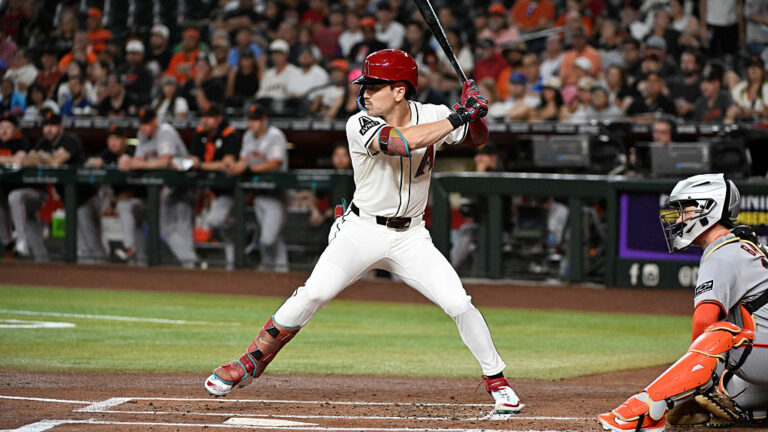
There was a version of Corbin Carroll who already looked like a franchise cornerstone.
He ran the bases with elite efficiency.
He played Gold Glove–caliber defense in the outfield.
He got on base, pressured defenses, and quietly accumulated value without ever needing to sell out for power.
That version of Carroll was valuable — extremely valuable.
But it wasn’t the version that changed how pitchers attack an entire lineup.
That version arrived in 2025.
The Subtle Setup Change That Set Everything in Motion
At first glance, Carroll doesn’t look dramatically different in the batter’s box. The stance is still athletic. The rhythm is still calm. The swing still looks compact and explosive.
But the most important change he made happens before the swing ever starts.
Carroll has tweaked his bat positioning when he sets up in the box, tilting the bat from nearly flat to a more upright angle. It’s subtle — easy to miss unless you’re specifically looking for it — but it fundamentally alters how his swing gets into motion.
This wasn’t an overnight adjustment. Carroll began experimenting with the new bat angle in the second half of 2024, a change our Aram Leighton highlighted, using game reps to feel how the barrel moved through the zone.
The following winter, his focus shifted from experimentation to refinement: finding a comfortable, repeatable spot to fire from that allowed him to be on time without rushing his hands.
That slightly more vertical bat angle accomplishes two critical things:
- It pre-loads the barrel, reducing the amount of late movement needed to get on plane
- It creates more margin for error against velocity, especially on pitches he wants to pull in the air
In simpler terms, Carroll is starting closer to the finish line.
Instead of Carroll having to manufacture bat speed late — which often leads to rushed contact or groundballs — the bat now enters the zone earlier and cleaner. The swing works with his natural athleticism instead of forcing him to compensate for it.
Turning Mechanical Intent Into Measurable Damage (Through Swing+)
Mechanical changes only matter if they show up in results.
Swing+ is how we can see that translation clearly.
Swing+ is a swing-quality model designed to isolate how a hitter creates contact, independent of outcomes like batting average or home runs. Instead of measuring what happened after the ball was hit, it focuses on the inputs that lead to damage — things like attack angle, attack direction, bat speed efficiency, and contact geometry.
In simpler terms, Swing+ evaluates whether a hitter’s process is built to produce impact, not whether the results happened to fall in.
That’s where Corbin Carroll’s transformation becomes unmistakable.
The refined setup — starting with a more upright, pre-loaded bat — unlocked two tangible changes that Swing+ is especially sensitive to:
- A steeper attack angle
- A more pull-oriented attack direction
Those two shifts explain nearly every improvement in Carroll’s batted-ball profile from 2024 to 2025.
In 2024, Carroll’s swing graded as highly athletic but flatter through the zone. That shape is excellent for speed-driven offense — line drives, groundballs, pressure — but it limits how often elite bat speed turns into elite damage.
In 2025, Swing+ captures a different hitter.
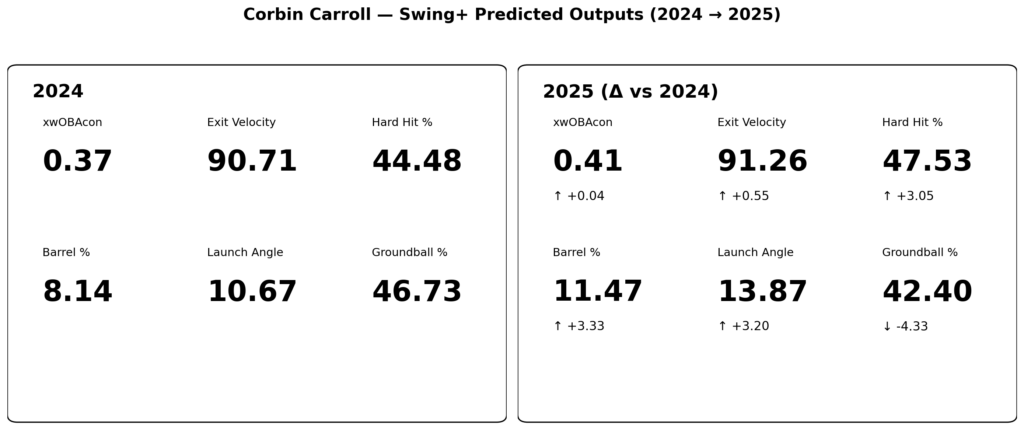
A steeper attack angle means Carroll is meeting the ball later and higher in the zone, converting contact that previously stayed on the ground into lifted contact. The more pull-oriented attack direction ensures that when he lifts the ball, it’s struck out in front — where his bat speed plays best.
The results align perfectly with the model’s expectations:
- Launch angle increased by over three degrees
- Groundball rate dropped by more than four percentage points
- Barrel rate jumped into impact territory
- Hard-hit rate climbed alongside a meaningful gain in exit velocity
- Expected production on contact took a substantial step forward
Crucially, this wasn’t achieved by swinging harder. Swing+ shows that Carroll’s power gains come from better swing geometry, not increased effort. The bat is simply arriving in a more advantageous position more often.
Why This Isn’t a Fluke
The improvements show up across every layer of batted-ball quality.
Carroll didn’t trade contact for power. He didn’t spike his fly-ball rate at the expense of pop-ups. Instead, he found a swing path that consistently lives in the optimal launch-angle band — the sweet spot where hard contact turns into real damage.
That combination is rare.
It signals a hitter who has found a repeatable swing pattern, one that allows natural athleticism to express itself through the barrel instead of relying on speed to clean up weak contact.
This is how players transition from being productive to being central.
A Fundamental Reframe of His Offensive Profile
Early in his career, Carroll was a sum-of-his-parts offensive player. His value came from stacking speed, defense, contact, and instincts into one elite package. The bat was good — sometimes very good — but it wasn’t the foundation.
That hierarchy has flipped.
Carroll is now a bat-first power-speed threat, with elite defense and baserunning supplementing an offensive engine capable of carrying a lineup. He no longer needs to string together singles and stolen bases to impact a game. One swing can do it.
That distinction matters for longevity.
Speed and defense raise a floor.
A swing that produces consistent barrels raises a ceiling.
By pairing the two, Carroll has fundamentally changed how his value ages.
The MVP Ceiling Is No Longer Theoretical
When Carroll signed his long-term extension, it was viewed as a team-friendly deal built around surplus value. Lock in a high-floor star early and let the WAR accumulate.
What’s changed is the shape of that value.
This version of Carroll isn’t just a complementary star — he’s a lineup driver. The type of hitter pitchers must plan around. The type of presence that changes how entire innings unfold.
Elite defense.
Elite speed.
Now paired with a swing built for sustainable, repeatable power.
That profile doesn’t describe a one-year breakout. It describes an MVP-level producer, year after year.
Why This Makes Carroll’s Contract One of Baseball’s Best
Team-friendly contracts usually age well because of surplus value.
This one may age well because of profile evolution.
If Carroll had remained a speed-and-defense-driven contributor, the deal would still look smart. But if this swing holds — and the mechanical changes strongly suggest it will — the Diamondbacks may have locked up a perennial MVP candidate at a price point typically reserved for “very good” stars.
That’s how franchises win margins.
Not by betting on volatility —
but by recognizing the moment when a player stops being what he is and becomes what he’s capable of being.
Corbin Carroll has crossed that line.

Written by