
Freddy Peralta Is the Ace That the Mets Desperately Needed
After a lack of starting pitching ruined the Mets' 2025 season, they addressed the rotation in a big way. Here's what Freddy Peralta does for the team.
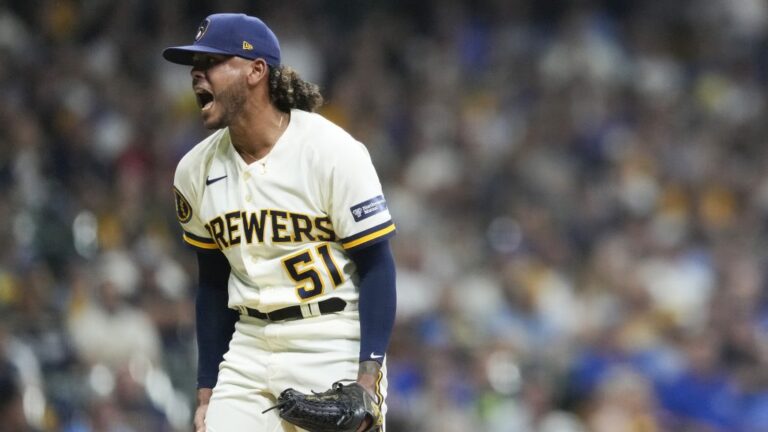
The 2025 New York Mets were a deeply flawed group of baseball players.
They struggled to cash in runs when given the opportunity. Their bullpen was shaky at times and was carried heavily by the stardom of closer Edwin Diaz. However, arguably their biggest undoing was the lack of starting pitching.
Specifically, a team with World Series aspirations was left without an ace, at least until the debut of Nolan McLean. Therefore, the Mets made it clear that they were looking to make an upgrade, specifically at the top of the staff.
“My preference is to add a starting pitcher,” president of baseball operations David Stearns said on Wednesday. “I can’t say with certainty that we’re going to be able to do that, but we remain engaged on a number of different fronts in that market.”
Well, not long after, he accomplished his goal.
Late on Wednesday, Jeff Passan of ESPN reported that the Mets agreed on a trade for starting pitcher Freddy Peralta from the Milwaukee Brewers. The price tag to acquire his services was not cheap, as New York sent Just Baseball’s No. 69 and 87 prospects, utility prospect Jett Williams and starting pitcher Brandon Sproat, respectively, to Milwaukee. Additionally, the Mets grabbed starter Tobias Myers in the swap.
While it’s a lot to give up for an expiring asset, the move is a no brainer for the Mets given what they want to accomplish in 2026 and what their need was with less than a month until pitchers and catchers report to camp.
Freddy Peralta’s Impressive Track Record
Since becoming a full-time starter in 2021, Peralta has been nothing short of spectacular and is coming off his best season.
In 2025, Peralta was named an All-Star for the second time in his career and finished fifth in National League Cy Young voting. He led the NL in wins, going 17-6, posting a sparkling 2.70 ERA, which ranked fourth in the league. Peralta struck out 200+ batters for the third straight season, punching 204 tickets in 176 ⅔ innings (10.4 K/9). He accrued 5.5 total bWAR in his age-29 season.
Peralta boasts a legitimate four-pitch mix, finding success with all four.
Despite averaging just 94.8 mph on his four-seam fastball, which he threw 53% of the time in ‘25, Peralta surrendered just a .209 batting average against on heaters. His changeup (.173), curveball (.183) and slider (.157) were all plus pitches as well, allowing Peralta to limit hard contact at one of the best rates in the game. His 34.5% hard-hit rate placed him in the 90th percentile in the game.
Peralta’s offspeed run value, according to Baseball Savant, placed in the 96th percentile.
The best part? His success is not limited to 2025.
After starting his career in the bullpen, Peralta moved to the rotation in 2021 and was immediately an All-Star. Since then, he has made fewer than 27 starts just once (2022).
In 738 ⅓ innings since 2021, Peralta owns a 3.30 ERA with a 126 ERA+. His ERA has not gone above 3.99 since 2019. While at times susceptible to the long ball, Peralta does not let runners reach base against him with a 1.09 WHIP.
Peralta, without question, is an ace. There is an argument to be made that he is one of the 10 best pitchers in the game, and is maybe the best bang-for-buck option out there. Now, the Mets have the privilege of calling him their ace.
The Financial Value of Peralta
At a time when free agents are commanding upwards of $30 million routinely, Peralta is set to make just $8 million in 2026. With the low financial commitment owed to Peralta, the Mets had to cough up more prospect capital to get a deal over the line.
Peralta is set to hit free agency after the 2026 season, making him a true rental. However, unlike Tarik Skubal — another top starting pitcher that was rumored to be on the trade market — Peralta is not represented by Scott Boras, leaving the door open to an extension before he sees the open market.
If the Mets did not acquire Peralta, they would likely have to look to the free agent market. The top option, Framber Valdez, is not going to be cheap for whoever ends up signing him. Not to mention, Valdez comes with additional baggage.
The return price is steep, but it is the industry standard. The Brewers reportedly tried to mimic the return that they got for Corbin Burnes two winters ago — a young starter and an infield prospect.
Williams is a near-MLB-ready offensive piece with defensive versatility and the potential to steal upwards of 40 bases per season. Sproat figures to slide into Milwaukee’s opening day rotation after debuting late in 2025.
Either way, there are very few bona fide aces that are being paid as small a paycheck as Peralta.
How Does Peralta Change the Mets?
To put it simply, the Mets needed an ace and they got one.
As mentioned above, the lack of quality starting pitching created a slew of other problems last season. To the dismay of many impatient fans, the rotation was the one area of the roster that Stearns did not upgrade this winter. That is, until Wednesday, with a trade that will make a seismic change in the NL East.
After the Mets had spent much of the offseason losing franchise stalwarts, they have added Bo Bichette, Luis Robert Jr. and now Peralta.
Playoff teams lean on their top starters come October. When the Mets made the postseason in 2024, Sean Manaea pitched like an ace down the stretch. However, his workload caught up to him in the NLCS as he simply ran out of gas.
In 2025, Manaea went down with an injury in spring training and never got right once returning. Kodai Senga had an excellent start to the season, but he suffered a leg injury on June 12, which threw his year off the rails. Though 13 starts, he held an ERA of 1.47. After returning, he pitched to a 5.90 ERA in nine starts, eventually getting optioned to Triple-A in September.
David Peterson was selected to his first-career All-Star Game, but he also fell apart in the second half. Peterson held a 6.34 ERA in the second half, following a 3.06 ERA first half.
Once McLean arrived in August, he essentially took over the top spot in the rotation after one start. Relying on a rookie with just a handful of games’ worth of MLB experience is not exactly the goal for a team in a playoff push, let alone this Mets team with its sights set on a World Series title.
Peralta solves this problem. He will give New York stability atop the rotation and thus knock everyone else down a peg. Behind him, McLean, Manaea, Senga, Peterson and Clay Holmes give the Mets six options to start games.
Myers has appeared as both a starter and reliever in his career, but was moved primarily to the bullpen late in 2025. For his career, he has a 3.15 ERA in 49 appearances.
However, Myers should be a solid addition to a bullpen that still needed help after losing Edwin Diaz. In 28 ⅓ relief innings in ‘25, Myers’ ERA was 1.91.
To add on, the trade will give Jonah Tong and Christian Scott a chance for some more minor-league seasoning. After their lack of starting pitching sunk the 2025 Mets, Stearns finally addressed the biggest gaping hole plaguing his group.
Freddy Peralta is a New York Met, putting the finishing touches on what was a very eventful week in Queens.

Written by
An aspiring sportswriter, George Caratzas' life is centered around the diamond. Based in the New York metro area, he covers the New York Mets for Just…