
Liomar Martinez: The Most Underrated Arm in the Marlins’ System
Martinez has a lethal pitch package that could make him one of the best arms in the Marlins organization.
The Miami Marlins are no strangers to identifying and developing some of baseball’s most electric young arms, both stateside and internationally.
Thomas White and Robby Snelling are amongst the more polished, MLB-ready pitchers in the organization, while Kevin DeFrank and Yohanfer Santana are your teenage prodigies.
However, the true test of a farm system’s strength is the quality of the low and mid-tier prospects, or the number of potential pieces who could outplay their projections.
There are a few of these names in Miami’s organization, but one who stands out above the others is 20-year-old Liomar Martinez.
A product of the franchise’s juggernaut DSL pitching factory, L-Mart took some time to hone his arsenal before turning in an impressive campaign at Single-A Jupiter in 2025.
He flashed a sub-10% BB% (9.7%) in his first full season stateside, while doing so over 101 innings pitched. For context, L-Mart was the only pitcher in MiLB this year, 20 years old or younger, with at least 100 IP, a sub-10% walk rate, and a 25% or higher strikeout rate.
He has a solid build for a future starter, standing at 6-foot-2 with room to add more weight and velocity as he ages.
Martinez’s fastball has caught up to his elite breaking ball and plus sweeper. Now that he features an intriguing three-pitch mix, he projects as a starter.
He’s far from a finished project, but Martinez offers a lethal pitch package that could transform him into one of the organization’s best arms. Let’s take a look at what makes him special.
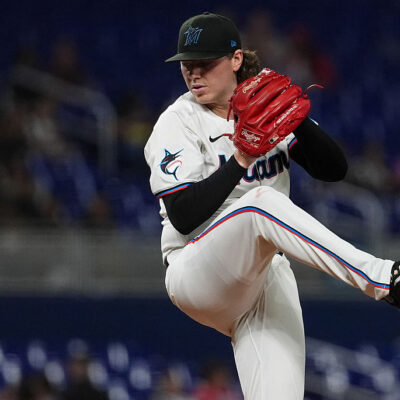
Fastball
Liomar Martinez Key Fastball Specs YOY
| Year | Pitch% | Velocity | IVB | Vertical Release Point | Extension | Whiff% |
|---|---|---|---|---|---|---|
| 2025 | 10 | 92.8 mph | 18.2 in. | 5.62 ft. | 6.6 in. | 23.8 |
| 2024 | 11.3 | 90.5 mph | 17.6 in. | 5.21 ft | 6.7 in. | 23.8 |
A vastly underrated component of Martinez’s profile is the heater that sat in the low-to-mid-90s, maxing out at 97 in 2025. That was a considerable jump from the year prior, when he sat in the low-90s.
He’s about to enter his age-21 season, and it’s entirely possible the ol’ number one could sit in the mid-90s at his peak.
There isn’t much difference in the movement profile, as even though he generated over half a foot of additional ride this past year, he did so from a higher slot. Generally speaking, the more vertical break you can induce from a lower slot, the better.
His extension off the mound remained the same, giving his heater a true mid-90s look when he threw it.
The most impressive feature about the pitch was the 3.5° flat VAA, making it extremely difficult for batters to recognize; he boasted a 34.8% whiff rate on the heater in the top third of the zone.
Overall, it generated a 23.8% whiff rate, and I think the improvement in its peripheral traits is essential to setting up the rest of his arsenal. We began to see that in 2025, and we should see more of it in 2026.
Martinez only threw the fastball 145 times last year, and given the increase in velocity, I’d love to see him drastically increase its usage in 2026.
Curveball
While Martinez’s fastball improvement has vaulted his prospect value, his selling point has always been his bender. It’s easily a plus-plus offering, with tight spin in the 2700 rpm range and 12.1 inches of drop.
He throws it in the high-70s and features depth that yields almost three feet of vertical offset from the fastball, allowing it to tunnel well off of his heater.
Martinez’s ability to cover multiple eye levels while changing speeds is the key to his success when sequencing the heater and hammer.
Although it currently generates a staggering 47.3% whiff rate, Martinez is prone to hanging his curveball and leaving it in the upper third of the zone.
It’s missing enough bats to where that isn’t a problem right now, but he may get burned in the upper minors. Regardless, it’s an elite offering that carries his profile.
Sweeper
Martínez’s sweeper is an intriguing weapon that complements his fastball/curveball mix. Sitting in the low-80s, it shows 14.1 inches of horizontal movement, generating awkward swings from right-handed hitters and weak contact against lefties.
The pitch profiles as above-average when he finishes it with conviction, though consistency remains uneven.
The pitch induced a 51.4% whiff rate in 2025; results like that, even at a lower level of MiLB, suggest it will yield success as he ascends the system.
With improved command, the sweeper could evolve into another reliable swing-and-miss offering and a key piece of his arsenal.
Martinez will effortlessly go east to west while already being a menace north to south, and will cover multiple planes with over two feet of horizontal offset from his fastball.
Sinker
In the event he loses command of his true four-seamer, Martinez’s sinker offers another reliable fastball option, sitting in the low-90s with 13.9 inches of arm-side run, distinguishing it from his flat four-seamer.
He has also seen a velo bump on his sinker, with its average velocity increasing from ~90.8 mph to 93.1 mph over the last year.
Due to its ability to induce weak contact, it complements his four-seam, curveball, and sweeper well.
Areas for Improvement
One swing factor for Martinez would be the development of an offspeed offering. It would help to add an arm-side pitch off of the fastball and to have a middle velocity option between the heater and curveball.
He toyed with a splitter and true change in 2025, throwing them a combined 97 times out of his total 1,446 recorded Single-A pitches.
Both sat in the mid-80s, creating a middle gear between the heater and curveball, but they didn’t generate enough arm-side run to give him a true eastward pitch.
Miami’s development team could help him focus on applying sidespin by having him pronate and release off the inside of the ball more frequently, allowing for more arm-side run against right-handed hitters.
A second swing factor would be the development of a gyro slider. His current true slider closely resembles a true bullet shape, but it generates slightly more glove-side movement than you’d expect (-5.9 in.).
Ideally, this value is between -5 and 0 inches of horizontal movement and more closely mirrors the fastball from a velocity perspective.
Martinez currently throws his slider at 83 mph. Less supination on this pitch would go a long way in giving him a middle point on his overall movement map.
He already goes north to south with the fastball and curveball and west with the sweeper. Provided he refines the changeup going east, the bullet slider would round out a scathing arsenal.
Outlook
Martinez has shown outstanding baseball maturity for a player who would’ve just started his academic junior season had he been raised in the United States and attended college.
The heater is much improved from last year and now does a much better job of setting up his secondaries, especially his elite bender; he’s already seen a two-tick increase in this department YOY.
Martinez’s arsenal expands beyond the pitches analyzed, so it’s challenging to find a direct comparison. It’s also entirely possible that some pitches may have been mistagged by Statcast.
His fastball shape closely resembles that of Tyler Mahle’s from an IVB, horizontal movement, arm slot, velocity, and extension standpoint.
It’s still early in his career, but I think he currently projects as a back-end starter with a green arrow pointing upward.
His 50th percentile outcome is a 5.0-6.0 WAR pitcher over the first six years of team control, averaging 1.0 WAR per season.
The ingredients of a No. 4 or 5 in a championship-caliber rotation are there, and he could click as a top-100 guy if he can continue on his current trajectory.

Written by
Adam Akbani is a writer and analyst from St. Louis, MO. He attended Washington University in St. Louis, double majoring in Economics & Strategy and Political…