
Seven Rule-5 Eligible Players to Keep an Eye On
Tuesday marked the 40-man roster deadline in Major League Baseball, so here are seven of the most intriguing names left unprotected.
This past Tuesday marked the 40-man roster deadline in Major League Baseball, and some notable Rule 5-eligible prospects were not added. It was a peculiar deadline this offseason. Front offices were operating under the assumption that there likely won’t be a Rule 5 Draft at all because of the impending collective bargaining negotiations and potential lockout. In turn, this left some very desirable names unprotected and vulnerable to being taken in the Rule 5 Draft.
This week, we’ll look at seven of the most intriguing names left off 40-man rosters. Prepare for a lot of pitchers, because the Rule 5 Draft has become a pitcher’s draft. Since 2022, 44 of the 53 selections in the MLB phase have been pitchers, so this will be a fairly pitcher-heavy list.
With some of the names left out in the cold, should the Rule 5 Draft happen, there could be a seismic shakeup.
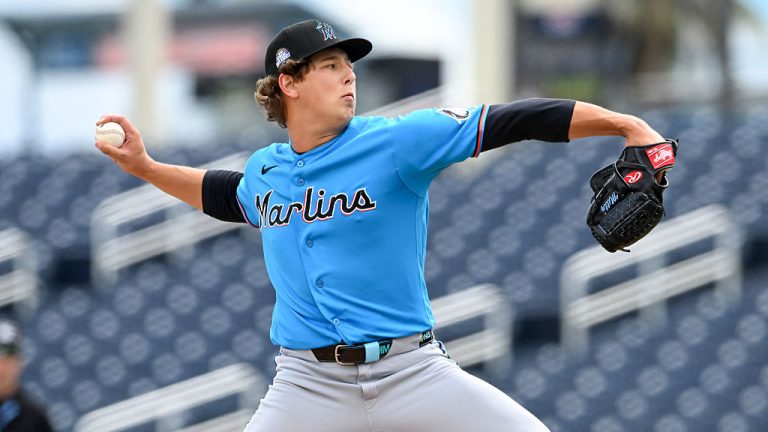
1. Karson Milbrandt: RHP, Miami Marlins
Milbrandt being left unprotected was a stunner. A true tale of two seasons, Milbrandt dominated Double-A, rising all the way to No. 70 in Just Baseball’s August update of the Top 100. Milbrandt was striking out nearly 40% of the hitters he faced, and his K-BB% jumped from an impressive 16.7% in 2025 to a staggering 29.0% in Double-A in 2026. Then he got promoted.
Milbrandt’s time in Triple-A can only be described as a confounding struggle, largely due to his lack of command and his stuff not translating. In A-ball in 2025, Milbrandt’s fastball averaged between 18-20 inches of induced vertical break. In Triple-A this past season, that had fallen to 16 inches. His vertical approach angle on fastballs along the top third of the zone went from -3.9, an incredibly strong mark, to -4.3.
Milbrandt saw his fastball get zapped of all the traits that made it special, aside from its velocity, seemingly overnight. And while, yes, there’s a noticeable difference in the ball between Double-A and Triple-A, this was still quite concerning. His ERA subsequently rose from 1.34 in 47 innings in Double-A to 8.39 across 64.1 innings of work in Triple-A. Milbrandt has quality spin capacity with above-average breakers, but he relied on his fastball to get ahead in counts, as his inability to stay in the zone with anything else led to an increased walk rate.
A team will take a flier on Milbrandt, guaranteed. But the question will be: What went wrong, and how do we fix it?
2. Zach Franklin: RHP, New York Mets
Franklin is a true reliever prospect, and he was part of the return the Mets received when they sent Huascar Brazoban to the White Sox at the 2026 deadline. The Mets made some intriguing tweaks with Franklin almost right away, and it did a lot for his fastball.
Franklin won’t wow with his velocity. He’ll sit 91-94 mph, but his unconventional motion, coupled with high spin and big rise, helps create deception that leads to whiffs. After the trade, Franklin’s arm angle got increasingly higher. His release point went from 5.75 feet before the trade to 5.97 feet with the Mets. This resulted in a couple of things happening for Franklin.
He leaned even further into his fastball’s cut-ride tendencies and gained over an inch in iVB. By September, Franklin saw his induced vertical break grow from 17.9 to 19.1 inches. His horizontal break decreased from 5.2 inches before the trade to 4.1 inches in the final month of the season. He induced a 30.4% whiff rate on his fastball in September, and its average exit velocity dropped from 90.5 mph as a White Sox player to 85.0 mph that month.
At the very least, Franklin’s funky motion and improved cut-ride fastball/splitter combo could make for a useful depth arm. The 28-year-old is on the cusp of his debut, and a relief-needy team could snag him for depth.
3. Ryan Clifford: 1B/OF, L/L, New York Mets
From one Met to another, Clifford being here is something that would have been unheard of two years ago. However, attempts to mitigate his swing-and-miss issues have only seen Clifford worsen during his time in the Mets’ organization, and he’s now gone from a once top-five prospect in the system to unprotected.
In 470 plate appearances in Triple-A, Clifford slashed a paltry .180/.277/.363 with 18 home runs and a 37% strikeout rate. Strikeouts and swing-and-miss have been attached to Clifford throughout his minor league career, but this was a concerning career worst.
There are holes aplenty in Clifford’s swing, but his power is prodigious and what lands him here. Despite the strikeouts and a 34.2% whiff rate, Clifford still put together a hard-hit rate just shy of 50%, an 11% barrel rate, and an EV90 north of 106 mph. The boom-or-bust, three-true-outcomes first basemen and corner outfielders are a dime a dozen, and Clifford falls into that category.
4. Owen Wild: RHP, Tampa Bay Rays
Owen Wild is a sight to behold. His release is so odd that he’s essentially broken pitcher summary charts. Wild’s extreme body tilt on the mound is truly bizarre, despite his release seemingly not appearing out of the ordinary at first glance. TJStats has his arm angle at 90 degrees, while Pitch Profiler reads a more modest 44 degrees. But what’s not up for debate is the quality of stuff Wild possesses.
It’s a two-pitch mix: a mid-90s cut-ride fastball and a mid-80s gyro slider. At nearly seven feet of extension, his fastball plays up, and at the top of the zone, it induces swings and misses with regularity. His slider dives and dies along the same plane, creating elite tunneling action.
Wild put together an incredibly strong second half, and given his stuff combined with his unique delivery, he could be a name that comes off the board.
5. Wilian Bormie: RHP, Texas Rangers
For a pitcher who can run it up north of 100 mph, their calling card typically isn’t another pitch. That’s what makes Bormie so unique: his high-level, zero-axis bullet slider is his primary offering.
Bormie is a different animal altogether. He’s sub-six feet in extension, his fastball generates as much run as it does ride, and he does it all from a fairly high three-quarters slot. At the end of the day, velocity like this doesn’t come around often, and while Bormie will have to be rostered on a 26-man roster, he’s still an interesting piece of clay worth trying to mold.
6. Cayden Wallace: 3B, R/R, Washington Nationals
Wallace has a lot of above-average tools, and after a breakout 2026 season, it came as a bit of a shock that the Nationals left him unprotected. After a pedestrian season at the plate in 2025, Wallace returned to Double-A to start 2026 and blew through the first three months of the season with ease. Wallace had never hit more than 13 home runs in a season as a minor leaguer. He smacked 18 in 71 games in Double-A.
Wallace then got promoted to Triple-A, and his torrid season continued. He hit another 11 home runs in 61 games and finished the season with a cumulative .300/.353/.543 slash line, good for a 133 wRC+. Wallace has always been a bit of a free swinger, but adjustments to his load kept him on balance more consistently, allowing him to lift the ball with consistency. Wallace also crushed left-handed pitching and has positional versatility across the infield, making him a potential real commodity should this draft happen.
7. Blake Holub: RHP, San Francisco Giants
If you’re looking for indicators that a Rule 5 Draft is not happening, this is a strong one. Just days after trading Ryan Walker to the Brewers, the Giants declined to add Holub, a piece of the return in that trade, to their 40-man roster. Read into that what you will.
Regardless, Holub has an extreme over-the-top arm angle, about as vertical as it can get, in fact. Standing at 6-foot-5, Holub generates elite extension, and his cutter flirts with 20 inches of iVB but generally settles back down between 17 and 18 inches. His slider is a true plus pitch from that release, as its downward action can approach a death-ball shape.
On top of that, he has found a really interesting two-seam option that mirrors the shape of a normal four-seam fastball. From his angle, it allows him to find something arm-side with mid-90s velocity. In all likelihood, in a normal year, Holub is protected. This offseason is far from normal.
Become a Member of Just Baseball
Subscribe and upgrade to go ad-free!
* Save 25% by subscribing annually.

Written by