
Top Prospects Teams Should Be Targeting in the Rule 5 Draft
Our list of the top prospects who were left unprotected, that teams should be eyeing to select in this year's Rule 5 Draft.
 | |
| | 
The Rule 5 Draft is always a fun time for teams to dig around in an effort to unearth a complementary piece to the 26-man roster.
Given the fact that a team who selects a player in the draft has to keep him on the active roster for the entirety of the season, there’s generally very specific types of roles and players targeted in the Rule 5, which many of players we will discuss today fit into, along with some bigger “gambles” mixed in.
Let’s dive into some of the top players who we would be looking to select that were left unprotected for the 2025 Rule 5 Draft.
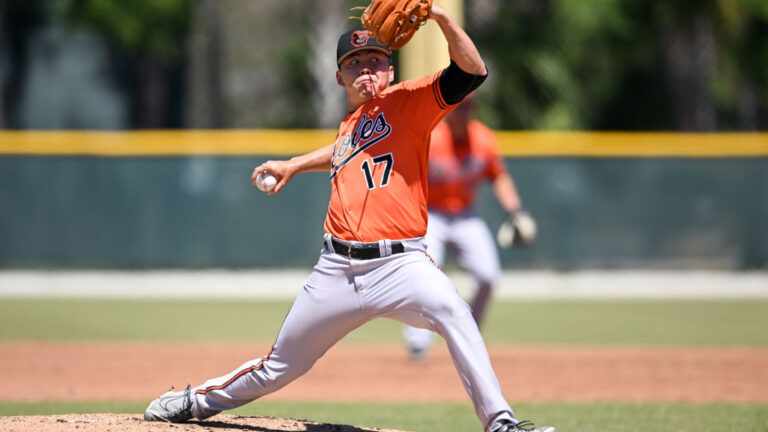
Alex Pham – RHP – Orioles
A forearm issue limited Pham to just 49 innings in 2025, but he returned back to the mound for the final two months of the season where his fastball velocity has back to his typical 92-94 MPH.
A straight over-the-top delivery, Pham generates elite ride on his fastball, averaging north of 20 inches of induced vertical break from a slightly above average release height.
His cutter is a unique pitch from his angle at 85-87 MPH, generating plenty of right on right swing and miss. His downer curveball in the upper 70s averages nearly 40 inches of vertical separation from his fastball. He added a bridge slider in the low 80s and will also mix in a splitter that does not stand out shape wise, but plays well off of his lively fastball.
Assuming the medicals are all good, Pham is a unique arm who has the upside to be a back-end starter but at least looks the part of a swingman with a well-rounded arsenal. He’ll need to improve a bit in the command department to reach that back end potential.
Hayden Mullins – LHP – Red Sox
A southpaw with a unique delivery, Mullins creates some deception built into a decent four pitch mix. His fastball only averaged 92.5 MPH in 2025, but it gets on hitters more quickly than the radar gun may imply thanks to the run and ride the pitch generates as he lets it rip after a high leg kick and inward twist.
The same components that make Mullins difficult to pick up may make it difficult for him to consistently fill up the zone, walking 12.4% of batters in 2025, hedged by a 30% strikeout rate and OPS against of .575.
Mullins posted nearly identical splits against both lefties and righties, aiding his starter case with his upper 70s curveball looking like a plus pitch. The gyro slider is a solid third offering along with a changeup that was farm improved.
Still yet to pitch above Double-A, teams could ultimately be too concerned about the command to select the southpaw, but the stuff and results in 2025 could be worth a shot.
RJ Petit – RHP – Tigers
A mountain of a man, Petit stands at 6-foot-8, 300 pounds, but has a pretty good feel for his arsenal, especially the plus slider that sits in the mid 80s. He went to the slurvy slider more than 30% of the time, generating a chase rate north of 40% while holding opponents to a .530 OPS.
His four-seam fastball averaged 96 MPH in 2025 with a sinker about two ticks below that which he likes to run in on the hands of righties. Petit finished the year with Triple-A success, racking up more ground balls and filling up the zone at a respectable clip. He looks the part of a big league reliever.
Jose Rodriguez – RHP – Dodgers
Another big right-handed reliever, Rodríguez’s numbers may not jump off of the page as he maneuvered a hitter-friendly PCL, but the underlying stuff and strikeout numbers are hard to ignore.
Despite an ERA in the mid 5s on the season, Rodríguez pitched to an ERA of nearly half that from June 1 onward while striking out 34% of hitters.
His changeup is wicked, throwing it north of 30% of the time, holding opponents to a batting average right around .100 with an OPS hardly over .300. He comes set at a closed position then twists inwards to the point that his back knee is pointed straight towards second base before unleashing a cross-fire delivery that makes it difficult to pick the ball up.
While the changeup is potentially 70 grade and the slider is a plus pitch as well, Rodriguez’s fastball was hit hard in 2025 and he walked 14% of batters. That said, he may just be too unique with too much underlying whiff to sneak through the Rule 5.
Peyton Pallette – RHP – White Sox
A surprising omission from the White Sox 40-man given the spots they still have open, I am now left wondering what I am missing on Pallette.
Moving the former second rounder to the bullpen proved plenty beneficial last season, as he turned in a 4.06 ERA with a 3.43 FIP and 32.5% strikeout rate. Over his final 30 appearances at the Triple-A level, Pallette pitched to a 2.78 ERA with an impressive 23.2% K-BB rate.
The fastball sat in the mid 90s, generating more whiff than his pitch data would suggest thanks to his whippy arm action and a low angle, allowing it to play well in the top half of the zone. He has a trio of intriguing secondaries with the slider and changeup really coming along to potentially leapfrog his curveball which used to be his preferred secondary.
Opponents hit a combined .188 with a chase rate north of 30% and swinging strike rate of 24% against his slider and changeup. Pallette at least looks the part of a middle reliever who is capable of going multiple innings.
Sammy Natera – LHP – Angels
I came away really impressed by Natera in the Arizona Fall League in 2024, highlighting him as a candidate to be fast-tracked to the Angels bullpen in 2025, but command issues held him back from a debut, walking 17% of batters.
Even with the lack of strikes between Double-A and Triple-A, Natera turned in a 2.84 ERA, a testament to the quality of his stuff.
His mid 90s fastball generates above average carry and extension with hitters really struggling to turn it around, evidenced by the .157 opponent batting average against his fastball in 2025.
The heavy fastball reliance and command issues may scare teams away, but lefties who can throw a fastball 75% of the time and strike out more than 34% of batters at the upper levels do not grow on trees, making Natera worth a shot.
Yordanny Monegro – RHP – Red Sox
There may not be a pitcher available in the Rule 5 draft with more upside than Monegro.
I highlighted him as a player worth a flier in the 2024 Rule 5, but given the fact that he hadn’t pitched above High-A with a walk rate of 10%, he snuck through and was assigned to Double-A where he dominated through eight starts, striking out 49 and walking just seven before going down with a torn UCL that would require underwent Tommy John surgery in June.
With his 2026 season wiped out as well, a team who drafts Monegro would be stashing him on the long-term injured list for the whole season, but he may just be worth it.
His 93-95 MPH sinker is a ground ball machine, with a plus curveball, a gyro slider that is at least average and a changeup that looked far improved in 2025.
If a team believes in the massive improvement Monegro made in the strike throwing department in 2025 and is willing to be patient, he could very well be selected.
Yohendrick Piñango – OF – Blue Jays
Piñango has long been a data darling who has struggled to turn incredible peripherals into production, but took a big step in the right direction in 2025.
In his age-23 season, Piñango posted an OPS of .790 between Double-A and Triple-A, launching a career-best 15 homers and 46 extra base hits.
The data was as impressive as ever, with a contact rate of 80%, hard hit rate of 50% and 90th percentile exit velocity of 109 MPH. Minor Leaguers with those peripherals are almost always top 100 guys, but Piñango’s biggest defect is the higher the quality of his contact, the lower the launch angle.
His average launch angle on hard hit balls was just 3.5 degrees in 2025, which was actually a four degree improvement from 2024 and likely played a part in his improved numbers, but is still about 10 degrees below where he wants to be.
I detailed more on this in a recent thread, but if a team can help Piñango improve his path to accommodate more loft, he could turn into a productive power bat in a corner. Teams may be more hesitant given his fringy defense in a corner, but prospects with elite bat speed, good contact skills and a patient approach are generally not acquirable for $100,000.
Cameron Cauley – UTIL – Rangers
Cauley is an explosive athlete at multiple premium positions, fitting the bill of what teams like to grab in the Rule 5. He plays a quality shortstop and second base, also seeing action in center field where his easy plus speed helps him chew up plenty of ground.
On the offensive side of things, Cauley looked much improved in 2025, cutting his chase rate by 5% and strikeout rate by 7% to roughly 25%. There’s still swing and miss concern, but he recognizes spin well, has a knack for pulling the ball in the air and is valuable on the base paths, swiping 139 bags in 160 tries in his pro career. Cauley has the goods to be a quality big league utility piece.
Other Names Worth Considering: Pete Hansen (LHP), Zach McCambley (RHP), Harrison Cohen (RHP), Noah Miller (SS), Andrew Pintar (OF)
Hansen may not be the most exciting arm in the world but the innings-eating southpaws are always an interesting archetype for teams and he racked up 142 1/3 innings in Double-A with the Cardinals with a 3.86 ERA and 6.5% walk rate.
Cohen and McCambley may not have stuff that jumps off of the page, but they both turned in fantastic seasons at the upper levels and sprinted through the finish line.
Over Cohen’s final 40 innings, he pitched to a 1.13 ERA between Double-A and Triple-A. McCambley pitched to a 2.65 ERA and 24% K-BB rate in his final 30 Triple-A appearances.
Miller and Pintar offer potentially elite defense at shortstop and centerfield respectively, albeit with light offensive profiles. The switch-hitting Miller at least posted an OPS above .700 from the left side between Double-A and Triple-A, but a team selecting him would be eyeing his vacuum defense on the infield dirt.
Pintar can go get it in center field and posted an OPS north of .900 against southpaws in 2025 giving him a clear niche to carve out for a team.
Written by
Aram Leighton is the Co-Founder and Executive Editor for Just Baseball. A Syracuse University grad, Aram is one of the hosts of the Just Baseball Show…