
Miami Marlins Top 15 Prospects
One of baseball's most rapidly improved systems, the Marlins all of a sudden offer plenty of prospect depth.
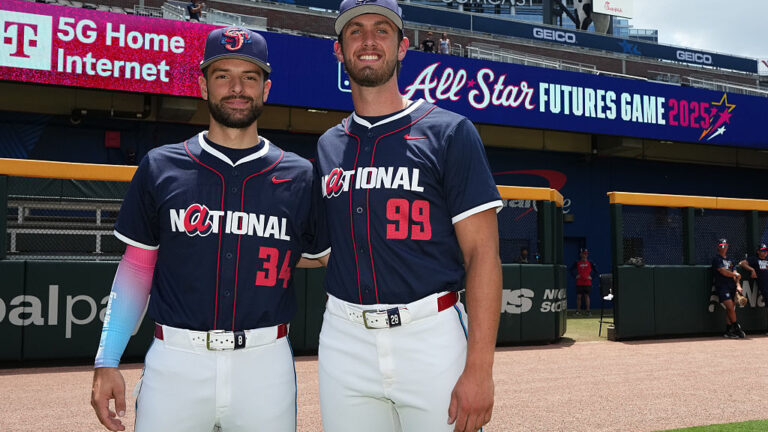
Since President of Baseball Operations Peter Bendix took the controls for the Miami Marlins, it has been made very clear that the former Rays GM wanted to hit the reset button on an organization that, at the time, possessed one of baseball’s worst farm systems.
The Marlins’ prospect depth is now a strength, headlined by four top 100 prospects and a handful of prospects in the 45 future value tier and above. Given the fact that the Marlins’ top three prospects were all in Triple-A to finish the 2025 season, there are more reinforcements on the way in Miami.
1. Thomas White – LHP – (Triple-A)
Height/Weight: 6’5, 210 | Bat/Throw: L/L | 1st Round-A (35), 2023 (MIA) | ETA: 2026
| FASTBALL | SLIDER | Curveball | CHANGEUP | COMMAND | FV |
| 60/65 | 50/55 | 60/60 | 60/60 | 35/45 | 55+ |
The top southpaw in the 2023 class, White already has an impressive feel for a strong four-pitch mix. Despite some command challenges, White has flown through the Minor Leagues thanks to his big whiff stuff, reaching Triple-A by the end of his age-20 season.
Arsenal
Towering at a lanky 6-foot-5, White produces high-quality stuff without a ton of effort and holds his velocity throughout the season.
His long arm action can be difficult to time up for him, affecting his command, but his arm path also plays into the deception he creates, hiding the ball behind him before working down on the mound.
The result is a fastball that can spring onto hitters more quickly than others at the same velocity despite just average extension.
His fastball sits in the mid-90s, touching 100 mph with late life. While that is already plenty of velocity, his projectable frame and relatively low-effort delivery make him a candidate to see an uptick into the upper 90s. Regardless, it is comfortably a plus heater.
Both White’s curveball and changeup are already above average, with the latter looking like a plus pitch in the early stages of his pro career.
The sweeping curveball sits in the low 80s with two-plane break and roughly 14 inches of horizontal break. It is a big whiff pitch left-on-left, but he has the tendency to leave it up at times, especially to righties. That said, it is still a great third option to opposite-handed hitters, especially when he buries it towards their back leg.
White’s preferred weapon to righties is his mid-80s changeup, which mirrors his fastball well thanks to his ability to maintain his arm speed and unique arm action.
Averaging nearly 15 inches of vertical separation and 13 mph of velocity separation from his fastball with a similar movement profile to Ryan Weathers’ change.
Outlook
Already flashing three plus offerings and a quality fourth from the left side, White has frontline stuff. A strikeout rate of 40% between Double-A and Triple-A in his age-20 season only backs up the stuff, but he will certainly need to cut down on his 13.6% walk rate.
With only a .174/.299/.225 slash line allowed in 2025 with just two home runs, it’s clear that the only person who can beat White in the upper minors is himself. There are shades of Blake Snell here, and if White can manage even fringy command, he could still reach towards the front of a big league rotation.
2. Joe Mack – C – (Triple-A)
Height/Weight: 6’1″, 205 | Bat/Throw: L/R | 1st Round (31), 2021 (MIA) | ETA: 2026
| HIT | Plate Disc. | GAME POWER | RUN | FIELD | FV |
| 30/35 | 50/55 | 50/55 | 40/40 | 60/70 | 55 |
After a couple of frustrating seasons to start his pro career (so it goes with high school catchers), Mack broke out in a big way in 2024, launching 24 home runs while showcasing plus defense behind the dish. He followed that up with more of the same in 2025, launching 21 homers in 112 games–most of which at Triple-A–along with some of the best defense in the minor leagues.
Hitting
Starting upright with his hands high over his head and the barrel pointed towards right field, Mack pulls his hands down and back as he shifts his weight into his backside.
Despite his hands traveling relatively far, Mack handles velocity extremely well, with an OPS around 1.000 against all fastballs and north of 1.000 against 93+ MPH.
On the contrary, Mack can struggle against spin. His overall production was better in 2025, but his 57% contact rate against breaking balls is something he will need to improve.
A combination of pitch recognition issues and inconsistent body control likely contributes to the poor results against breaking balls, often spinning off with his front side and/or drifting onto his front foot prematurely.
His average exit velocity of 90 MPH and 90th percentile exit velocity of 105 MPH are comfortably above average, and there may even be room for a bit more from Mack, especially as he finds more lower-half control and balance.
His feel to elevate, paired with above-average raw power, gives him 20-25 home run potential at the highest level, even if the hit tool is below average. Mack’s plate discipline has continued to progress, which could help take some pressure off his contact skills.
Defense/Speed
Mack has all of the tools to be an elite defender behind the dish. His receiving grades are out well above average, while his arm is plus, throwing out 34% of attempted base stealers in 2024 and 33% in 2025, making the caliber of throws that are even rarely seen at the highest level.
A good blocker who is technically sound, Mack is an athletic catcher who moves well.
Outlook
With the hit tool likely to be below average, the power development has been huge for Mack’s offensive case.
If Mack can improve his ability to hit secondaries, he has a chance to be an above-average offensive threat, which, paired with his defense, could make him a 4+ win catcher. Even if the hit tool is below average, his defensive ability and above-average power should make him at least an average regular at the position.
3. Robby Snelling – LHP – (Triple-A)
Height/Weight: 6’3″, 210 | Bat/Throw: R/L | 1st Round (39), 2022 (SDP) | ETA: 2025
| FASTBALL | Curveball | CHANGEUP | Slider | COMMAND | FV |
| 60/60 | 60/60 | 50/55 | 50/50 | 55/60 | 55 |
A top linebacker recruit in high school, Snelling is one of the more athletic pitchers you’ll find.
After dominating with a 1.82 ERA across 103.2 IP. His stuff backed up a bit in 2024, and with that, his command at points, resulting in a frustrating sophomore year before being traded to the Marlins as the headliner in the Tanner Scott/Bryan Hoeing return.
Snelling worked hard in the offseason heading into 2025 to regain his stuff and optimize his mechanics, emerging with a vastly improved fastball and better overall stuff.
Check out our interview with Robby Snelling!
Arsenal
A good feel for three pitches, Snelling features a fastball, curveball, and changeup.
Starting with his fastball, Snelling sat more 92-94 MPH in 2023, then saw his velocity drop a tick in 2024 before making some mechanical tweaks heading into 2025 that have allowed him to tick up to 94-96 MPH with improved carry.
He dominated upper minor league hitters to the tune of a batting average around .160, a strike rate north of 70% and a swinging strike rate of 15%, making it the best-performing fastball in the Marlins organization.
In addition to his improved quality of fastball, Snelling’s mechanical tweaks helped him get his command back to where it typically has been, throwing strikes at an above-average clip.
He has leaned back into his sweeping curveball that had been effective for him early in his career, finding success with it in the upper minors both from a command and whiff perspective.
Snelling’s third offering is a changeup that is at least average and has benefited from his improved fastball velocity and shape.
He is not as consistent with it as his fastball and curveball, but it is a strong third pitch, averaging more than 13 inches of vertical separation and another six inches of horizontal.
Snelling added a gyro slider heading into 2025, which is a decent taste-breaking offering, especially left on left.
Outlook
After taking the Minor Leagues by storm in 2023, Snelling hit a wall in 2024 and was traded to the Marlins as part of the Tanner Scott/Bryan Hoeing return.
As he detailed on The Call Up, Snelling worked hard in the offseason to optimize his mechanics and delivery, emerging in 2025 with the loudest stuff of his career and regained command.
Once viewed as a liability, Snelling’s fastball was one of the most effective in the entire minor leagues while maintaining his plus command. Teammates and people within the organization rave about the way that Snelling carries himself and competes.
He is one of the highest floor arms in the minor leagues, but has now pushed his ceiling to that of a No. 2 starter.
4. Aiva Arquette – SS – (High-A)
Height/Weight: 6’5″, 220 | Bat/Throw: R/R | 1st Round, (7) 2025 (MIA) | ETA: 2027
| HIT | Plate Disc. | GAME POWER | RUN | FIELD | FV |
| 40/50 | 40/50 | 50/60 | 50/50 | 40/50 | 50+ |
Long levered with underrated athleticism and intriguing power potential, Arquette looks the part of an above-average regular, even if he slides over to third base.
Hitting
Starting with his feet a little more than shoulder-width apart and his hands just in front of his back shoulder, Arquette looks very relaxed in his setup before getting into a decent-sized leg kick. While his hands are a little noisy, he hasn’t had much trouble timing up the barrel movement with his leg kick, looking controlled and rarely rushed.
Arquette’s long levers make it easy for him to generate good bat speed, producing plus exit velocities while hitting the ball at optimal angles. His average launch angle on batted balls 95+ MPH was nearly 20 degrees in 2025, giving him the potential for plus game power at the highest level.
Despite his longer frame and loft in his swing, Arquette has a decent feel for the barrel, producing solid contact rates in his draft year, providing optimism for an average hit tool. He recognized spin well as an amateur, but it will be important to monitor if his moving parts can lead to some timing issues against higher-quality stuff in pro ball.
It will likely be power-over-hit for Arquette, but his plus power potential will give him a good chance to be an above-average bat, even if the hit tool is fringy. If the hit tool and plate discipline progress to average, there’s enough there to be a middle-of-the-order masher.
Defense/Speed
A good athlete for his size, the Marlins are going to give Arquette every opportunity to stick at shortstop, where his range is sneaky with pretty good hands and a plus arm.
It can take some time to get the ball out, and he can struggle to throw from different arm angles. If Arquette moves to third base, he would easily project as an above-average defender.
While he only stole seven bags on eight tries in 2025, Arquette is at least an average runner underway, sometimes turning in above-average run times up the line.
Outlook
The Marlins were thrilled to land the top college bat in the 2025 class with the seventh overall selection, instantly becoming the organization’s top infield prospect.
Of course, the profile is more appealing if Arquette can play an average shortstop, but even if Arquette moves to third base, his power upside and glove would give him above-average regular upside.
5. Starlyn Caba – SS – (Low-A)
Height/Weight: 5’9″, 170 | Bat/Throw: S/R | IFA: $3M, 2023 (PHI) | ETA: 2027
| HIT | Plate Disc. | GAME POWER | RUN | FIELD | FV |
| 50/60 | 55/65 | 20/30 | 60/60 | 60/70 | 50 |
A defensive wizard at shortstop, Caba is a contact-oriented switch-hitter who is far more advanced than his peers. He was acquired by the Marlins as the main piece in the Jesus Luzardo deal, battling multiple injuries that limited his 2025 season to just 51 games of poor offensive production before looking far better in the AFL.
Offense
A switch hitter with a quiet operation from both sides, Caba is a contact-oriented hitter with a quick and compact stroke.
Between his efficiency and feel for the barrel, Caba has posted strong contact rates, but the combination of low exit velocities and launch angles kept the batting average down in his first two Low-A stints.
Caba’s quality of contact was significantly better from the right side, but he appeared to close that gap late in the regular season and throughout the Arizona Fall League as he was further removed from a left thumb issue that would likely affect his left-handed swing more.
Caba’s patience and knowledge of the strike zone are also advanced for his age, running a chase rate of just 13% in 2024 and 18% in 2025, helping him walk more than he struck out as a pro.
While there’s room within Caba’s modest frame for some more strength, he’ll likely be a below-average power source. There’s potential for plus hit and plate discipline that would make him an ideal top-of-the-order bat with gap-to-gap power if he can elevate more consistently.
Defense/Speed
A plus runner with great footwork at short, Caba is a rangy shortstop with a plus arm and mature instincts. His pregame work is meticulous. He attacks the ball with confidence, demonstrating the ability to make difficult throws on the run from different angles.
He projects as an easily plus defender with potentially elite defensive ability at shortstop. Caba was a very aggressive base stealer in 2024, swiping 50 bags in 78 games, but his injuries limited his volume in 2025.
Outlook
Though 2025 was somewhat of a lost season due to injury and poor performance, Caba ended the year on a high note with his AFL showing and has the ingredients to make up for lost time.
He compensates for his lack of power projection by providing value in just about every other facet of the game.
Between his plus defense at shortstop and contact/on-base skills, Caba’s floor is higher than most other teenage prospects while still offering enough upside to dream on an above-average everyday shortstop.
Still just 20 years old for the entire 2026 campaign, Caba still has time to develop, but it will be important for him to prove that he can stay healthy and carry the improvements impact wise from the AFL into 2026.
6. Kemp Alderman – OF – (Triple-A)
Height/Weight: 6’3″, 230 | Bat/Throw: R/R | 2nd Round, (47) 2023 (MIA) | ETA: 2026
| HIT | Plate Disc. | GAME POWER | RUN | FIELD | FV |
| 40/40 | 40/45 | 50/60 | 50/50 | 40/45 | 45+ |
Huge raw power is the calling card for Alderman, which he really started to tap into in the back half of the 2025 season. There’s not a ton of value beyond the bat and there’s some swing and miss concern, placing plenty of importance on his ability to convert elite exit velocities into plus game power.
Hitting
Starting upright and slightly open, Alderman’s operation is rather simple with a moderate stride as he pulls his hands up and back. His hands can get a little too far behind him at times, making his margin for error thinner in regard to delivering the barrel on time against velocity.
As a result, his contact point against fastballs can tend to be deeper, making it difficult to pull the ball in the air consistently.
Alderman is strong as an ox, boasting the highest 90th percentile exit velocity in Minor League Baseball of players with at least 100 games played in 2025 at 111 MPH. The challenge is that his flatter path and deeper contact point resulted in an average launch angle of just 6.5 degrees and a ground ball rate north of 50%.
It was encouraging to see Alderman at least maintain his fringy contact rates at the upper levels while cutting his chase rate by 5%. That said, he will need to continue to improve swing decisions, still hovering around a 30% chase rate, struggling to lay off of fastballs at the top.
If Alderman can improve his swing decisions and angles, he has monstrous power upside, but those are two big ifs. The quality of contact gives him a bit wider a margin for error, assuming he maintains his fringy contact rates at the highest level, or takes a step forward swing decisions-wise.
Defense/Speed
Alderman is an average runner, which allows him to cover enough ground to get by in a corner, but his reads and routes are still a bit shaky, especially working back towards the wall. His plus arm helps his case, but it’s likely average defense at best.
He has worked to become more of a factor on the base paths, swiping 22 bags in 2025, but he was also caught 10 times.
Outlook
Alderman is a difficult player to assess. There’s top-of-the-scale raw power and seemingly enough contact skills to potentially get into it, but the batted ball angles and swing decisions create more variables in addition to the fact that the hit tool could degrade at the highest level.
The other side of the coin is that there is less than a handful of players in Major League Baseball with more raw power than Alderman, and while he still has more work to do, he made gains with his swing decisions, elevating the baseball and defense.
It may be asking a lot, but another comparable step forward across the board in 2026 would have Alderman looking like an everyday corner outfielder. If not, he is likely a streaky platoon power bat who teases with his upside.
7. Karson Milbrandt – RHP – (Double-A)
Height/Weight: 6’2″, 225 | Bat/Throw: R/R | 3rd Round (85), 2022 (MIA) | ETA: 2026
| FASTBALL | Slider | Curveball | Sweeper | COMMAND | FV |
| 55/60 | 55/60 | 50/50 | 40/45 | 40/45 | 45+ |
Milbrandt is the best pitching example in the Marlins org of a prospect who pre-dated the front office and now took a leap under the new player development infrastructure. The fastball ticked up in 2025, as did the quality of secondaries. He still has some things to refine, but Milbrandt looks like a big league arm one way or another.
Arsenal
Not only did Milbrandt see his fastball go from 94 MPH on average to 95 MPH in 2025, but he also added an upper-80s slider that immediately became his most effective and consistent offering.
The fastball would occasionally touch 98 MPH with more ride than expected from his arm angle. The unique look Milbrandt creates with the heater and improved velocity made it a dominant pitch in 2025, holding opponents to a .170 batting average with an in-zone whiff rate north of 30%.
His hard bullet slider worked off of the fastball well with a short, late drop that garnered both whiffs within the zone and chase below it. Milbrandt’s feel for the slider was more consistent than any of his offerings in 2025, landing it for a strike 66% of the time.
Milbrandt’s 83-85 MPH curveball is a solid third pitch, though it is shorter and harder than most curveballs. He found a bit more depth with the pitch in 2025 as he worked to separate it further from his new slider. He’ll mix it in evenly to lefties and righties with quality of contact figures that point towards it being at least an average third offering.
He also added an inconsistent sweeper that seemed to be phased out a bit as the season progressed. Given Milbrandt’s feel to spin breaking balls, there’s hope that pitch can develop further as another look to give righties, but it’s just a change of pace offering at this point.
Outlook
Milbrandt’s improved fastball and new slider give him a pair of offerings that elevate his floor as a potential relief option while providing the upside of a No. 4 starter if the command can take another step forward in 2026.
Turning 22 years old shortly after the start of the 2026 season, Milbrandt will begin at Double-A, where, particularly, his fastball command will be the most important thing to monitor.
He tends to spray his fastball as much as any offering, but with it developing into a good swing-and-miss pitch, more consistency with fastball execution would ease his transition to the upper levels and push his ceiling higher.
Similar to AJ Blubaugh of the Astros, Milbrandt’s command challenges could prevent him from starting every fifth day in a strong rotation, but the quality of stuff paired with 40-grade command could make him a very unique Swiss-Army knife capable of making five and dive starts and appearances out of the bullpen.
8. Kevin Defrank – RHP – (CPX)
Height/Weight: 6’5″, 235 | Bat/Throw: R/R | IFA: $560K 2025 (MIA) | ETA: 2029
| FASTBALL | Slider | Splitter | COMMAND | FV |
| 55/65 | 45/60 | 35/50 | 30/45 | 45+ |
A big-bodied teenage arm who touched triple digits with his fastball before his 17th birthday, Defrank provides plenty to dream on but is understandably quite raw.
Arsenal
In his age-16 season, Defrank averaged 97.2 MPH on his fastball, touching 100 with a wide range of shapes due to his inconsistent release, with some reading as dead zone four seamers while others as sinkers with plenty of horizontal action.
He moves well for his size, but is still learning to utilize his athleticism more effectively to repeat his timing and delivery more consistently, as well as working down the mound a little better.
At this stage, the fastballs with heavier arm-side run seem like the more natural throw to him. There’s clearly room for more velocity and effectiveness on his fastball as he optimizes his shapes, consistency, and simply matures.
Defrank’s most-used secondary was a gyro slider in the mid-80s which also has some variance shape-wise, but mostly has bullet spin, working under barrels of both lefties and righties, generating strong ground ball numbers.
His 89-91 MPH splitter flashes, but he can get firm on him. He struggled to locate it with much consistency in his pro debut, though it could eventually become a quality third pitch.
Outlook
There’s no doubting that Defrank is an exciting pitching prospect, given his blend of advanced velocity and size for his age, with good mobility.
More of a thrower than a pitcher at this stage, Defrank will need to find more consistency with his delivery and pitch shapes to keep pushing towards his exciting ceiling.
It will be interesting to see how aggressive the Marlins opt to be with Defrank as he prepares for his first season stateside. If he showcases gains with his command and overall feel to pitch, Defrank could become the youngest pitcher at the Low-A level at some point in 2026.
Regardless, it’s a wait-and-see game for the talented pitcher to see if he can tap into his high upside.
9. Cam Cannarella – OF – (High-A)
Height/Weight: 6’0″, 180 | Bat/Throw: L/R | CB-A Round (43), 2025 (MIA) | ETA: 2028
| HIT | Plate Disc. | GAME POWER | RUN | FIELD | FV |
| 40/50 | 50/60 | 30/35 | 60/60 | 60/70 | 45 |
Superb centerfield defense is the calling card for Cannarella, but the bat somewhat stalled in his three years at Clemson, pushing him out of the first round and into the Marlins’ lap at 43rd overall.
His skill set makes him a high probability big league bench piece, though the Marlins are hoping offensive gains as a pro could push him closer to an everyday centerfielder’s outlook.
Hitting
Starting with his hands right by the ear flap of his helmet, Cannarella features a big gathering leg kick, then pulls his hands back behind him as he strides forward.
The counter-move of pulling his hands back may help him create some hip-shoulder separation, but his lower-half timing can be inconsistent, resulting in the upper and lower halves being out of sync.
He still showcases a pretty good feel for the barrel, especially when he is in sync. He handles velocity well, hammering fastballs both in his draft year and in his pro debut, with the production improving against 93+ MPH.
Cannarella can get pulled onto his front side prematurely against secondary stuff, impacting his quality of contact, and with the way he likes the pull, his hands deep behind him as he strides, the bat can get stuck behind him.
He has good knowledge of the strike zone and is patient, running a walk rate of 17% in his draft year while continuing to draw free passes at a solid clip in his pro debut. The power is well below average at this stage, and Cannarella did not make the gains in his draft year that evaluators had hoped.
Both a 90th percentile exit velocity of 101 MPH with metal and an average launch angle of roughly 7 degrees limited Cannarrella’s power output, though there is hope that he can tap into more as he optimizes his mechanics and potentially adds more strength to his wiry frame.
Defense/Speed
A plus runner who covers plenty of ground in centerfield, Cannarella’s good jumps and already efficient routes make him capable of running down low probability grabs in the gaps with the instincts to seemingly always know where he is on the field when he works back towards the wall.
His athleticism and hand-eye coordination allow him to finish some ridiculous highlight reel plays. Cannarella has the goods to be a 70-grade defender up the middle.
Despite his speed, Cannarella was not much of a base stealer in his three years at Clemson, an aspect of his game the Marlins hope to improve.
Outlook
Cannarella’s defensive prowess in center field and on-base skills give him a good chance of landing as a fourth outfielder. That said, there’s every day center fielder upside to dream on if he can make progress with his swing mechanics and strength as a pro.
The Marlins came away encouraged by his 25-game pro debut at High-A, and he will likely head back to Beloit to begin the 2026 season.
10. Brandon Compton – OF – (High-A)
Height/Weight: 6’1″, 160 | Bat/Throw: L/R | CB-A Round (46), 2025 (MIA) | ETA: 2028
| HIT | Plate Disc. | GAME POWER | RUN | FIELD | FV |
| 30/40 | 40/50 | 40/60 | 50/50 | 40/45 | 40+ |
Huge raw power is the calling card for Compton, but he is still working to get into it in games. Though there was plenty of whiff in his brief pro debut, Compton also provided flashes that have the Marlins excited about what could be.
Hitting
Starting settled into his base with the bat resting on his shoulder, Compton sinks further into his back side with a moderate gather as he pulls the knob towards the catcher. Compton swings hard, but he generates plenty of force, popping exit velocities as high as 115 MPH in his brief pro debut with one of the highest EV90s of the 2025 draft class.
There can be some drag to Compton’s swing, getting armsy at times, which results in challenges against velocity, producing an OPS hardly above .600 against pitches 92+ MPH between his draft year at Arizona State and 30-game pro debut.
The challenges against velocity resulted in a less-productive walk year than his sophomore season, though he did hedge the gap some with improved production against secondaries.
In addition to the contact questions, Compton is still working to get into his potentially double-plus raw power in games.
After hitting 14 homers in his sophomore season and six more on the Cape, Compton left the yard just nine times in 59 games in 2025, seeing his OPS drop by more than 200 points.
The power output is likely limited in large part by his challenges to elevate fastballs and hard sliders with consistency. It could very well be a swing path issue as he seems to enter the zone somewhat shallow, which can make it more difficult to get on plane for harder stuff.
Potentially 70 grade raw power and respectable contact rates in his three years at Arizona State and on the Cape were enough to make him worth the gamble in the first two rounds. There’s intriguing power upside, but Compton will still need to clean up his path and improve his pitch selection to even have a chance of getting there.
Defense/Speed
A bulky but compact build, Compton is not the most agile, but he moves well underway. His arm plays better in left field, and he covers enough ground to be passable out there. A willing base stealer, Compton stole 8 bags on 9 tries through his first 30 pro games.
Outlook
Compton is a volatile profile who will really need to slug to be an everyday player, but he has demonstrated a skill set that gives him a chance at doing so. Given the fact that the hit tool projects to be about 40 grade at best, swing decisions will be an important variable to hedge the bat to ball concerns and aid his ability to get into plus game power.
There’s a fair deal of risk that Compton does not hit enough to stick in the big leagues, given the increased pressure on the bat, given the lack of value beyond it, but he has time to iron out his path and swing decisions as he prepares for his first full pro season in 2026.
11. Andrew Salas – IF/OF – (Low-A)
Height/Weight: 6’1″, 180 | Bat/Throw: S/R | IFA: $3.7M, 2024 (MIA) | ETA: 2029
| HIT | Plate Disc. | GAME POWER | RUN | FIELD | FV |
| 30/50 | 55/65 | 20/40 | 55/55 | 40/55 | 40+ |
The brother of one of the top catching prospects in the game, Ethan Salas, and former Marlins prospect Jose Salas, Andrew headlined the Marlins’ 2024 IFA class with a $3.7 million signing bonus. Salas is polished beyond his years, playing in the Venezuelan League as a 16-year-old and Low-A as a 17-year-old.
While impressive that he can compete at these levels, the early going of his pro career has been reminiscent of his brother Ethan, where we are ultimately reminded why even the most talented players their age do not receive such aggressive assignments.
Salas hit just .186/.319/.245 in 104 Low-A games, completely skipping the DSL and Florida Complex League to start his pro career, shortly after his 17th birthday.
The polish and feel for the game is already evident. With the Marlins wanting to keep Salas’ bat in the lineup and a glut of infielders at the lower levels, Salas saw action at six different positions, mostly relying on instincts, good hands, and an extremely accurate throwing arm.
He made the majority of his starts in centerfield, where he may ultimately project best, but he clearly has the chops to be able to play quality infield defense as well.
The bat is the big question, and what is ultimately difficult to project with much confidence. The bat looks a little heavy for the switch-hitting teenager, understandably lacking some violence with his swing and an average exit velocity south of 80 MPH.
He is extremely patient, bordering on passive at times, with a great feel for the strike zone and a chase rate of just 16%.
Salas will be 18 years old for the entirety of the 2026 season as he likely gets his second look at Low-A. If he can add some strength and impact, Salas has a chance to take a big step forward with the bat-to-ball skills and approach already ahead of his years.
12. Fenwick Trimble – OF – (Double-A)
Height/Weight: 6’2″, 200 | Bat/Throw: L/R | 4th Round (122), 2024 (MIA) | ETA: 2026
| HIT | Plate Disc. | GAME POWER | RUN | FIELD | FV |
| 45/50 | 60/60 | 40/45 | 55/55 | 45/50 | 40+ |
Trimble put up monster numbers in three seasons at James Madison, offering enough intrigue tools-wise as well to be selected in the fourth round in 2024.
Since then, Trimble has really turned heads in the organization with his game. Not because anything jumps off the page, but because of his well-rounded skill set and the way he goes about his business.
Everything beneath the hood looked far better in 2025 as well, even as he took on Double-A pitching for the first time, followed by an AFL stint. Trimble cut his chase rate by 10%, consistently demonstrating plus plate discipline throughout the season, and he saw his average exit velocity rise by 1.5 MPH to 89.8 MPH.
He is an above-average runner and effective base stealer, but projects best defensively in a corner. Trimble looks like he could be a second-division regular or strong bench piece.
13. Luis Cova – OF – (DSL)
Height/Weight: 6’1″, 160 | Bat/Throw: R/R | IFA: $1.4M, 2024 (MIA) | ETA: 2028
| HIT | Plate Disc. | GAME POWER | RUN | FIELD | FV |
| 35/50 | 45/55 | 30/45 | 60/60 | 40/50 | 40+ |
The prize of the Marlins’ 2024 IFA class, Cova turned in a mediocre first pro season, repeating the DSL in 2025, where he put up a .950 OPS and swiped 35 bags for the second season in a row.
In addition to filling out, Cova will need to get his lower half more successfully involved in his swing to tap into more impact, as his swing can be armsy with the tendency to collapse his backside to try to create more space. The good news is, Cova has a pretty good feel for the barrel, running a contact rate of 80% in 2024 and 2025 with a relatively advanced approach.
A plus runner, Cova moved to the outfielder later in his amateur career, relying on his closing speed to make up for jumps and reads that are a work in progress. Cova has a chance to really jolt his stock if he makes a smooth transition stateside, with the tools and physical projection to dream a little bit.
14. Dillon Head – OF – (Low-A)
Height/Weight: 5’10″, 185 | Bat/Throw: L/L | 1st Round (25), 2023 (SD) | ETA: 2028
| HIT | Plate Disc. | GAME POWER | RUN | FIELD | FV |
| 35/50 | 40/50 | 30/35 | 70/70 | 50/60 | 40+ |
Traded to the Marlins as the then-headline piece in the Luis Arraez trade with the Padres, Head saw his 2024 season cut short shortly after the trade due to a left hip issue that required surgery, and it may be fair to assume that it affected him when he returned to action in 2025.
Head seemed to struggle to stay in his backside, and the natural feel to combat that for a hitter is often to coil with the upper half to fight the forward move. He pushes his hands up and tips the barrel late in his load, which can make it really difficult to get on plane on time with the bat lagging behind.
Despite the low batting average as a pro, Head has a good feel for the barrel, producing above-average contact rates since his debut. His quality of contact is the main issue, with a swing that is too flat and the aforementioned mechanical hurdles.
Head is a great runner with the skill set to provide at least above-average defense in centerfield. He is wiry strong with enough power to hit double-digit homers if he can improve his angles. There’s still a world where Head is an everyday player, but he’s going to need to take a big step forward in 2026 to keep that dream alive. His skill set gives him a fallback of a bench outfielder.
15. Maximo Acosta – INF – (MLB)
Height/Weight: 6’1″, 190 | Bat/Throw: R/R | IFA: $1.65M, 2019 (TEX) | ETA: 2025
| HIT | Plate Disc. | GAME POWER | RUN | FIELD | FV |
| 45/45 | 50/50 | 45/45 | 55/55 | 50/50 | 40 |
Acosta caught the Marlins’ attention after a breakout second half of the 2024 season that was validated by a strong AFL showing and targeted the once highly touted IFA prospect in the Jake Burger trade with the Rangers.
It was a disappointing follow-up to Acosta’s sprint through the finish line in 2025, struggling to an OPS below .600 through his first 50 games at Triple-A. He shook off the slow start a bit and bumped that figure up to .744 the rest of the way, which included 18 MLB games, but still finished the season with a wRC+ of 87 in 2025.
Even through the struggles, Acosta flashed plenty of traits that should give him a solid chance to at least be an infield utility piece. The exit velocities and contact rates are right on the edge of average, and he is good enough at pulling the ball in the air to get more out of his contact.
He is capable at shortstop and has gained more comfort at third base and second base as he has seen additional reps there. He’s also an above-average runner who will provide value on the base paths. Acosta looks the part of a utility infielder who can plug in at shortstop.
Names to Watch
Nigel Belgrave – RHP – (Triple-A): A 6-foot-5, 210-pound right-hander, Belgrave ripped through Double-A before carrying his success into a cup of coffee at the Triple-A level. His slider is one of the best in the organization, and he uses it more than any arm at nearly 60% of the time.
He boasts superb command of it in the 83-85 MPH range with nearly identical numbers against both lefties and righties despite it being more of a sweepy pitch.
His cutter is an effective bridge pitch between his 93-95 MPH four-seamer and sinker as well. Belgrave looks the part of a middle relief arm.
Keyner Benitez – LHP – (Low-A): Benitez showed up in 2025 with a fastball that was more than a tick and a half harder (94 MPH) and a new sinker.
The results were positive before an injury ended his season right around the halfway mark. Benitez’s bread and butter is his changeup, which very well may be a plus pitch, but spinning a breaking ball comes far less naturally.
The new sinker paired with the changeup from his low, extended release creates a nightmare angle for left-handed hitters, evidenced by the zero extra base hits he allowed to same-handed hitters in a little over 50 innings.
The command needs to improve, and he will likely need more distinct shapes in his arsenal to succeed at the upper levels, but Benitez’s athletic delivery and up arrow with the stuff make him an intriguing arm heading into his age-20 season.
Deyvison De Los Santos – 1B – (MLB): It was a lost season for De Los Santos, as his approach limitations and elevated ground ball rate hampered his power output outside of Amarillo and the PCL (he was traded with Andrew Pintar for A.J. Puk at the 2024 deadline).
Though he cut his chase rate down from just north of 40% to just north of 30% in 2025, the swing decisions are still an issue. Still just 22 years old for the first half of 2026, De Los Santos has double-plus raw power with the chance to hit 30+ homers; it just seems decreasingly likely he gets there given his expansive approach and poor batted ball angles.
Eliazar Dishmey – RHP – (High-A): Signed for $50,000 in 2022, Dishmey took a big step forward in his age-20 season, pitching to a 2.90 ERA in 99 1/3 innings, adding a splitter that became an effective equalizer for him with a higher strike rate than the changeup he featured prior.
Nothing jumps off the page, but the fastball has been effective at 93-95 MPH with a slider and splitter that could be average.
Josh Ekness – RHP – (Triple-A): Ekness moved to the bullpen after the Marlins drafted him in the 13th round in 2023, and the results have been undeniable. He reached Triple-A by the end of the 2025 season and pitched to a 2.83 ERA in his 102 appearances on the way.
Ekness’s fastball velocity fluctuated a bit in 2025, averaging 98 MPH in some outings while closer to 95 in others. He has a low release that can help the fastball play up at the top of the zone, and his sweeper has been dominant since entering pro ball.
He will mix in a slurvy breaking ball and sinker to disrupt patterns and looks the part of a big league relief piece that should join the Marlins bullpen sometime in 2026.
Matthew Etzel – OF – (Triple-A): Acquired from the Rays in exchange for Nick Fortes, Etzel was banged up in June, but returned to action with the Marlins for 35 Triple-A games, OPS’ing .768 the rest of the way. He fits best in a corner outfield spot, but can plug into centerfield and is a good base stealer giving him a chance to be a decent fourth outfield option.
Liomar Martinez – RHP – (Low-A): Signed for $80,000 in 2022, Martinez saw his stuff tick up in 2025 with his fastball jumping 2 MPH, averaging just above 93 MPH.
His curveball is his best pitch, with two-plane break at 79-82 MPH, holding opponents to a batting average around .150. The slider lags behind, and his splitter is nascent, but it’s a decent pitch mix and encouraging results in 2025, pitching to a 3.30 ERA in 101 Low-A innings as a 19/20-year-old with a 28% strike rate.
Victor Mesa Jr. – OF – (MLB): A $1 million IFA signing in 2018 along with his brother Victor Victor Mesa ($5.25 million), it is the younger Mesa who turned out to be a big leaguer, overcoming an early-season injury to earn a cup of coffee in Miami while producing an OPS of .878 in 42 Triple-A games.
Mesa Jr.’s tools are mostly average across the board, but he has a knack for pulling the ball in the air and is an above-average defender at all three outfield spots.
The exit velocities are fringe-average, the swing decisions are aggressive but calculated, and the angles are good. There are some challenges with premium velocity, though he made improvements in that regard in 2025. Mesa Jr. has enough going for him to become a second division regular or at least a bench outfielder.
Noble Meyer – RHP – (High-A): Meyer has seen his stuff back up each of his last two seasons while still struggling to throw strikes. His fastball averaged 92 MPH in 2025 with a walk rate of 13%, two percent better than his career average.
All that said, Meyer still has time to figure it out one way or another. He’s 6-foot-5, throws from a unique slot, has a feel to spin a breaking ball, and is still just 20 years old. The reality is, figuring it out for Meyer at this point likely means he’s an effective big league reliever.
PJ Morlando – OF – (Low-A): The Marlins’ first-round pick in 2024, Morlando received an under-slot $3.4 million bonus at 16th overall. He has struggled to stay healthy since debuting, dealing with a stress reaction in his back after his first pro game in 2024, followed by an elbow surgery that limited him to just 52 games in 2025.
He flashes good bat speed and is a good runner underway, but the swing is rigid, creating challenges against secondaries. He really struggled in the Arizona Fall League, further clouding his outlook as he heads into his age 20/21 season in 2026.
Will Schomberg – RHP – (Double-A): It was Schomberg’s best season as a pro, pitching to a 3.20 ERA in 90 innings between High-A and a little bit of Double-A while cutting his walk rate by 4% to 10%. Not only did Schomberg throw more strikes, but his fastball jumped a tick, averaging 93 MPH. It’s a unique, extremely low three-quarters release that allows the changeup and sweeper to play up horizontally, which already gets a ridiculous amount of action east/west. He threw enough strikes to extend his runway as a starter, but projects best as a reliever/swingman who can be tough on righties.
Jared Serna – UTIL – (Triple-A): Acquired alongside Agustin Ramirez and Abrahan Ramirez in the Jazz Chisholm trade, Serna enjoyed a breakout 2024 season before hitting a wall in 2025.
He offered more pop than his 5-foot-7, 170-pound frame would suggest, with above-average bat speed and a knack for pulling balls in the air, but he took a step back in both departments at Double-A and Triple-A.
He is defensively versatile, capable at shortstop, and above average at second base while starting to see outfield action in the Mexican Winter League. If he can regain his 2024 form offensively, Serna could be a utility piece.
Josh White – RHP – (Triple-A): Added to the 40-man roster following the end of the 2025 season, White offers a mid-90s fastball with good life and a wipeout curveball that tunnels well off of the heater from his more vertical arm angle.
It was one of the most dominant pitches in the minor leagues, holding opponents to a batting average below .100 with a chase rate north of 40%. He will also mix in an effective slider that generates good whiff numbers as well, but just tends to hang up at times. White has a chance to break camp in 2026.

Written by
Aram Leighton is the Co-Founder and Executive Editor for Just Baseball. A Syracuse University grad, Aram is one of the hosts of the Just Baseball Show…