
Arjun Nimmala Has Found His Power Stroke
A change in organizations and some meaningful swing changes have helped Arjun Nimmala tap into newfound power.
Each year during the trade deadline, teams become more and more willing to deal some of their potential “blue-chip” prospects as the deadline clock ticks down. In 2026, the dealing of high-end prospect capital began very early on the morning of August 3, as the Blue Jays landed Jose Soriano from the Los Angeles Angels by swapping former first-round shortstop Arjun Nimmala.
After a peculiar 2025 season that left Nimmala with a 92 wRC+ across 120 High-A games, Nimmala looked like he was putting it together early in 2026 during his return to the level. He notched a 119 wRC+ through his first 23 games of the campaign, giving the Blue Jays enough confidence to promote him to Double-A.
His red-hot stretch at the plate continued with his promotion, as he shined through 33 Double-A games with the Blue Jays before the trade broke. He hit four homers, posted a 115 wRC+, and was looking more and more comfortable at the dish. With Nimmala’s projectable frame, standout raw tools, and solid on-field play to that point, it made the trade that much more jarring when the news broke.
Since being dealt to the Angels, Nimmala hasn’t slowed down one bit. In fact, he’s actually growing as a hitter, as he’s currently in the midst of one of the best stretches of his career. More specifically, he’s seemingly added real impact for the first time in his career, which has completely transformed what his potential ceiling may look like in the future.
Recently ranked No. 25 by Aram Leighton on our most recent Top 100 prospects list, he’s become a power-over-hit shortstop with intriguing defense, representing the best version we’ve seen of him to this point in his professional career.
With significant added impact, a clear runway to the big leagues, and an organization that’s already helped him make some meaningful swing changes, the time is now to buy stock in his future.
Added Impact
When examining Nimmala’s numbers under the hood, the first thing that immediately jumps out is his growth in power, which has been one of the more underrated developments in the minor leagues this season. He hasn’t just grown and advanced as a slugging shortstop, but he’s making more hard contact than ever before in 2026.
For starters, Nimmala has seen an average exit velocity increase of over 4.0 mph, going from 88.5 mph in 2025 to 92.7 mph in 2026. If you were to compare this mark to big-league hitters, the only qualified hitter with an average exit velocity equal to Nimmala’s is Matt Olson, who finds himself 14th on the MLB average exit velocity leaderboard.
Growth of this magnitude is nearly unheard of. For reference, six qualified hitters in MLB have posted an 88.5 mph average exit velocity, the same mark as Nimmala last season. This mark is good enough for the league’s 37th percentile, meaning Nimmala would’ve jumped from the 37th percentile in this area to the 95th percentile in about a year.
This isn’t the only absurd quality-of-contact jump Nimmala has had this season, either. Last season, he posted a hard-hit rate of 39%, a less-than-stellar metric by any measure. Fast-forward to 2026, and his hard-hit rate has improved by 12%, currently sitting at an astounding 51%. Once again, this would place him at the top of MLB leaderboards, as only 18 qualified hitters have posted a 51% or better hard-hit rate this season.
Interestingly, when hitters experience a rare power surge like this, they tend to go all in and sell out for power and air-pull. In Nimmala’s case, this isn’t true whatsoever, as he’s managed to stay disciplined and pick up hard-hit knocks to all fields, which is one of the most impressive aspects of his game.
His strikeout rate has only increased by 1.4% this season, moving from 21.4% in 2025 to a still very manageable 22.8% in 2026. His average launch angle has held pretty steady, too, decreasing slightly to produce more line drives rather than steeply increasing to produce only fly balls. His air-pull rate is up, but it’s an increase of only about 3%, meaning he’s not completely selling out for these types of batted balls by any means.
Going one step further, Nimmala is actually chasing less in 2026 despite adding more power, which is a true testament to the type of adjustments he’s made at the plate this season. His chase rate is down to just 18% this season, meaning that, for all intents and purposes, he’s been one of the most patient, lethal hitters in the minors this season.
Saying that Nimmala has added significant impact is an understatement, as he’s completely transformed his offensive profile in 2026. He’s become a completely new hitter without sacrificing the discipline and hit tool that made him such an interesting prospect even before the power surge, which has really helped tie together his breakout campaign.
Meaningful Swing Changes
Any time a hitter takes a leap forward of this nature, there’s always a deeper reason for their breakout. These types of improvements don’t simply happen overnight, but rather are the result of carefully constructed swing developments that have taken place through consistent work in the cages.
For Arjun Nimmala, this couldn’t be more accurate. Although he had already taken massive steps forward in his swing development early this season with the Blue Jays, his progression has only continued since joining the Angels organization, as he’s hammered out a lot of the mechanical inefficiencies that plagued his earlier at-bats in 2026.
The changes immediately begin in his setup, where he’s moving more athletically and putting himself in a better position to maximize his impact.
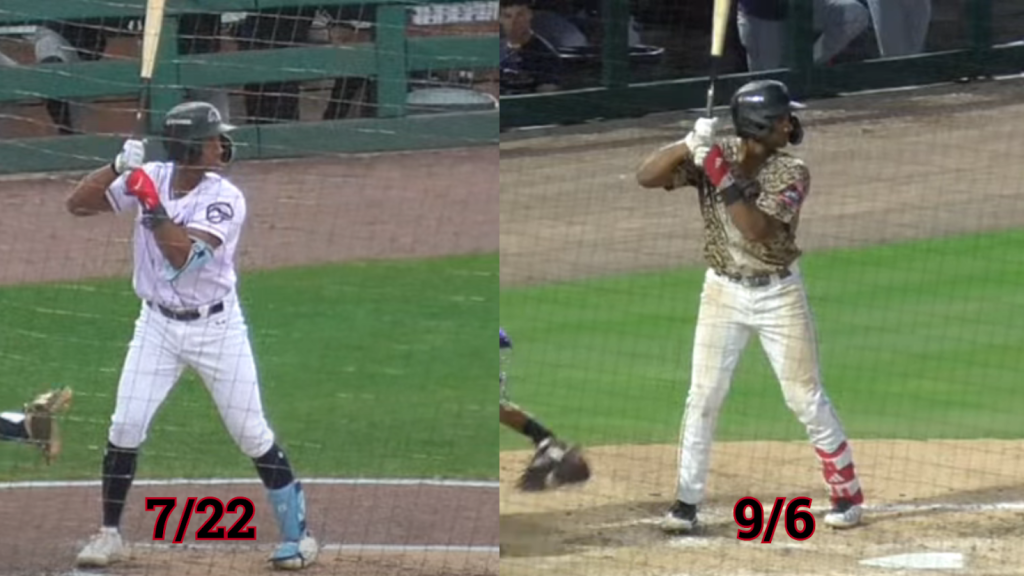
Here, the first change that begins to stand out is the difference in Nimmala’s hand positioning. Back in July, his hands were loaded slightly higher and further behind his head, which often created some drag in his bat path, keeping him from being as direct to the baseball as he’s been as of late.
On top of that, his stance as a whole is much more compact, which will become a theme as we look at more still frames throughout these swings. He’s shortened the distance between his legs, compacted his arms ever so slightly, and is standing taller as of late. This will help cut out some of the unnecessary movement Nimmala has battled with during his swing, once again helping him work more directly to the baseball.
On top of this, he’s not as loaded into his back hip in September, which has been a key change for him. While coiling and engaging the back hip is important, it can be done incorrectly and in a harmful manner if exaggerated too much too early in the swing, as he had done earlier this season.
His back elbow is also ever so slightly raised in September, which is another change to help with his bat path and direction.
Moving to the first piece of his load, we see why a lot of these small changes begin to matter so much.
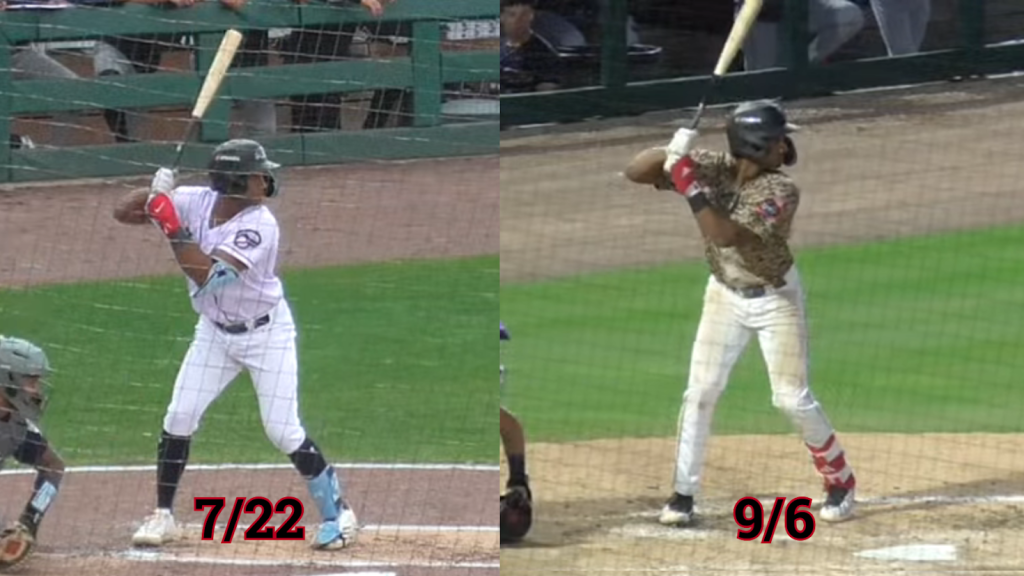
Unlike most big-league hitters, Nimmala’s load is sort of like a hybrid between a toe tap and a gather, as he loads back ever so slightly before striding forward as opposed to a traditional leg kick. This is the still frame of that move, and we can see why a lot of the changes I pointed out in the first frame are important.
Beginning with his hand positioning, in July, they were loaded far further behind his head and lower. This often caused his hands to lag behind the rest of his swing, leading to a longer bat path and a less direct move toward the baseball. In September, Nimmala corrected this by raising his hands, keeping them tight to his body, and keeping his back elbow raised, which also helped his direction a lot.
Overall, the difference in posture is quite noticeable between these two swings as well. Because of how much Nimmala had already coiled into his back hip, you can begin to see him get more stuck on his back side, which hurt him a lot as the swing continued to progress. He’s now using his load as the point where he begins to really coil into his back hip, which has helped him avoid coiling too much.
His move is also much smaller and more compact overall, which, again, is a theme of his entire recent swing.
As he moves into the beginning of his swing, these themes progress even further.
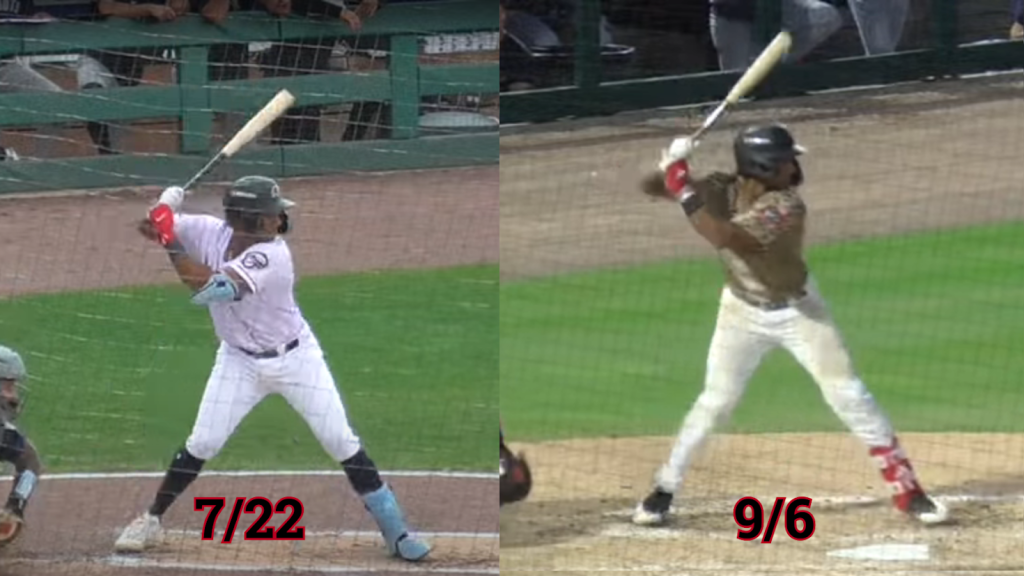
Beginning again with his hands, this is a clear example of how his hands were previously lagging behind him during his load. In July, you can see how his hands are raised almost evenly with the middle of his head, and they’re so far behind him that if you were to draw a line from his hands to the ground, you’d barely touch his back foot on the way down.
In September, his hands are lower, more even with his shoulders, and a lot closer to his helmet. If you were to draw another line from his hands to the ground, this time that line would fall more on the inside of his foot, which translates to one thing: less barrel drag and a cleaner, more direct path straight to the baseball.
In fact, back in July, his entire body was more stacked on his backside, and you can see the detrimental effect this was having on his swing. His back half is already kind of collapsing as a result, and this is no longer the case in September. Rather than his first move being a collapse of the back half, his hips are about to explode and rotate forward, and his hands are about to begin firing.
Heading closer to the point of contact, the differences continue to reveal themselves.
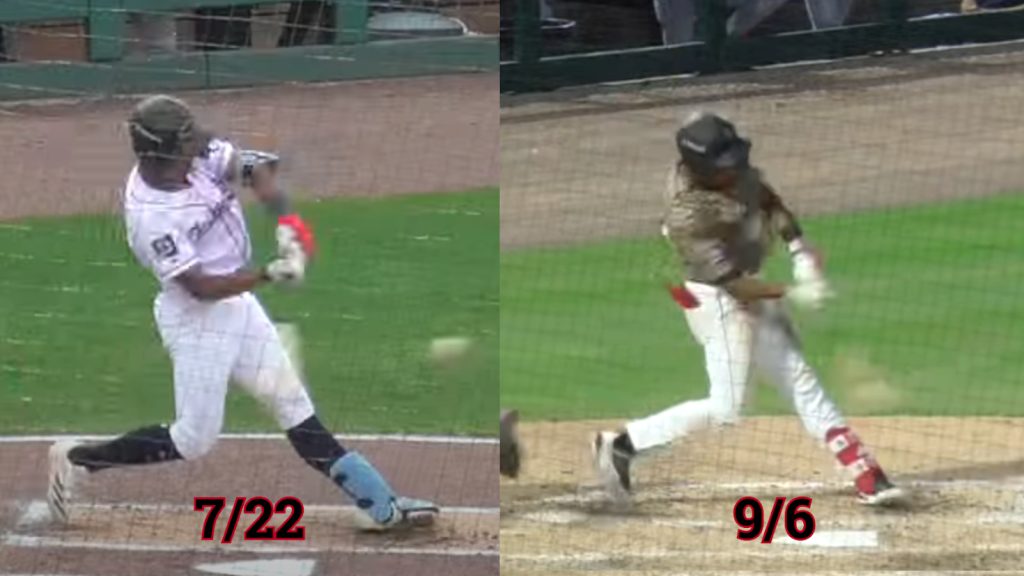
Here, the immediate difference is where Nimmala is impacting the baseball, and it’s a result of the moves we discussed in earlier frames. In July, he’s a lot further behind the baseball due to the slight lag of his hands and being stuck on his back half. Although he’s still square to the baseball with plenty of space in his swing, it’s a less efficient launch position overall.
Fast-forward to September, and this is completely different. Because of his cleaner bat path, he’s able to catch this ball out in front, almost swinging down on the ball to make contact. His posture is a lot better, as his head is above the center of his body, as opposed to being stuck over his back knee in July, which was a red flag that he was stuck on the back side.
As his swing concludes, we see a few final indications of the differences between these two hacks.
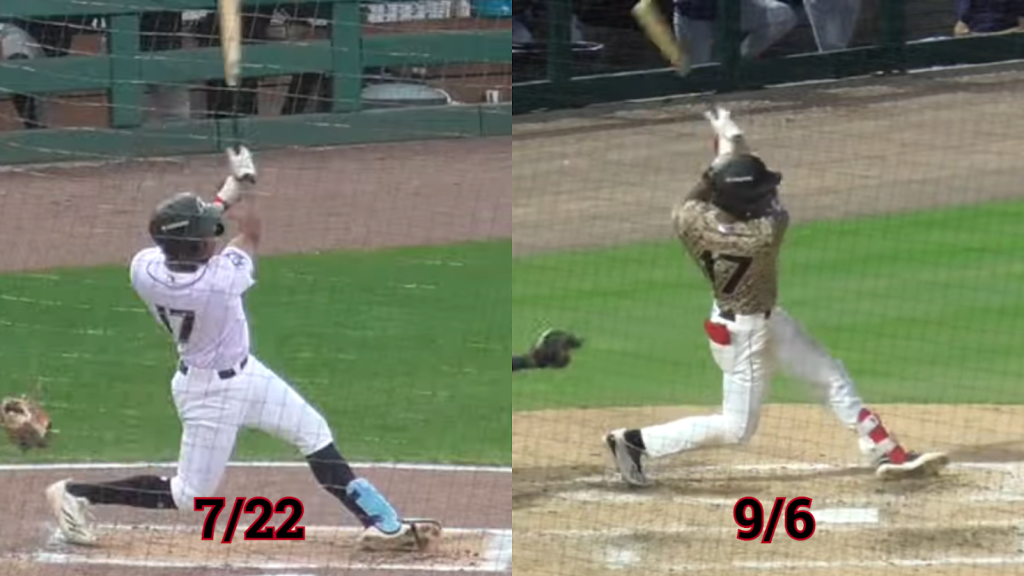
Here, we see the conclusion of these two swings, and a few things jump out to me right away. First, you can again see that his head is stacked more toward the back of his body in July, as opposed to being over the center of his body in September.
In both swings, he’s extending through contact, which is a huge reason why he’s developed more power this season as a whole.
With a cleaner bat path, better posture, and an improved swing overall as of late, it’s no wonder that he’s begun to find even more consistent hard contact during his time with the Angels compared to earlier this year with the Blue Jays.
Is It Time To Buy In?
Seeing the improvements he’s made in terms of added impact by way of calculated swing decisions, we’re left with one remaining question: Is now the time to buy in on Nimmala’s game?
In my opinion, the answer is a resounding yes, absolutely. As we established earlier in this story, few hitters in the major leagues are impacting the ball like Nimmala has while also maintaining good plate discipline and a strong hit tool, which is an immediate signal that he could be a special hitter if this trend continues.
Pairing this offensive profile with a clean swing path that can’t help but remind me of Mookie Betts, as well as defense that received a 55 FV from Aram Leighton in our Top 100, Nimmala grows even more intriguing. This is not the same Nimmala we’ve seen in years past, as he’s added legitimate impact and transformed his offensive ceiling.
With the Angels seemingly becoming more willing to take their time with their prospects and let them develop before challenging them in the big leagues, Nimmala is set up really well to succeed in the near future, and he’s only getting better as time goes on. Two of his 10 hardest-hit batted balls have taken place in September, showing just how good he’s been as of late.
This is yet another budding star shortstop, and now is the time to buy in before the hype train leaves the station.
Become a Member of Just Baseball
Subscribe and upgrade to go ad-free!
* Save 25% by subscribing annually.

Written by
Jay Staph, a huge baseball fan and stat nerd, founded and ran his own baseball writing website, BSBWrites, at just 16-years-old. With focal points around prospects,…