
Trading Brandon Nimmo Unlocked Options for David Stearns’ Mets
By moving off a core member of the New York Mets, David Stearns opened up a world of possibilities for his front office this offseason.
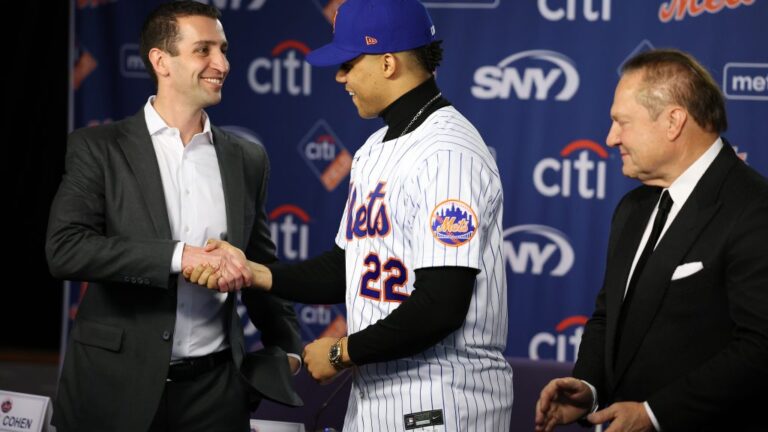
“We believed and still believe that we have to be open to anything.”
David Stearns has put the league on notice: the New York Mets are open for business.
The Mets’ President of Baseball Operations kicked off his offseason on Sunday by completing a stunning trade that sent lifelong Met Brandon Nimmo packing to join another former Met great in Texas (Jacob deGrom).
Considering the fact that Nimmo is entering his age-33 season, still owed over $100 million, and had a full no-trade clause, it seemed like his contract would have been one of the more immovable on the Mets roster.
If Nimmo had remained with the Mets and played out his eight-year, $162 million deal, there is a good chance that the No. 9 would have been hanging in the rafters one day.
Getting a player to give up that personal legacy is not easy, especially when that player is so ingrained in the fabric of your team.
When Nimmo spoke about the trade in a conference call with Texas Rangers media on Monday, he explained the dilemma that he faced about whether or not to waive his no-trade clause.
Nimmo was celebrating his daughter’s first birthday, and talked about how he had just finished a three-year build of a house in Port St. Luvie, which he was hoping to use to host team functions, as the Mets stalwart never expected to play anywhere in his career except for the franchise that drafted him back in 2011.
On the call, Nimmo even remarked that his parents had moved to Port St. Lucie, further showing how out of left field this trade request was.
At the end of the day, Nimmo was sold on the Rangers being an exciting new chapter in his career, going to the place that desperately wanted him, rather than using his no-trade clause to stay with the team that was ready to move on.
Some Mets fans are outraged that Nimmo has been sent packing, while others are just happy the team is going to be different. Stearns made it clear that this trade is the result of an organizational failure, one that can’t be pinned on Nimmo alone, but one that justifies sweeping changes.
“It is a recognition that what we did last year wasn’t good enough. And running back the exact same group was not the right thing to do.” Stearns said.
The Mets endured an embarrassing collapse out of the postseason, losing Game 162 to miss out on a playoff berth via a tiebreaker at 83 wins. The first move in response to the failure was cleaning house on the coaching staff, aside from manager Carlos Mendoza and a few select coaches.
Now, the first transaction of the offseason is trading the franchise’s longest-tenured player.
A fan-favorite who is beloved within the Mets organization. In some ways, a ruthless move, but one that has merits when you consider the last four years of Mets baseball.
In 2022, the Mets won 101 games, but still blew the division to the Braves and lost in the Wild Card round. In 2023, the Mets went from the biggest spenders of the offseason to the biggest sellers at the deadline, completing a fire sale to make the most of a lost season.
In 2024, the Mets went to Game 6 of the NLCS, only to follow it up with another embarrassing season in 2025, where everything fell apart after being the best team in baseball by record in the middle of June.
Trading Nimmo was a way to signal change within the Mets. It was to throw sentiment out the window and focus solely on what makes the Mets a better team in 2026, and puts them in a better position to remain contenders for years to come.
Why Semien is a Better Fit on the Mets Than Nimmo
Right now, there is no fair grade to give the Brandon Nimmo trade, because assessing the deal in a vacuum is not a fair way to evaluate what the Mets just did, as there are so many layers to a trade like this.
If you are just comparing player to player, it is fair to say Nimmo is a better player than Marcus Semien right now. But Semien is not replacing Nimmo on the roster. He is replacing the production the Mets got at second base in 2025.
In 2025, Jeff McNeil was the Mets’ primary second baseman, but they also relied on Brett Baty as well as Luisangel Acuna. If you compare the production the Mets got as a team at second base to what Semien produced for the Rangers, it is remarkable how close the numbers really are.
| Slash line | HR | Runs | RBI | wRC+ | fWAR | |
| Marcus Semien | .230/.305/.364 | 15 | 62 | 62 | 89 | 2.1 |
| Mets 2B | .237/.305/.367 | 14 | 70 | 52 | 91 | 2.2 |
When you consider that Semien’s season was cut short due to fracturing his foot on a foul ball, and his production came in 127 games, compared to the full season for the Mets’ second basemen, it becomes clear that this is an upgrade for the Mets.
Semien is a two-time Gold Glove winner who just won the award for his work in 2025.
While the offensive production has fallen off, Semien still outhomered the Mets group at second, and drove in more runs as well, despite playing 35 fewer games.
If Semien can get into his pull-side power a little bit more playing in friendlier confines at Citi Field, it is not outside the question that he can pop over 20 home runs again.
If the Mets get that, and Gold Glove defense at second base, they will be more than happy to pay the remaining $72 million on Semien’s deal.
Why the Money Matters to the Mets in This Deal
It is easy to scoff at the idea of money mattering to Steve Cohen’s Mets, but as Stearns said on Monday, “payroll space is not unending”. The New York Mets have crowded books. Between Juan Soto and Francisco Lindor, Cohen will shell out over $1 billion to two players alone.
The Mets have huge free agent decisions on Pete Alonso and Edwin Diaz, and Nimmo was still locked in for an annual $20.5 million through the 2030 season.
Nimmo was signed to an eight-year deal after the 2022 season, when he hit free agency as the best center fielder on the market.
Since then, Nimmo has gone from an above-average center fielder to a league-average corner outfielder. Part of that is playing through injuries to stay on the field, but there is also the aging curve of a player who is entering his age-33 season.
If Nimmo reached the point in three years where he was no longer capable of playing a good left field, the Mets would be looking at a DH spot being clogged by Nimmo. Where does that leave Pete Alonso in three years? How about Juan Soto?
The Mets are looking to improve their defense, and since Soto is entrenched in an outfield spot, all eyes turned to Nimmo. Moving off the uncertainty of Nimmo’s next five years compared to Semien’s next three years was attractive to the Mets.
Semien helps the defense at second base and brings a new veteran leader to fill the void that will be left by Nimmo in the clubhouse. Now we mentioned the age curve on Nimmo, so it is fair to point out that the Mets just signed up for Semien’s age 35-37 seasons.
The difference is that if the floor drops out on Semien after this season, the Mets only owe him $46 million over the next two years. If Nimmo’s production tailed off, he would still be owed $82 million over four years after 2026.
This is a move that frees up future spending and keeps the roster more flexible to accommodate a budding farm system.
Counting on the Kids?
This might be the point in the article where you would think it is time to talk about Kyle Tucker and Cody Bellinger, but I think it is more important to talk about Carson Benge, Jett Williams, and AJ Ewing.
In our latest top 100 update, the Mets led the league with eight top prospects that made the list.
Of those eight prospects, four of them are outfielders who finished 2025 in the upper levels of the minor leagues.
Three of those top prospects were promoted to Triple-A together, as the Mets promoted Carson Benge, Jett Williams, and Ryan Clifford to Syracuse on August 12th.
Benge (No. 15 in our top 100) is clearly being factored into the Mets’ plans in 2026, as Stearns has made it a point to swing the door wide open for his top position player prospect this winter.
At the GM Meetings, Stearns was asked about how they viewed their center field situation, and unprompted, Stearns said that Benge would have a chance to win a job in spring training.
Asked again about their outfield mix following the Nimmo trade, Stearns flatly said Benge is going to play, and also mentioned Jett Williams as a big league option for them.
Clifford (No. 99) actually fared the best of the three in their small sample in Triple-A, but his lack of quickness will probably keep him out of the Mets’ outfield plans, even though he has continued to get playing time in both corners. First base or DH at-bats aren’t outside the question for Clifford.
The fourth top 100 outfield prospect the Mets have is Ewing, a fast-rising prospect who started last season in Low-A and finished in Double-A. The 21-year-old went from unranked, all the way up to No. 65 on the top 100, actually ranking a few slots ahead of Williams (No. 69).
There is every chance that Ewing can be the Mets center fielder of the future, while Jett or Benge is their center fielder of the present, all depending on who stands out the most in spring training.
Another option for the Mets is taking their prospect capital into the trade market to try to land a center fielder through trade, like Jarren Duran or Byron Buxton.
With Nimmo and Soto both on the books together for the next five seasons, the Mets were locked into an outfield that only had reps for a center fielder, with two bat-first players entrenched in either corner. Now, the Mets have the flexibility to reconfigure their outfield around Juan Soto.
It can either be a youth movement with a Jeff McNeil placeholder sticking around just in case, or it could be making another big splash to land a Nimmo replacement this winter.
The Mets created the flexibility to have their options opened, while locking in Semien at a position that was much harder to address in free agency or the trade market. The best free agent second baseman was Jorge Polanco, and trade candidates Ketel Marte and Brendan Donovan are going to fetch a haul.
McNeil is a fine second baseman, but my theory is that Stearns is looking to make him a bench piece, where his utility would be even more valuable, rather than being a super-utility guy that gets worn down having to play every day.
Semien does block the second base position for the Mets, but as Stearns pointed out in his presser on Monday, all the young players who have logged time at second base have also logged time at other positions.
Jett Williams has primarily played shortstop, and while his best position in the big leagues may be second base, he has appeared in more games in center field (49) than he has at second (33).
On the big league roster, Brett Baty, Ronny Mauricio, and Luisangel Acuña have all logged time at second base, but Baty and Mauricio are both better at third anyway, while Acuña can play anywhere on the diamond.
The Mets have the ability to trade from their MLB roster with these infielders, or trade from their farm system, while also having the flexibility to play these guys in other positions, rather than second base.
For the Mets, locking a Gold Glover into second base improves their defense now, and long-term, it does not jam up their prospects, as all of them still have avenues to get on the field.
How Does This Impact Jeff McNeil, Pete Alonso, and Edwin Diaz?
The Mets have had a core of players who have been together since 2019, with Jeff McNeil, Pete Alonso, and Edwin Diaz all joining Nimmo on the big league club that season.
McNeil and Alonso were homegrown players in their first full MLB seasons, while Diaz was an adopted Met, coming over in the trade for a 36-year-old second baseman in Robinson Cano (the Mets may have a type).
The core of Alonso, McNeil, Nimmo, and Diaz made the postseason two times in seven seasons, without ever winning their division. It is understandable to move on from any parts of that core based on that fact alone.
With that said, Alonso is still the top right-handed slugger on the market, and Diaz is the best closer. It is going to be harder to replace those guys than it would be to simply re-sign them, and moving Nimmo’s contract only makes it all the easier to get them done.
The Mets are still going to be hesitant to give Alonso anything beyond four or five years, and likely feel the same about going beyond three or four for Diaz. Still, there is a good chance that at least one of these fan-favorites will be back in Queens.
If either or both move on, the Mets will likely turn their attention to other top free agents like Kyle Schwarber or Munetaka Murakami to replace Alonso, or Devin Williams to replace Diaz.
The expectation should be for the Mets to land top-end talent at closer, first base/DH, and likely add a frontline arm to their starting rotation. An outfield addition is a bit trickier due to a thin market for impact two-way players on the grass.
This is where McNeil becomes an interesting safety blanket for the Mets, as he provides insurance at both corner outfield spots, along with second and first base. If the Mets strike out on Alonso, they can always sign Schwarber to DH and platoon McNeil and Vientos at first base.
If they want to wait on the kids to fill their outfield spots, they can use McNeil as a placeholder early in the season for either Jett Williams and/or Carson Benge to get ready in Triple-A.
Many are assuming that since Nimmo was traded, expect McNeil to go next, but I wouldn’t be too sure. If the best they can get back for McNeil is salary relief, they are better off keeping him as a high-end bench piece that fills four spots on the depth chart.
Are the Mets in the Market for a Top Outfielder?
When the news of the Nimmo trade broke, it was not long before sad Mets fans moved past the denial and anger stages of grief, and into bargaining, where they started to wonder if that opens the door for the Mets to get in the top free agent of this year’s class, Kyle Tucker.
Tucker could slide into right field and push Soto to left, giving the Mets arguably the best set of left-handed corner outfielders in baseball.
The thought is tantalizing, but the reality of adding another $300+ million contract on the payroll may not be as appetizing. Just ask the Padres with Fernando Tatis Jr., Manny Machado, and Xander Bogaerts all on the books for the next 8+ years.
Stearns just got out of a long marriage with Nimmo. I wouldn’t be so quick to think that he is going to marry the next player he gets in bed with. Especially not to a 10-year deal.
A middle ground may be Cody Bellinger, who provides the additional versatility of being able to come into the infield and play a good first base.
Similar to how McNeil can provide the Mets with versatility in different places, Bellinger could do the same at first base and center field, while being at his best when playing in the corner outfield spots.
If the Mets signed Bellinger, he could start the year in center field if Benge/Jett are not ready, and then, when one of them is, he could move over and take a corner outfield spot that very well could have been occupied by McNeil.
Then, if at some point the Mets have two young outfielders who are earning playing time next to Soto, Bellinger could come into the infield and push a re-signed Alonso off of first base to the DH spot.
There is a lot of flexibility that Bellinger can bring to the Mets that Nimmo was not, making him more attractive on a five-year deal for the defense-conscious Mets. If Bellinger’s sweepstakes take him past five years, something tells me the Mets won’t be interested.
Another route the Mets can go is the trade market, which offers a few intriguing options.
The Mets could trade for Jarren Duran, who comes with a fixed $7.7 million salary that he agreed on with the Red Sox for 2026, with two more years of arbitration waiting for him after the season.
New York could offer Boston a top 100 pitching prospect like Brandon Sproat, along with Jett Williams, as the foundation of a solid deal to land Duran. They could also float a similar package to Minnesota if Byron Buxton truly hits the trade market.
Again, these are just some of the many options that Stearns and his front office will have at their disposal now that they are in the height of the offseason, with the Winter Meetings less than two weeks away.
Trading Nimmo Gave Stearns Ownership Over the Mets Roster
When David Stearns took over the Mets after the 2023 season, he inherited a lot of mistakes from the past regime. After winning 101 games in 2022, in just Cohen’s second year owning the team, the Mets went bananas in free agency.
They signed Justin Verlander from $43.3 million a season to replace Jacob deGrom, courted and landed Kodai Senga from Japan, signed Nimmo to the aforementioned eight-year, $162 million deal, and extended Jeff McNeil when he still had two years left of team control.
It is fair to say that outside of Senga, Stearns likely would not have made any of those same roster decisions, and let’s not even mention the fact that the Mets nearly signed Carlos Correa to a $300+ million contract after the Giants flagged his physical.
Now, after the Nimmo trade, when you look at the future money on the Mets’ books, Stearns has been responsible for almost every deal except Francisco Lindor’s.
There are two years left with Kodai Senga, who is ‘extremely available’ in trade talks right now, and McNeil is in the final year of his deal. Once those deals expire, every other guaranteed contract (again, outside of Lindor) will have been given out by Stearns’ regime.
This is, and should be, a team built in Stearns’ image, as he was hired to make the Mets the big-market version of his former Brewers team, which just won an MLB-best 97 games in 2025.
The Brewers’ success under Stearns was predicated on pitching and defense, something they continue to excel at to this day. The Brewers roster is full of speedsters who cover a ton of ground in the outfield and are pesky on the basepaths.
When you look at the Mets’ farm system, Jett Williams, AJ Ewing, and Nick Morabito all fit that build.
How the Mets proceed from here is anyone’s guess. It could be a full youth movement in the outfield, or it could be an opening to swing a big move for an established outfielder.
Whatever takes place from here, it will be Stearns who is calling the shots, building what he thinks is the best roster for the Mets moving forward. It is clear Stearns has the full faith of ownership to make these decisions and build the Mets into a perennial winner.
Trading Brandon Nimmo was a bold first move that kicks off what is sure to be a fascinating offseason. It sent a message around the league that the Mets truly were open for business on anything, and it sent a message to the fans that sentiment is secondary to improving the team.
I, for one, can’t wait to see what comes next and how the Mets try to remake themselves to become a World Series contender in 2026 and beyond.

Written by
Ryan Finkelstein has led editorial for Just Baseball since 2021 and officially became the Editor-in-Chief in 2025. He also hosts Locked On Mets, the No. 1…