
Washington Nationals Arbitration Projections and Tender Decisions
A deep dive into the Washington Nationals roster outlook, with projected arbitration salaries and tender decisions to be made this offseason.
Once a team comes up with its projected salary for all of its arbitration-eligible players, it will begin a tender analysis to simply determine: “Are we comfortable guaranteeing Player X this much money?”
If the answer is yes, the player will be tendered a contract prior to the mid-November Tender Deadline. Tendering a contract means the team offers the player a contract for the following season while retaining his rights, with the player’s salary either agreed to later or determined through the arbitration process.
If the answer is no, the player will be DFA’d/non-tendered. Once a player is non-tendered, he is removed from the 40-man roster and becomes a free agent immediately.
The other option a team has is to pre-tender a player, which is a contract agreed to before the Tender Deadline that takes the player out of the arbitration process. This is typically done when a team wants to keep a player, but only at a slightly discounted rate, or when it is a very obvious, typically small raise case that teams like to get out of the way.
This article dives into the market analysis of each case, showing the reasoning behind my leaguewide salary projections, before predicting the tender decision for each player.
All opinions in this article are my own, there was no non-public information used in my analysis.
Washington Nationals Roster Outlook
40-MAN + 60-DAY IL (NON-FA): 45
PENDING FA + MUTUAL OPTIONS: None
OPTIONS: None
R5 MUST ADDS: 3; Jarlin Susana, Travis Sykora, Alejandro Rosario
JOSIAH GRAY (5.075): $1,375,000 ($25k raise)
The Case: Gray returned from a long-term injury at the very end of the season and threw 4 scoreless innings. While the return itself gives him slightly more of a case than a pitcher who missed the entire season, there is not enough platform-year volume to justify any significant movement in salary. I project the typical small increase at this level with a $25K raise, bringing Gray to $1.375M.
Tender Prediction: I believe Josiah Gray will be DFA/non-tendered. The Nationals need to make room on their roster with no free agents coming off and a handful of young SPs to add to protect from the Rule 5 Draft.
Gray is now over 5 years of service, which gives him the right to elect FA and keep his salary if knocked off the roster and he goes through waivers, which is the most likely outcome as he is not a top-eight rotation option for them. Non-Tender.
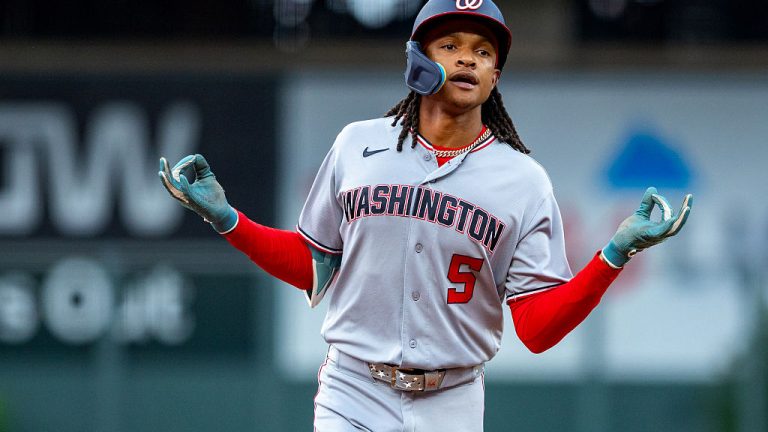
CJ ABRAMS (4.130): $10,600,000 ($6.4M raise)
The Case: Abrams enters his second trip through arbitration coming off a 654 PA season with 33 HR, 34 SB, 106 RBI and a 124 wRC+.
Mookie Betts (2018, $9.6M raise) is the only other player in this market with a 30/30 season, but his offensive quality of 185 wRC+ and winning the MVP creates a ceiling that Abrams cannot get near.
Kyle Tucker (2023, $7M raise) and Teoscar Hernández (2021, $6.325M raise) is the range where this case likely lives. Tucker’s platform season with 674 PA, 29 HR, 112 RBI, 30 SB and a 139 wRC+. The two cases are extremely close in the traditional counting categories: Tucker has just 20 more PA and 6 more RBI, while Abrams has 4 more HR and 4 more SB. The separator is offensive quality, where Tucker’s 139 wRC+ gives him a significant 15-point advantage over Abrams’ 124. Abrams will not reach Tucker’s raise.
Hernández finished his platform season with 595 PA, 32 HR, 116 RBI, 12 SB and a 131 wRC+. Abrams holds the PA advantage with 1 more HR and 22 more SB, while Hernández holds the advantages in RBI by 10 and wRC+ by 7 points. Hernández also finished 19th in MVP voting. Abrams’ significant bulk and speed advantages, combined with playing a premium position at shortstop and the possibility of finishing higher in MVP voting, give him enough separation to get above Hernández’s $6.325M raise
Abrams also provides additional value at SS and could finish higher in MVP voting than Hernández did entering his case. I project Abrams slightly above Hernández at a $6.4M raise, resulting in a $10.6M total salary.
Abrams should receive the highest raise of this season’s Arb-2 position player class.
Tender Prediction: Abrams will be tendered a contract. His representatives could get overly aggressive here and make things interesting, but this should ultimately get done without a hearing. The result of this case could greatly affect other players which will make it get a lot of attention fro MLB and MLBPA. Tender
RICHARD LOVELADY (4.052): $1,350,000 ($350k raise)
The Case: Lovelady signed a $1M free-agent contract after becoming a free agent when he finished the 2025 season off the 40-man roster. Because he was not in the arbitration system there are multiple ways to analyze a case like this, either as a simple raise case from previous salary or using total salary based on career stats of players with similar service time.
Clubs and agents will use whatever avenue favors them more in a case. Ryan Thompson (2023, $350k raise) is a great raise comparison after spending similar time off the active roster between option days and IL days, with both players also being DFA’d and moving teams midseason. They posted very similar bulk by IP, quality by ERA and similar SV+HLDs with a slight edge for Lovelady.
From the career stats view, Julian Merryweather (2024, $1.225M salary) provides a floor with similar career bulk by IP and quality by ERA, while Lovelady has more holds and saves with less IL and option time.
Tayler Saucedo (2026, $1.3M proj. salary) also provides a useful current-class comparison as both entered the season outside the arbitration system with $1M MLB salaries. Lovelady should slot slightly higher because of the additional IP and staying on an active roster all season. Both avenues get Lovelady to around a $350K raise resulting in a $1.35M total salary if tendered a contract.
Tender Prediction: This decision will come down to roster crunch numbers. I think the Nationals would be open to having Lovelady back, but they have a handful of other LHRs coming back from injury who have options available (Poulin, Waldichuk, Parker), which ultimately leads me to predict Lovelady is a DFA/non-tender candidate. Non-Tender.
JAKE BIRD (3.169): $1,050,000 ($75k raise)
The Case: Bird is an odd case because he spent the entire month of September finishing the season on optional assignment. There are not many recent comparisons who finished the platform season on optional assignment.
Adrian Morejon (2023, $50k raise) and Sam Moll (2025, $17.5k raise) are the two recent ones, with Bird throwing at least 2x more MLB innings than both at similarly bad quality. Bird’s representatives will point to some statistically similar comparisons at higher raises, but the end of season optional assignment gives all the leverage to the club side in this negotiation. I project a $75K raise resulting in a $1.05M total salary.
Tender Prediction: Bird will be tendered a contract. The Nationals had him thrown into the Garcia Jr. deal and I imagine they will want to see this out. He has high upside with 2 years of team control at a reasonable cost, and I could see this one getting done pre-tender. Pre-Tender.
JAKE IRVIN (3.152): $4,000,000 ($1.2M raise)
The Case: Irvin threw 106.2 IP across 20 starts with a 5.48 ERA, 2-9 record and 0 Quality Starts.
Adrian Houser (2022, $1.175M raise) made 21 starts across 102.2 IP with a 4.73 ERA, while Aaron Sanchez (2018, $1.2M raise) is the closest historical comparison after making exactly 20 starts and throwing 105 IP with a 4.89 ERA. I project Irvin at Sanchez’s $1.2M raise resulting in a $4M total salary.
Tender Prediction: Irvin will be tendered a contract, and the case should settle without needing to go to a hearing. Tender.
KEN WALDICHUK (3.150): $870,000 ($45k raise)
The Case: Waldichuk only pitched in 5 games before spending the rest of the season on the IL.
Lucas Gilbreath (2024, $25K raise) appeared in only 3 games and recorded 3 outs, while Tejay Antone (2023, $60K raise) also appeared in 5 games but posted the better ERA and pitched in higher leverage. Waldichuk slots right between the two, and I project a $45k raise resulting in an $870k total salary.
Tender Prediction: This depends solely on health. The last update was early 2027 as a target return, in which case I believe they pre-tender him and possibly try to get a split deal out of it to help build optionable RP depth. Pre-Tender.
JACOB YOUNG (3.037): $2,600,000
The Case: Young is a speed/defense first player and enters arbitration with 1,477 career PA, amassing 15 career HR, including 10 in his platform year, leading him to an 82 career wRC+ and complementing the offense with 79 career SB. He has played in over 120 games in three straight seasons, qualifying in one of them.
Geraldo Perdomo (2024, $2.55M salary) represents another speed/defense first comparison entering the market with similar bulk with 1,420 career PA, 15 HR and 34 SB to the tune of an 86 career wRC+. Perdomo had 0 qualifying seasons, though he missed it by 1 PA in his first full season. Both players failed to qualify in their platform seasons with Perdomo posting a 103 wRC+ across 388 PA and Young a 95 wRC+ across 471 PA.
Brendan Donovan (2024, $2.85M salary) is a player higher in the market with similar career bulk, entering with 1,491 career PA and 30 HR to a 120 wRC+. Coming off a qualified season and with the clear wRC+ advantage, Donovan is a clear ceiling that Young cannot get to.
Young slots in right above Perdomo at $2.6M, getting by with the qualifying-season advantage and platform-year PA advantage.
Tender Prediction: Young will be tendered a contract, and the case should settle without needing to go to a hearing. Tender.
MITCHELL PARKER (2.167): $1,150,000
The Case: Parker had been used primarily as a SP until this past season when he was used exclusively out of the bullpen. He has totaled 355.1 IP across 84 games and 59 starts with 22 Quality Starts, pitching to a 5.19 career ERA, but enters the market injured after undergoing internal brace surgery in July, limiting him to only 39.2 IP this season to the tune of a 6.58 ERA.
Joey Lucchesi (2021, $1.15M salary) is likely the best lookback comparison, throwing 38.1 IP to a 4.40 ERA in his platform year in a hybrid SP/RP role before ending the season injured. On a career basis, Lucchesi amassed a similar 337.2 IP while making 66 career starts with 17 Quality Starts and a 4.24 ERA. Due to the similarities entering the market, Parker should receive the same $1.15M salary as Lucchesi.
Tender Prediction: This depends on the health, but I expect a tender. Parker has shown flashes and still comes with 3 years of team control. Tender.
Become a Member of Just Baseball
Subscribe and upgrade to go ad-free!
* Save 25% by subscribing annually.

Written by
Zach Cioffi has seen the game of baseball from both sides of the business, specializing in arbitration, the CBA, contracts, and transactions, with additional professional experience…