
Are Top Prospects Being Traded More or Less Than Ever Before?
Are top 100 prospects being traded more than ever before, or are those trades actually trending down compared to years past?
The history of trading top prospects is complex. The team trading away their youth is often seen as mortgaging their future, with the recipient of the prospect often pushing their competition window further into the future.
In a way, nobody is ever happy with these trades until five years in the future, when prospect dust has actually settled.
When beginning this project, I had an assumption that top prospects were being traded more than ever before. Maybe you have the same assumption.
Farm systems are deeper than ever because talent within baseball has simply gotten better, and with this influx of talent, prospects would appear to be more expendable than ever.
You can simply replace that guy next July using your brand new draft model, or from the recommendation from the analyst you hired to replace your old regional scout.
When diving into my research, noting truly historic trends became difficult. Finding reliable top prospect lists from over a decade ago is hard, and my code was starting to use more bottles of water than my laptop could handle.
So, for this exercise, we’ll be looking at the last 10 years of prospect trades. 2016 was a much different time in baseball, and as you’ll soon see, prospect trades have appropriately shifted with each era of baseball.
The reality is this: top prospects are being traded less frequently than ever before, while trading in general has steadily decreased over the last decade.
However, 2026 appears to be a resurgence. We’ve seen four top prospects traded since January 1st, which is near the top of the list for the most top prospects traded in a 40-day window. 2026 is setting up to be one of the biggest years for trading in recent memory. This article will answer the ‘why’.
A Rise and Fall
I’ve had a hard time trying to figure out why my original hypothesis was wrong. I truly believed that trading was at an all-time high, thinking that GMs were wheeling and dealing more than ever before.
Patience within baseball is at an all-time low. Fans despise rebuilds, and owners are trying to make money, so being competitive is in everyone’s best interest.
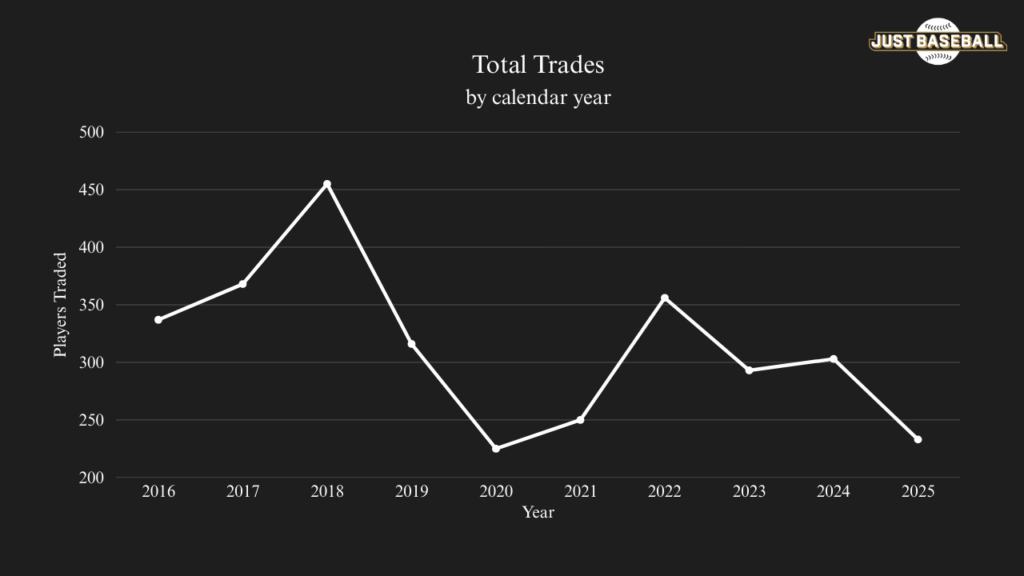
As you can see, trades peaked in 2018 at over 450 unique moves. Public baseball data was starting to boom around this time, with Baseball Savant beginning to take off, giving the public behind-the-scenes access to player value.
Most teams had fully embraced statistical modeling by 2018, but not all, which allowed savvy GMs to make up some value in the margins by executing a boatload of transactions.
Around this time, AJ Preller and Jerry Dipoto were at the peaks of their power, ushering in a new era of management that was constantly transacting.
Trading took a sharp decline in 2019, before bottoming out in 2020 due to the shortened COVID season. The 5-round draft is also a notable factor, with many organizations having less MiLB roster turnover than in previous seasons.
Post-COVID, trades peaked again at 350 unique moves in 2022, still a good distance from the heights of 2018. The past three years have seen trading reach historically low marks, with roughly the same number of trades in 2025 as there were in the 2020 COVID year.
What’s Changed?

There are lots of reasons for trades to decrease over the past decade. The first, most obvious answer, is the shortening of the MLB draft and the elimination of a minor league level.
Following the 2019 season, 40 minor league teams were eliminated, and minor league baseball went from six levels to five. This decreased organizational roster sizes significantly.
The 2021 draft also officially decreased the number of rounds from 40 to 20, aligning itself with one less level of minor league baseball.
So if we step back and examine what was going on in 2018, the trade boom makes perfect sense. Technology and player valuation were booming, and there were more lottery ticket low-MiLB players available to trade for.
The 27th round pick of an organization that was playing ‘Short Season A-Ball’ might pop on your new fancy model, and he was definitely available for a trade if his own team didn’t value him the same.
In short, 2025 has had fewer trades because fewer players are available to be traded for. However, there’s more to the story than just that. Let’s do some quick math to prove this.
How Fewer Players Have Equaled Fewer Trades
In 2018, there were roughly 275 players in each organization. It’s harder to find exact numbers in 2025, but a fair guess would be an average of 250 players in each organization in the present day.
This means roster size decreased around 10% since 2018. But total trades decreased by over 45%. That’s all the proof I need to say that something else is afoot.
While this article is mostly about top prospects, the theory is shared between top prospect trades and overall trades.
There is a strong correlation (R around 0.75) between the number of top prospects being traded and the number of overall trades being executed in a given year. We can also say that about 54% of the variation in the top 100 prospects being dealt is based on how busy the market is, overall.
My main theory is that we are in an era of player development like never before. Scouts are targeting players that fit with their team’s development strengths more than ever before, and with overall draft talent slowly increasing every year, a team can satisfy all its needs in July.
The modern organization choosing to trade for a coveted player by giving up one of their own pieces that they also value, because they drafted or signed them for a reason, doesn’t make that much sense, really.
The technology playing field is more level than ever before. Player valuation has become more standardized than ever before. Fleecing a team for a prospect just isn’t the same as it used to be.
In the past, you might have had data points or scouting intel on a player that another team didn’t have. In 2026, that’s much more unlikely.
Is 2026 the Resurgence?
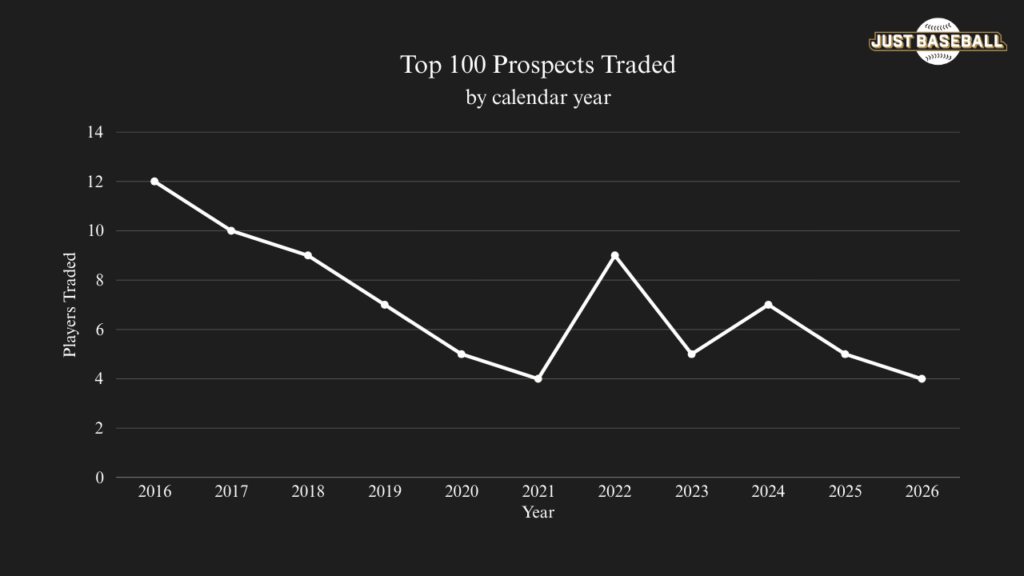
The year 2026 has only been a thing for about 40 days at the time of this piece being written, yet there have already been four top prospects dealt. In 2025, five top 100 prospects were dealt, including Jhostynxon Garcia and Harry Ford being dealt in December.
One important note to this research is that I am using MLB Pipeline’s top 100 for these rankings. Trust me, I want to use Aram and Just Baseball’s incredible prospect rankings, but JB does not have top 100 rankings dating back to 2016, and for the sake of consistency, I had to use Pipeline due to their public and free historic top prospect rankings.
Most of these year-to-year numbers will be pretty similar if we use JB’s modern top 100 list.
Already in 2026, Owen Caissie was dealt to the Marlins, Jurrangelo Cijntje went to the Cardinals, Jett Williams and Brandon Sproat both went to the Brewers.
Typically, over half of the top prospects traded in a year happen at the deadline. Using this thought process, we could easily see double-digit top prospect trades in 2026, which would be something we haven’t seen since 2017.
We already established that top prospect trade numbers correlate with the number of total trades in a year. However, the total number of trades in 2026 is unlikely to increase significantly, so how can we have more top prospect trades without more total trades? The answer is a perfect storm.
When looking at farm system rankings across the league, you’ll notice something very interesting. A LOT of the teams with the best farm systems are also 2025 playoff teams.
The Brewers and Tigers are both top farm systems, with the Guardians, Mets, Mariners, and Dodgers all in the top half of the league. Those six teams have an astounding thirty top 100 prospects according to MLB Pipeline.
Thus, the perfect storm is born. The teams in need of impact MLB help also possess highly coveted prospects. The Cijntje and Caissie deals are great examples of this. Neither prospect makes the team better in the short term, and both teams are in need of short-term help.
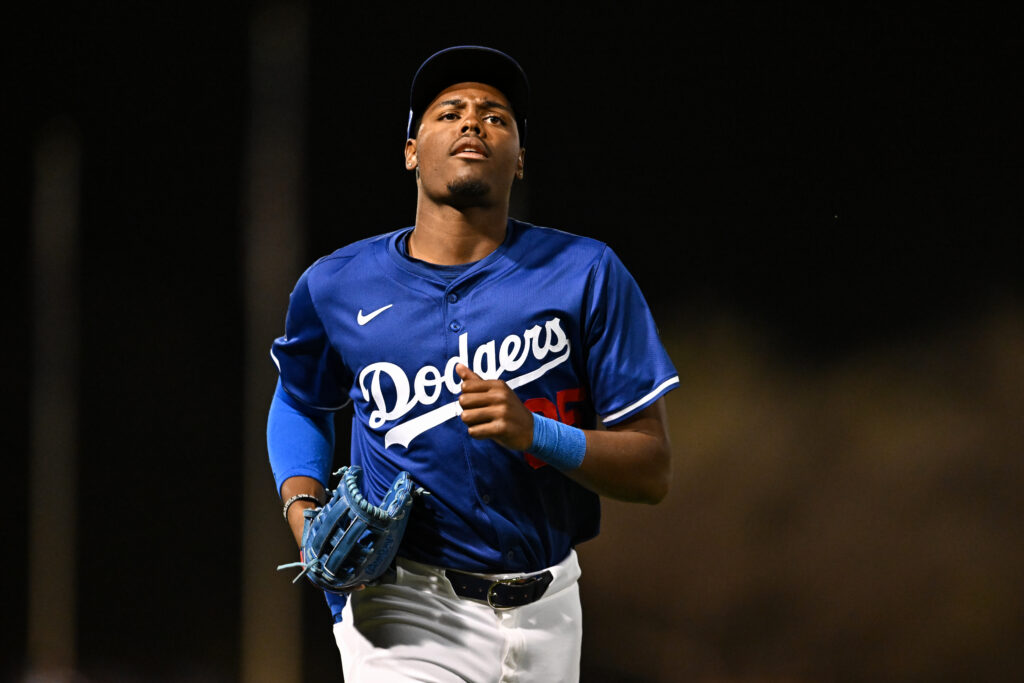
It’s honestly a miracle more top prospects haven’t been traded already. The Dodgers have a plethora of talent that appears to be blocked for multiple years, including three top outfield prospects that will certainly be in discussion at the deadline.
This storm is what could make 2026 a potential outlier year for top prospects being dealt. The overall trade market is not expected to reach previous peaks at 450+ trades per year, so the leftover prospect trade variance is coming from contenders with strong farm systems.
Looking Back at the History of Top Prospects Traded
The last important factor that teams are likely thinking about is how often trading top prospects actually works out. The reality is that the team trading the prospect away wins the deal more often than not.
Let’s take a look at every prospect traded between 2016 and 2021, because we can pretty accurately say if each prospect panned out or not.
2016-2021
- Anderson Espinoza
- Gleyber Torres
- Billy McKinney
- Clint Frazier
- Lewis Brinson
- Dillon Tate
- Grant Holmes
- Frankie Montas
- Reese McGuire
- Alex Jackson
- Yoán Moncada
- Lucas Giolito
- José De León
- Eloy Jiménez
- Dylan Cease
- Blake Rutherford
- Tyler O’Neill
- Jorge Mateo
- James Kaprielian
- Willie Calhoun
- Jeimer Candelario
- Christian Arroyo
- Lewis Brinson
- Monte Harrison
- Francisco Mejía
- Austin Meadows
- Shane Baz
- Justus Sheffield
- J. P. Crawford
- Carson Kelly
- Jake Bauers
- Sixto Sánchez
- Taylor Trammell
- Jesús Sánchez
- Jazz Chisholm Jr.
- Corbin Martin
- J. B. Bukauskas
- Luis Urías
- Matthew Liberatore
- Jeter Downs
- Brusdar Graterol
- Taylor Trammell
- Luis Patiño
- Austin Martin
- Simeon Woods Richardson
- Keibert Ruiz
- Josiah Gray
There are A LOT of names on this list that did not achieve what their prospect pedigree suggested they might. Jazz Chisholm Jr. and Dylan Cease are the brightest spots on a list that is dominated by guys who didn’t pan out at the MLB level.
Teams could see this trend and believe that trading top prospects away is good business. Maybe that could drive more deals in the future.
In the long-term, I would expect top prospect trends to continue at around five top 100 deals per year, with short-term variance coming from what teams possess the most top prospects.
There may be a short-term fluctuation based on the looming MLB lockout, but it’s hard to predict exactly how teams will manage their prospects in that situation.
For 2026 specifically, buckle up and fire up your trade machine. Maybe your personal mock trades on X aren’t that crazy after all!
For fun, here’s the list of every top prospect traded since 2021. It’s too early to say on a lot of these guys, but there are definitely a few more bright spots in early returns.
2021-2026
- Cristian Pache
- Shea Langeliers
- Noelvi Marte
- Robert Hassell III
- Jordan Groshans
- Logan O’Hoppe
- James Wood
- Edwin Arroyo
- Gabriel Moreno
- Luisangel Acuña
- Drew Gilbert
- Kyle Manzardo
- Edgar Quero
- Ryan Pepiot
- Michael Busch
- Gabriel Gonzalez
- Joey Ortiz
- Drew Thorpe
- Robby Snelling
- Dylan Lesko
- Kyle Teel
- Leo De Vries
- Eduardo Tait
- Mick Abel
- Jhostynxon Garcia
- Harry Ford
- Owen Caissie
- Jurrangelo Cijntje
- Brandon Sproat
- Jett Williams
TLDR & Summary
-The overall number of trades has decreased since 2016
-COVID, the draft shortening, and MiLB levels’ decreasing all play roles in trade’s decreasing
-Top prospect trades have decreased since 2016
-New technology and the draft and develop method influence the decrease in trades
-Trading for top prospects is a risky business
-2026 is shaping up to be one of the biggest trade years since pre-2020
Become a Member of Just Baseball
Subscribe and upgrade to go ad-free!
* Save 25% by subscribing annually.

Written by
MiLB/MLB Analysis. Pitching Coach at Bushnell University.