
Despite Power Outage, Riley Greene Is Thriving
Greene is putting up the best offensive numbers of his career, despite a surprising lack of home runs. What's going on?
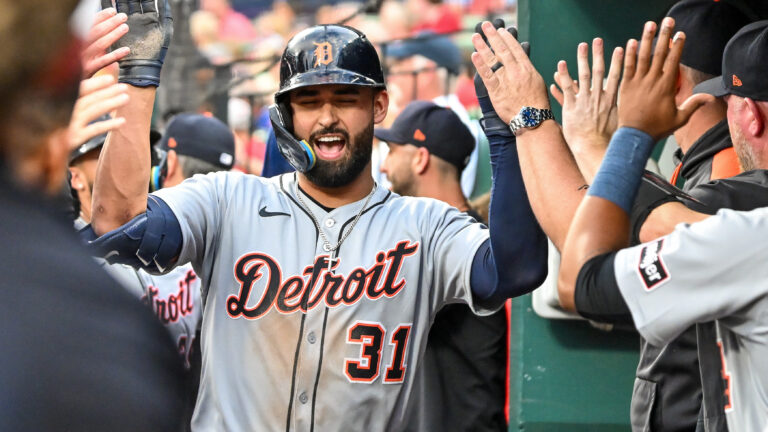
The Detroit Tigers‘ season is off to a miserable start. A number of crucial players are on the injured list, and their offense, which was carried by an unusually high number of career years in 2025, has fallen flat. However, Riley Greene is not one to blame.
Greene, the fifth overall selection in the 2019 draft, was one of the prizes for the Tigers’ rebuild and now is a pillar for the future. After a solid but unspectacular debut in 2019, Greene quickly became an offensive threat and the best hitter in Detroit.
With each passing season, we saw Greene’s power numbers tick up, culminating in a career best 36 home runs in 2026. He became the type of power bat that could fill the middle of the order and give the Tigers a chance to add runs in each at-bat. But, the power came with a tradeoff.
Greene started to chase the fences more and more, and the result was fewer complete at-bats, hot and cold streaks, and a trend towards being more of a one-trick pony. Although, the trick was still very valuable.
What we have seen in 2026 looks completely different. Greene has been able to find a way to bring value to the Tigers’ lineup despite his power taking a fall off a cliff. What has caused this change, and is it ultimately a better fit going forward?
Stats updated prior to games on May 22.
What Has Changed with Riley Greene?
Before we go any further, I need to say that Riley Greene has always been a valuable player. Sure, his cold stretches and high strikeouts drove some fans too far in a negative direction, but the overall production at season’s end was always positive.
The player we have seen in 2026 is a more complete hitter. His .333/.430/.486 slash and 162 wRC+ is not a product of luck or tiny sample size, but a player who is growing and developing. Someone who can “win” in more ways than one, which has allowed Greene to find success through different avenues, providing more value to the Tigers.
Many people thought that Greene needed to make changes in order to become the type of hitter he is now.
“Oh, his swing is far too upper cut, and it is only suited for homers or nothing!” Well, his swing path is one degree different, 44 compared to 45, different from last season. His attack angle is also just one degree different.
His swing is not what has led to Greene’s transformation; it’s his swing decisions.
Greene has always had his fits with breaking balls. When he connected, the results were fine, but connecting on spin was an issue. Each of the past two seasons, Greene has had a whiff rate of 39% on breaking balls. This season? He’s dropped that rate to only 29%, which has resulted in a .372 average on breaking balls.
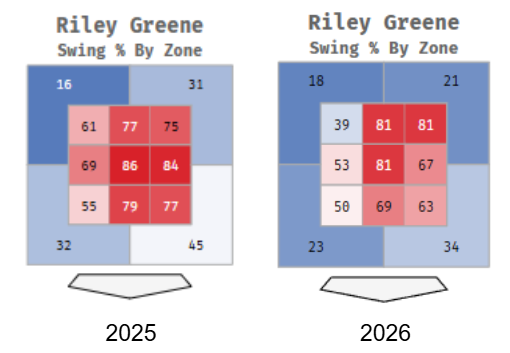
The picture you see above shows his swing percentage, by zone, from 2025 and 2026. A couple of things to note. Greene is laying off pitches low and away at a 9% improvement while also improving by 11% on pitches low and inside. You can also see a change in not swinging at pitches on the outside portion of the strike zone, with rather drastic changes to his overall approach.
By being more selective on outside pitches, Greene allows himself to make the pitcher execute more pitches in areas of the zone that he can do more damage with. Laying off balls allows for more strikes. Simple, right? This is also a reason we have seen his walk rate double over the past season.
We see this change encapsulated by his chase rate, which has improved from 31% last year to only 24% this season. Greene now sees more strikes, which has helped improve his zone contact rate from 76% to 81%, which is just slightly below league average.
Now, we all know Greene is going to swing and miss. That’s part of his game, and I doubt someone with a swing as fast and vicious as his will see his swing and miss drop too drastically, which is why not wasting those swinging strikes on pitches out of the zone that he cannot do much with is so important.
Don’t forget that Greene is not a limited hitter. We all know the type of power hitter that looks to pull everything and hopes he connects on the right spot 30 times a year. That’s not Greene. He has always had an all-fields approach.
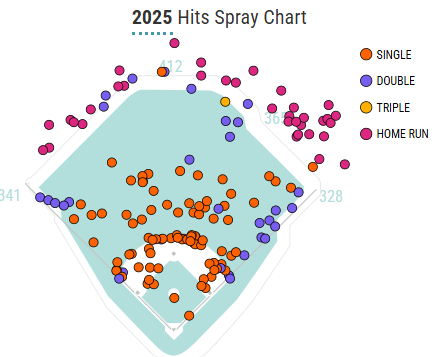
Look at his spray chart from 2025. Beautiful. The power to all fields really stands out. We are still seeing the same all fields approach, but the power has not quite been there. I guess the next question is, can it return?
Optimism for More Power
As refreshing as it is to see more complete at-bats and a safer approach, the Tigers still need Riley Greene to provide power. You can’t have two Colt Keiths out there. Luckily, I do think the power will return, and the changes we have seen will only give Greene more margin for error.
Power requires a combination of hitting the ball hard (exit velocity) and having that contact lifted at optimum angles (launch angle). A few metrics below will show how his 2026 numbers compare to 2025, when he launched 36 home runs.
| Year | Avg. Exit Velo | Avg LA (Degrees) | Barrel % | LA Sweet Spot % | Slg | xSLG |
| 2025 | 89.9 mph | 15.0 | 17.1% | 36.9% | .493 | .494 |
| 2026 | 90.9 mph | 14.9 | 13.2% | 41.3% | .475 | .499 |
As you can see, the numbers are relatively the same. He’s still making hard contact, and he’s producing the same average launch angle. His launch angle sweet spot, which sounds goofy but is important, is actually better.
The only metric standing out as negative has been his barrel rate, which measures the type of contact that leads to the best results.
Last season, Greene had a career-best barrel rate, but he has landed at 13% in the past (2024) and still produced 24 home runs. In fact, the Riley Greene we are seeing is looking like the 2024 version of himself, a player who slashed .262/.348/.479 with a career-best 134 wRC+.
In 2024, Greene had 10 home runs by the end of May. I think it is safe to say we will not see that in 2026, but who could be upset with a .916 OPS? Not me.
What truly matters is that Greene’s quality of contact has not taken a nose-dive in exchange for contact. His bat speed is still near the top of the league, and his quality of contact leads me to believe his power can, and likely will, return.
Final Thoughts
You can find plenty of people who are willing to debate if big power numbers are worth the fall off in other areas of a player’s offensive game. A different debate for a different day. What I can say is this version of Greene, a more selective hitter who’s making smarter swing decisions, is a happy medium that serves him well.
Once the weather heats up, power numbers tend to go in the same direction. I still predict that Greene will reach 20 home runs, which is far from a bold prediction, even with him starting behind the eight ball.
Detroit might need a miracle in order to get back in the thick of the AL Central race, but having a hitter like this version of Riley Greene gives them a fighting chance. Now, it’s time to get healthy and find more contributors throughout the lineup.
Become a Member of Just Baseball
Subscribe and upgrade to go ad-free!
* Save 25% by subscribing annually.

Written by