
Stock Watch: Biggest Risers and Fallers in MLB Through May 21
With Memorial Day weekend approaching, here are players who've seen their stock rise the most as well as others who have seen it fall.
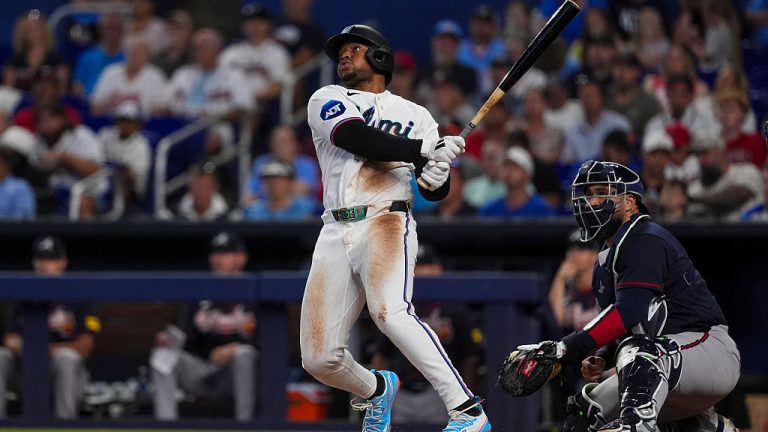
In a couple days, baseball and its fans will begin the celebration of Memorial Day weekend. With that comes the time of year where sample sizes aren’t quite as small anymore and both fast and slow starts for players start feeling a little more real.
It doesn’t necessarily mean that teams are going to start panicking and finding replacements for players who have started off slow, or fully committing to high-performing players for that matter. But it may have them thinking about what adjustments to make to still be competitive by season’s end.
As player performances rise and fall, so does their stock in the eyes of fans and evaluators. Let’s take a look at the following group of players and who come in as some of the biggest risers and fallers across the league.
Stats are from game results prior to play on May 21.
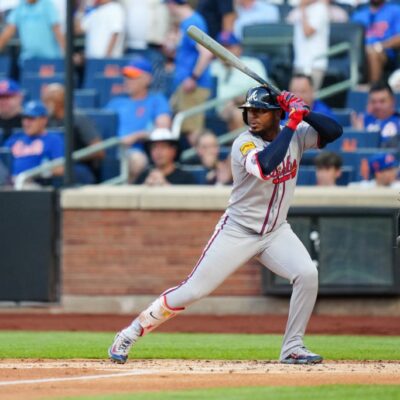
Stock Up
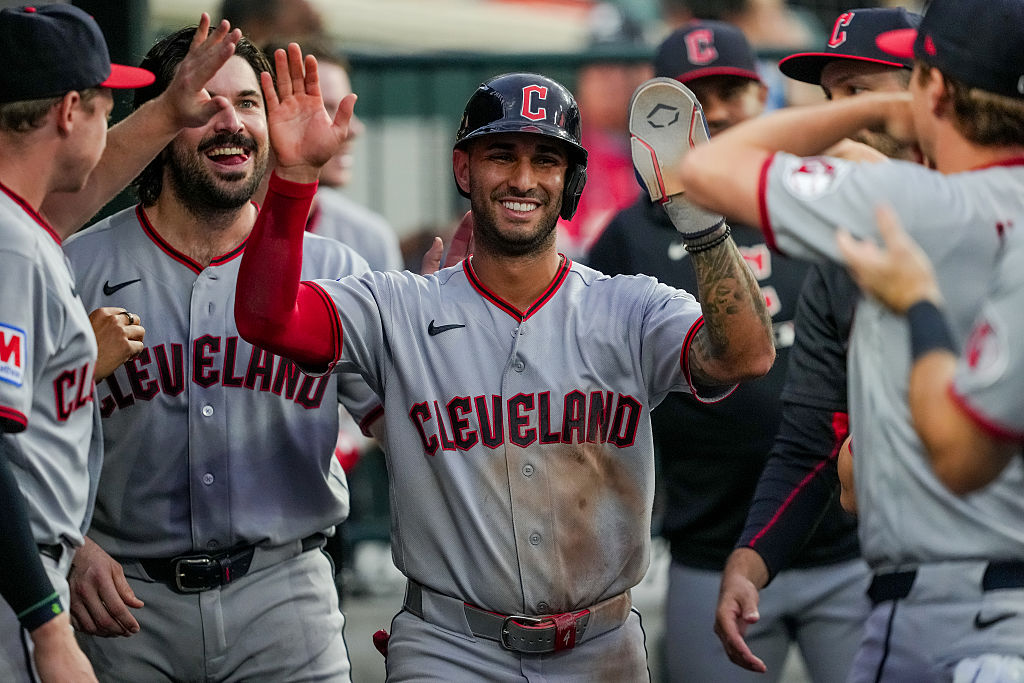
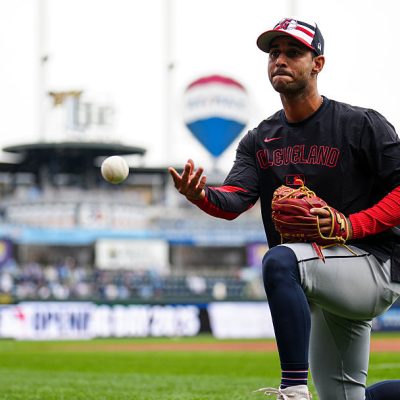
Brayan Rocchio
Prior to his debut with the Cleveland Guardians in 2023, Brayan Rocchio was considered a top-five prospect in the organization. Many felt as though his strong hit tool would translate well to the majors.
But his first three seasons didn’t see that happen. Through 2025 (281 games played), Rocchio hadn’t yet had a wRC+ over 79. His OPS hadn’t yet eclipsed .630 in a season.
Apparently all he needed was a little extra time. Rocchio has come out of the gates swinging (no pun intended) and is blowing away his past production. Through 49 games he’s slashing a sizzling .277/.366/.396.
Rocchio’s four homers are already halfway to his career high of eight set two years ago while his eight stolen bases are already two shy of his career high 10 from the same year. His 121 wRC+ would be nearly 50 points higher than his previous best mark of 79.
Patience has been Rocchio’s virtue. His 47.7% swing rate this season is two percent down from his career average and his 28.7% first pitch swing rate is a whopping 7.4% lower. This, in part, has allowed him to drop his strikeout rate all the way down to 9.9%, which is in the 98th percentile of MLB hitters.
Should Rocchio continue to stay this disciplined at the plate, his production could be relatively sustainable. That would be great for a Guardians team looking to repeat as AL Central champs.
Xavier Edwards
Two years ago, infielder Xavier Edwards burst onto the scene for the Miami Marlins. Though he missed the first half of the season with a foot injury, he’d ultimately slash an impressive .328/.397/.423 with a 129 wRC+ in 70 games, offering a glimpse of the team’s future in the middle of the infield.
Edwards would trend more toward average in his 139 games last season, finishing with a wRC+ of 95. His year also came with a transition from shortstop to second base, one that worked out in his favor as he finished with 11 defensive runs saved and nine outs above average at his new home.
Well, maybe he’s feeling more settled or maybe he’s just bouncing back in general. But in 2026, Edwards is back to looking like an above average threat at the plate for the Marlins.
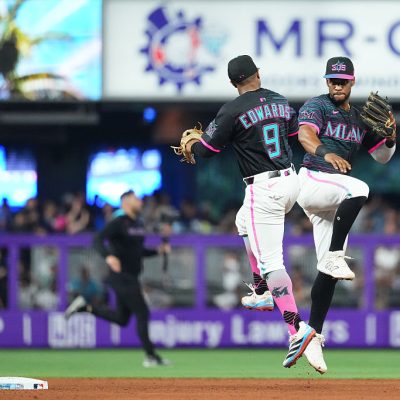
Edwards is slashing .317/.398/.489 with a whopping 151 wRC+ in his first 50 games of the season. HIs on base percentage is currently leading the National League while his six home runs are already a career high and are two more than his total of four coming into the season.
Edwards’ calling card is his ability to get on base, so it shouldn’t come as a surprise that his walk rate dipped from 10.9% to 7.9% from 2024 to 2025. He is back to being patient at the plate with a 11.8% rate that would clock in as a career best.
His extra power numbers are also the result of some much improved bat placement. Edwards’ 6.9% barrel rate is well above his career 2.1% mark while his 40.8% squared up rate is tied for second-best among all qualified MLB batters.
Even if the numbers aren’t fully sustainable, Edwards has proven to be a weapon for the Marlins once again. The performance could propel him to the first All-Star appearance of his career at this rate.
Davis Martin
The second-place Chicago White Sox (yes, really!) have finally been fun for the fans to watch again, though not necessarily due to the performance of the starting rotation. Four of the team’s main starters have ERAs over 4.00 on the season so far.
The one starter performing well, though, might not have been the one fans came into the season expecting to do so. Davis Martin, the 14th rounder from 2018, is not only leading the staff, he’s one of the top starters in the AL to begin the 2026 season.
Martin had never had an ERA under 4.00, an opponent’s batting average below .250, or a strikeout rate above 21.5% prior to this season. Through his first nine starts in 2026, though, he’s crushing those marks at a 1.61 ERA, a .223 average, and a 27.4 K%.
The 29-year-old throws a six-pitch mix, all of which he also used last year. The most devastating of the group is his slider, which was very good last year but has been nearly unhittable this season.
While Martin has dropped his slider usage from 21.5% to 15.6% from year to year, opposing batters are hitting a miniscule .129 against it with a whopping 52.9% whiff rate. A increase of of 3.7 inches in vertical drop and 2.7 inches of glove-side break can do that.
Add a career best 4.7 walk rate that lands in the 95th percentile and it’s easy to see why hitters are struggling against Martin. If some of the other starters can follow his lead, the Sox can reach a level they haven’t seen in years.
Stock Down
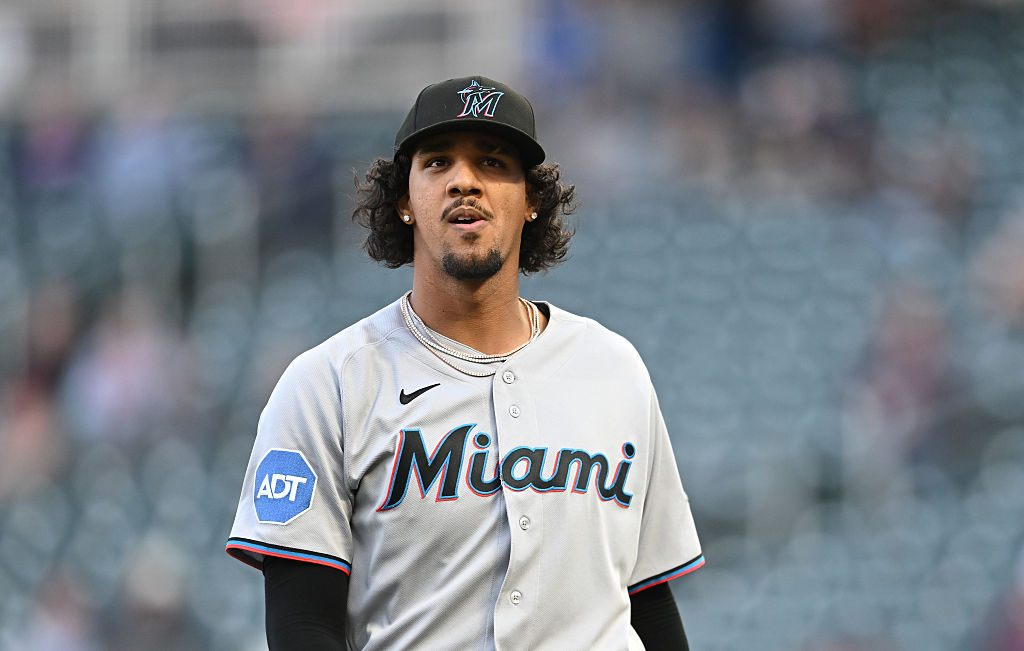
Eury Pérez
Fair or not, lofty expectations have been placed on young Marlins starter Eury Pérez. The 23-year-old debuted three years ago, and tied for seventh in NL Rookie of the Year voting while flashing raw talent worthy of a future star.
After missing a season and a half due to Tommy John surgery, Pérez had up and down results upon his return last year. The hope was that being further removed from injury here in 2026, he would have a chance to return to form.
That has yet to be the case. Pérez has struggled even more so far this season with a 5.33 ERA over his first 10 starts. He’s give up three earned runs or more in seven of those ten outings.
While Pérez’s 25.2% strikeout rate isn’t too far off of his 27.4% career rate, he is letting more runners on base than ever before. His 12.2% walk rate and .234 opponents’ batting average are a jump from his respective 9.2% and .211 career marks.
Velocity isn’t the problem, which can often be a concern after a major injury. In fact, five of his six pitches are actually up in velocity over last year.
And yet, Pérez is getting squared up on more than in the past. Even though his hard hit rate and average exit velocity are right near his career averages, opposing hitters are barreling him up at a 14.3% rate, much higher than his 10.9% rate for his career.
Regardless of what’s causing the poor numbers, Pérez is not performing to the best of his ability. If he were, Miami could be in an even better place right now.
Jarren Duran
This offseason, many mused about whether the Boston Red Sox would trade from their surplus of outfielders, primarily Wilyer Abreu or Jarren Duran. Right now, fans might be wishing the team had moved on from the latter.
Abreu is having another solid year, on pace for a career best season. Duran, on the other hand, is trending in the complete opposite direction and is in the middle of one of his worst starts ever.
Through 44 games, Duran’s slash line is way down at .195/.266/.362 with both the average and slugging percentage trending to be career lows. His 71 wRC+ would be his lowest since his 33-game rookie season and is a far cry from the 121 he’s put up over the last three seasons combined.
A few things stand out. Duran is both swinging at few pitches in the zone (63.7% versus 67.5% for his career) and chasing more pitches out of the zone (35.4% versus 30.5%). One can imagine, then, why his whiff rate has also escalated (33.9% versus 27.7%).

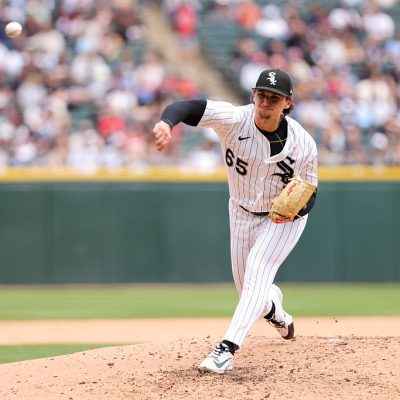
And while Duran’s barrel rate (9.7%), average exit velocity (90.3 mph), and bat speed (74.7 mph) are all near or above career marks, his hard hit rate is somehow down (41.1% versus 44.1%).
To his credit, Duran’s expected weighted on base average of .299 is higher than his actual .281, so it’s possible there’s a little bad luck at play.
Either way, the actual results are well below Duran’s, and Red Sox fans’, expectations. Boston is well behind the pace in the AL and a turnaround from Duran could help them start to make up some ground.
Vinnie Pasquantino
The Kansas City Royals have been a bit of an offensive wasteland to start, sitting second to last in the AL at just 3.88 runs per game. A slow start from their starting first baseman certainly isn’t helping.
Vinnie Pasquantino signed a two-year contract this offseason, buying out his first two arbitration years. Whether it’s the pressure of a new contract or general struggles, the Royals are not getting their money’s worth.
Pasquantino is slashing just .194/.279/.326 with a 68 wRC+, all easily on their way to being career lows. He has just three extra base hits in the month of May (a double and two homers) and just three hits total in his last 26 at-bats.
One big concern is a decline in bat speed, which has clocked in at 69.6 mph against a career of 71.7 mph. Because of this, his hard hit rate is down a whole eight percent at 36.2% versus 44.2% for his career. His average exit velocity is also down to 88.9 mph from 90.6 mph.
In addition to that, Pasquantino has become more pull heavy, hitting 49.3% of balls to his pull side, and is hitting over two thirds (50.4%, 13th-highest among qualified hitters) of balls up into the air.
A struggle with mechanics could explain much of the issues here, though there haven’t been specific reports on that. This is the first season that has seen Pasquantino really fight through things, so perhaps there is hope on the horizon.
Become a Member of Just Baseball
Subscribe and upgrade to go ad-free!
* Save 25% by subscribing annually.

Written by
Matt Carroll is a writer for Just Baseball and former site expert at Reviewing the Brew. He studied journalism at the University of Wisconsin-Madison and currently…