
Playing GM: 3 Moves to Complete Houston Astros Roster for 2026
The Houston Astros missed the playoffs for the first time in a long time in 2025. These offseason moves will help them avoid that fate again.
The 2025 campaign presented the Houston Astros with unfamiliar territory. When Game 162 concluded, so did their season.
For the first time since 2016, the Houston Astros watched all of the postseason from their sofas. The Astros aren’t foreign to roster turnover, but the departure of Alex Bregman and the trade of Kyle Tucker changed the trajectory of the organization.
Suddenly, a team that always found a way to do enough couldn’t get out of its own way.
With all of that said, the 2026 offseason promised to be an interesting one for Houston. All-Star southpaw Framber Valdez hit free agency, having already begun falling out of favor because of “Crossup-Gate.”
As a result, the rotation became entirely right-handed — even more so with the acquisitions of Japanese star Tatsuya Imai and former Pittsburgh Pirates right-hander Mike Burrows.
The offense is still talented, with intriguing young players such as Cam Smith and Zach Cole primed for increased contribution in 2026. However, even with the pitching acquisitions, they shouldn’t be done eyeballing ways to improve the roster.
This is a continuation of our “Playing GM” series. This trip takes us to Houston, where a much-maligned organization looks to return to the mountaintop. But how can it do it?
Here are three moves to complete the Astros roster heading into the 2026 campaign.
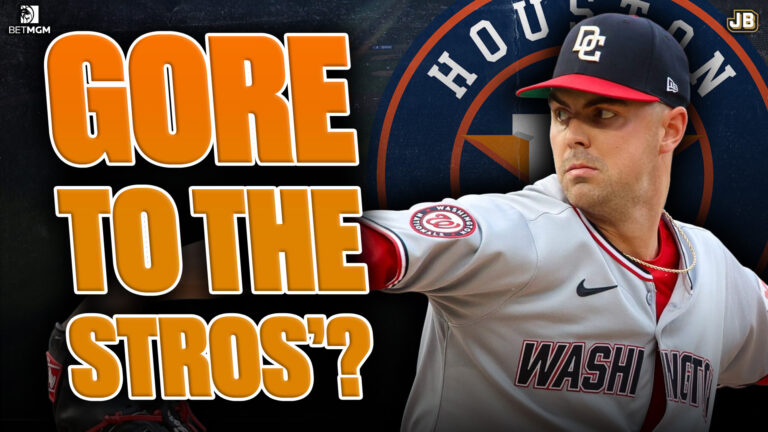
1. Trade Four Players for MacKenzie Gore
As mentioned, the pending departure of Valdez leaves the Astros without a lefty starting pitcher. Fortunately, the Washington Nationals aren’t shy about their willingness to listen on the ace left-hander.
It was a tale of two seasons for Gore in 2025. It’s clear he’s talented enough to be among the game’s best; it’s just about sustaining that production deep into the season.
At the All-Star Break, the almost 27-year-old had a 3.02 ERA, a 2.96 FIP, and a 30.6% strikeout rate in 110.1 innings. He was so dominant, he got selected to his first All-Star Game.
After the break, he went into a tailspin, posting a 6.75 ERA in 11 starts. Overall, he settled into a 4.17 ERA and 2.9 fWAR. But beyond the run prevention, he had four pitches that exceeded a 35% whiff rate. His slider is especially nasty, holding opponents to a .195 average and a 40.5% whiff rate.
Trade Return: IF Brice Matthews (JB’s No. 2 Astros Prospect), IF Xavier Neyens (No. 1), RHP AJ Blubaugh (No. 9), and OF Kevin Alvarez (No. 10)
The acquisition cost, despite the second-half fall-off, is still high. Matthews played just 13 games at the MLB level last year, with mixed results. But in Triple-A, he posted a .371 OBP with 17 home runs and 41 stolen bases. He does have some whiff concerns, but was 80th percentile for chase rate among Triple-A hitters.
Of the remaining three, only Blubaugh has MLB service time, posting a 1.69 ERA in 32 innings in 2025.
The 25-year-old was a heavy fastball-usage guy in Triple-A, yet still increased usage of the offering in MLB to tremendous results. He’s been a starter all throughout the minors, but doesn’t have much opportunity to break camp in the MLB rotation for Houston.
He’d have much greater opportunity in D.C., not just for the rotation, but the majors in general.
Neither Neyens nor Alvarez has affiliated ball experience as professionals. Alvarez played 47 games in the Dominican Summer League, slashing .301/.419/.455 with more walks than strikeouts.
He’s also a physical specimen at 6-foot-4 and, at just 18 years old (on Jan. 13), very well could become more physically imposing as his body matures.
Neyens was the team’s first-round pick last season but didn’t make his professional debut. He’s got some whiff concerns, but he went in the first round for a reason.
2. Sign Right-Hander Evan Phillips to a One-Year Deal
Phillips made just seven appearances in 2025 before an elbow injury ended his season in May. After undergoing Tommy John Surgery, his expected timeline takes him out until at least late 2026.
That said, he’s one of the most effective relievers in baseball over the past half-decade.
Since his first full season with the Los Angeles Dodgers, he’s sixth among qualified relievers with a 2.14 ERA. Relievers in his tier make $16-plus million a season; at $4 million, the Astros only need him to be that guy for about six weeks.
Houston has elite relievers already in southpaw Josh Hader and right-hander Bryan Abreu, but there’s always room for more. At worst, it’s a waste of $4 million. But for a savvy organization like the Astros, this is the exact kind of deal they’d benefit from.
3. Trade Jesus Sanchez to the Detroit Tigers for Prospects
The Astros acquired Sanchez at the deadline last year, but the marriage didn’t work. In 48 games, he slashed .199/.269/.342 with just four home runs.
That said, he’s cost-controlled for two seasons and remains a decent power source among left-handed hitting outfielders. With the Tigers looking for more offense, Sanchez could be enticing to them.
As for Houston, it should be finding more opportunities for the aforementioned Cole and Smith to contribute. Having Sanchez creates a logjam that only takes away from their playing time, namely, Smith’s.
Trade Return: C/1B Eduardo Valencia (JB’s No. 16 Tigers prospect) and LHP Blake Dickerson
Valencia isn’t a sexy prospect, but he mashed his way to Triple-A in 2025. He’s not necessarily a long-term catcher, but the bat plays. In Triple-A, he was 94th percentile for expected wOBA and 91st percentile for barrel rate.
The good news is the Astros need a short-term backup catcher with first base potential as they wait-and-see-it with Christian Walker. Not that they’d be against giving him another chance, but there have been reports that he’s available this winter.
As for Dickerson, the 2023 12th-round pick only has 10 career professional outings. He’s essentially a dartboard throw for the Astros, who could use a facelift in their pitching prospect pool.

Written by