
10 Takeaways From a Turbulent Offseason for the Boston Red Sox
The Red Sox may have failed to re-sign Alex Bregman this offseason, but they are still in prime position to contend in a loaded AL East.
 | |
| | 
There is no soap opera in baseball these days quite like the Boston Red Sox.
Being in the headlines is nothing new for a team that has won four World Series Championships this century and plays in one of the most ravenous sports markets in the country, but the Red Sox rollercoaster has been turned up to another level this decade.
The two most defining moments of Red Sox baseball since 2020 have come away from Fenway Park with the trades of franchise cornerstones Mookie Betts and Rafael Devers.
Though both were dealt under very different circumstances, the willingness to move on from two homegrown superstars only raised questions about the team’s commitment to winning, a sentiment not helped by the franchise’s mishandling of an Xander Bogaerts extension.
Despite all of the talent that has been pushed out the door, the Red Sox proved they were a team on the rise in 2025, making their first postseason appearance in four years on the strength of a rebuilt pitching staff and an emerging young core.
The team’s success only added to the pressure for Chief Baseball Officer Craig Breslow to add aggressively this offseason, particularly after comments from team president Sam Kennedy at the outset of the offseason.
“We need to build on what he saw this year to try and take that next step forward,” Kennedy said on the “310 to Left” podcast. “And yes, the American League East needs to be the goal. Winning the American League East.”
If the Red Sox were dead-set on returning to the top of the AL East, however, their actions through the first three months of the winter could only be defined as underwhelming.
Separate trades with the St. Louis Cardinals for starting pitcher Sonny Gray and first baseman Willson Contreras added two proven veterans to the mix, but hardly moved the AL East needle, particularly in the wake of the Toronto Blue Jays’ signing of ace Dylan Cease.
On the free agency front, the Red Sox were outbid by the division rival Baltimore Orioles for first baseman Pete Alonso, a player who seemed like a perfect fit for a power-deficient lineup.
When the Colorado Rockies signed Michael Lorenzen on January 15, the Red Sox became the only team that had not signed a major-league free agent this winter.
The Red Sox’s lack of aggressiveness created angst throughout the fanbase, and that angst quickly shifted into rage with the revelation that third baseman Alex Bregman would be departing for the Chicago Cubs.
It had seemed like a forgone conclusion that Bregman would be retained, given how seamlessly he had acclimated to both the city and the clubhouse, but the Red Sox’s passive approach to his contract negotiations and refusal to budge on the inclusion of a no-trade clause allowed the Cubs to come in and steal him away.
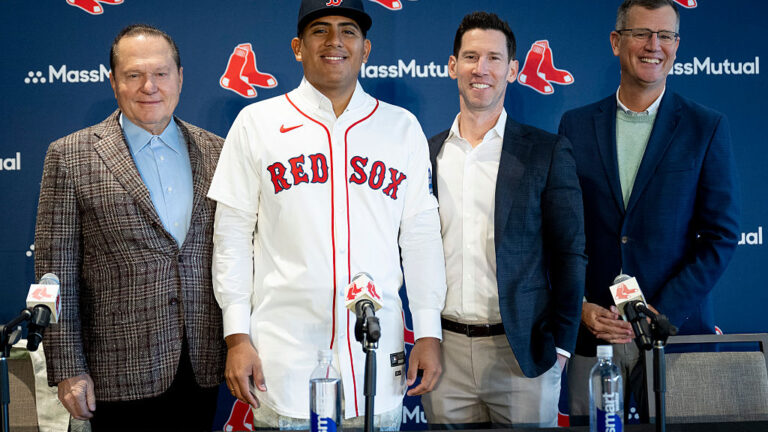
Yet just when all hope seemed lost, the Red Sox finally demonstrated the decisiveness the fanbase had been waiting for all winter. The signing of All-Star left-hander Ranger Suárez to a five-year, $130 deal not only represented the biggest free-agent expenditure of the Craig Breslow era but also strengthened what might be the best starting rotation in baseball.
Here are 10 thoughts on the departure of Bregman, the arrival of Suárez, and what comes next.
1. The Red Sox blew the Alex Bregman negotiations
Regardless of how you think Bregman will age during his five-year deal and the ensuing pivot to Suárez, there is no getting around the fact that the Red Sox blew the Bregman negotiations.
Though his on-field performance was hampered by a mid-season quad injury, Bregman’s leadership and connection with the club’s emerging young core proved to be invaluable during a tumultuous 2025 season.
There is no question that the Red Sox valued what Bregman brought to the table. If they didn’t, they wouldn’t have offered him a five-year,$165 million deal, a contract they have been notoriously cautious with for players in their 30s.
With the lengths the Red Sox were willing to go to keep Bregman around and Bregman’s desire to keep playing in Boston and for Alex Cora, there was a clear pathway to getting a deal done. Yet like so many times in recent years, the Red Sox couldn’t close.
They refused to budge on including a no-trade clause, a reasonable request by Bregman given their unfortunate tendency to trade stars before. They refused to budge on the structure of long-term deferrals despite clearly having enough money in the budget to give him cash up front.
Most importantly, they failed to take the threat of the Cubs seriously, holding their ground on their offer rather than taking Boras and Co. at their word that they had a better offer.
The Red Sox treated these negotiations like Bregman was a player they wanted to have rather than a player they needed to have, a bizarre strategy given how evident it was that he was their Plan A.
They only wanted Bregman on their terms, which is just not how free agency works.
You have to be willing to get a little bit irrational and accept that the last couple of years of the contract are not going to give you a 100% return on investment.
The Red Sox were not willing to do that, and the result is that they are once again left with egg on their face.
2. The Devers/Bregman situation was a self-inflicted, unmitigated disaster
One thing I want to make clear is that the Red Sox should not have paid Bregman just because they traded Devers. That is the definition of a sunk-cost fallacy, as a Bregman extension wouldn’t have erased the damage of trading Devers.
If the Red Sox were going to pay Bregman, it should have been because they believed he would be worth the contract, not to make up for a mistake they made six months ago.
At the same time, the fact that the Red Sox lost two All-Star third basemen in the span of the calendar year is a catastrophe of their own doing.
They bungled the communication with Devers about their pursuit of Bregman last winter, and they bungled the contract negotiations with Bregman this winter.
If they had been transparent with Devers from the beginning and offered Bregman the five-year, $165 million contract last winter, both players would still be on the roster, and the lineup would be far better than currently constructed.
Of course, the elephant in the room is that the Red Sox may not have really wanted to pay either of them long-term and felt that there were better ways to allocate that money. We have already begun to see the pivot with the signing of Suárez, but the lineup is still a major work in progress.
The pressure will be on Breslow to adequately replace the production Bregman and Devers would have given them this year, and a failure to do so will only make a disastrous series of events look even worse.
3. The Red Sox were not sold on Alex Bregman long-term
As much as Red Sox fans grew attached to Bregman during his season in Boston, his on-field performance raised some serious red flags. After a red-hot start, Bregman suffered his second serious quad injury in five years on May 23, which was initially expected to sideline him until the end of August.
Through an expedited rehab process, Bregman was able to return right before the All-Star break, but he clearly wasn’t the same player upon his return. He slashed just .180/.273/.262 from August 23 on and recorded just six extra-base hits in 139 plate appearances.
As much as they may have respected Bregman as a competitor and a player, the Red Sox never had any desire to pay him top-of-the-market money into his mid-thirties.
It’s why they held firm on their three-year offer last winter and only landed Bregman because he was willing to bet on himself for a year.
Bregman’s 2025 performance did little to change the Red Sox’s mind. Aside from the injury and second-half slump, his middling batting ball profile is not one that ages well. Bregman has been able to boost his power numbers by pulling the ball in the air at one of the highest rates in the league, but that is a dangerous game to play if he loses a couple more points of exit velocity.
Take third base contemporary Nolan Arenado, for instance. Like Bregman, Arenado never hit the ball particularly hard but maximized his slugging by pulling the ball in the air at an extraordinary rate.
Yet after posting an average exit velocity between 87.8 and 89.4 in every season from 2016 to 2023, the last two seasons have seen that number drop to 86.8 and 86.3, respectively.
As a result, Arenado has hit a combined 28 home runs in his age 33 and 34 seasons after hitting at least 26 in each of his previous eight full seasons, resulting in his two worst seasons by OPS since his rookie season. Though Bregman is a more complete hitter than Arenado, his struggles at the end of last season may have foreshadowed a similar power drop-off in his mid-thirties.
All of this is to say that the Red Sox had little confidence that Bregman’s on-field production would be worth the $160 million deal he was set to receive. The only way they were willing to give him five years was to water down the AAV with deferrals and by retaining the ability to trade him if his production bottomed out.
Understandably, Bregman went with the team that offered more present-day and total value and gave him the security of a no-trade clause. Perhaps the Red Sox breathed a minor sigh of relief, but the pathway to upgrading the lineup for 2026 became a lot more difficult.
4 . Free-agency whiffs have become an unfortunate Craig Breslow theme
The jury is still out on Breslow’s tenure, but we have enough data from his first two seasons to confidently assess his strengths and weaknesses.
On the plus side, Breslow has lived up to his billing as a pitching guru, completely overhauling the pitching pipeline and finding gems in his acquisitions of Garrett Crochet, Aroldis Chapman, and Justin Slaten.
He also has proven apt at extending young players, locking up Brayan Bello, Ceddanne Rafaela, Kristian Campbell, Crochet, and Roman Anthony.
When it comes to the free-agent market, however, Breslow has not been nearly as successful. His first winter was a disaster, coming up well short in his bids for Seth Lugo, Teoscar Hernández, and Shota Imanaga and instead landing reclamation project Lucas Giolito.
While the Chapman singing last winter worked out better than anyone could have expected, Breslow also handed a one-year, prove-it deal to Walker Buehler, who had just posted a 5.38 ERA with the Los Angeles Dodgers in 2025.
The hope was that Buehler could regain his All-Star form another season removed from Tommy John surgery, but he would post even worse numbers in Boston before getting released in September.
As strange as some of Breslow’s free-agency processes have been over his first two offseasons, this winter may have been the most confusing of them all.
After Breslow explicitly talked about the need to add more power to a lineup that finished 27th in second-half home runs, the Red Sox didn’t show much interest in a reunion with Kyle Schwarber and came up well short in their bid for Pete Alonso, two players who combined for 94 home runs last year.
With those two sluggers off the table, Breslow turned his attention to retaining Bregman, but his negotiation strategy didn’t reflect a player they viewed as a top priority.
The Red Sox seemed content waiting for Bregman to come back to them rather than set the market, opening the door for a team like the Cubs to swoop in and steal him away.
That, at its core, is the issue with Breslow’s approach to free agency.
The Red Sox clearly had the money to spend on any of the three aforementioned stars, as evidenced by the $26 million AAV they shelled out to Suárez. What they lacked was a refuse-to-be-denied attitude towards landing their Plan A.
The Red Sox are simply far too comfortable putting their eggs in 50 different baskets and waiting for the perfect target to come to them on exactly their terms.
That’s not how a big-market team should operate. If there is a player that they feel convicted on, they should do whatever it takes to land that player.
There are obvious exceptions to this, such as when the San Diego Padres blew everyone out of the water with an outrageous 11-year contract to Xander Bogaerts, but neither of the contracts given to Alonso nor Bregman reached that level of absurdness.
If you truly believe that Alonso has the capability of transforming a lineup in 2026, you can’t be willing to lose him over the difference between a four-year and a five-year deal.
If you truly value everything Bregman brought to the organization on and off the field, you can’t be willing to lose him over the presence of a no-trade clause and the structure of deferral payments.
The quick pivot to Suárez was an encouraging sign of decisiveness, but Breslow needs to be better at executing his Plan A earlier in the offseason.
5. There is a serious leadership void in the Red Sox clubhouse
As much as I love talking stats, there is a human element to baseball that cannot be quantified.
The Red Sox were a tough and resilient group last year, in large part because they just…seemed to like each other?
It might seem silly to care about whether a group of professional baseball players seems to get along, but there was an objective amount of good vibes with the Red Sox last year.
At the center of everything was Bregman, who brought necessary championship experience to a team without any and took rookies Marcelo Mayer and Roman Anthony under his wing.
His ability to connect with the team and the city in such a short amount of time speaks to the kind of teammate and competitor he is, and losing his presence in the clubhouse may be just as impactful as his bat in the lineup or his glove in the field.
In addition to Bregman, the Red Sox also saw platoon outfielder Rob Refsnyder depart for a one-year, $6 million deal with the Seattle Mariners.
While obviously not as impactful on the field as Bregman, Refsnyder has become a respected veteran presence during his four years in Boston and could always be counted on to work a professional at-bat.
So who will fill the leadership void? The obvious candidate is Trevor Story, who already begun to take charge during a resurgent 2025 season.
Depending so heavily on a guy who averaged just 57 games in his first three years in Boston, however, is a dangerous task, especially considering Story has been known to go through frightening month-long slumps where he is borderline unplayable.
Barring a trade, Jarren Duran can also step into a deeper leadership position, but you would like your team leader to have fewer defensive and baserunning lapses.
Garrett Crochet is certainly the leader of the pitcher staff, but can only make so much impact while playing every five days, while Roman Anthony and Carlos Narvaez are likely too young to fully take charge.
I won’t worry too much about the makeup of the Red Sox as long as Alex Cora is the manager, but it will be difficult to replicate all the things Bregman brought to the Red Sox last season.
6. The Red Sox deserve credit for a quick and aggressive pivot
This offseason has felt eerily similar to the 2024 Winter Meetings. The Red Sox made an aggressive offer to Max Fried but came up just short to the Yankees, who were willing to go an eighth year.
Besides losing the best free-agent starting pitcher to their archrival, the Red Sox came under fire for extending themselves to an uncomfortable length but failing to close the deal.
Less than 24 hours later, the Red Sox made their pivot. With their trade for a Garrett Crochet, the Red Sox got what turned out to be a better, younger pitcher at a lower price, albeit with a substantial prospect cost.
Though no one would confuse Suárez with Crochet, the Red Sox once again deserve credit for decisively pivoting to a secondary target.
The decisiveness that they showed in closing the Suárez deal was exactly what Red Sox fans wanted to see this winter and is hopefully a sign of a lesson learned from the Bregman catastrophe.
7. What the Red Sox like about Ranger Suárez
As important as velocity and fastball shape have become, there is something to be said about knowing how to pitch. Suárez is a complete throwback in the way he attacks hitters, using all five pitches and all four quadrants of the strike zone.
Take a look at the first clip again. That’s Vladimir Guerrero Jr., one of the best hitters in the game, completely frozen on a front-door, two-seam fastball at just 91 miles-per-hour. You can only do that if you have an advanced understanding of how to sequence pitches and set up hitters.
Compared to other soft-tossing left-handers, Suárez has actually posted a respectable 23.2% strikeout rate last season, thanks in large part to a changeup that registered a 33% whiff rate.
Both Suárez’s changeup and curveball ranked in the top 12th percentile in terms of runs value, more than making up for a pedestrian fastball.
Suárez’s ability to change speeds and present different looks to opposing hitters has also made him a master of generating soft contact.
He ranked in the 98th percentile in hard-hit percentage and in the 95th percentile in average exit velocity last season and has never rated below the 70th percentile in either category.
The ability to create weak contact is generally considered a sustainable trait, and Suárez should only get better in that area as his understanding of pitching grows.
Suárez has demonstrated that he can dominate with middling velocity, providing hope that he can continue to be a frontline starter into his mid-30s.
Though small-sample-size postseason statistics cannot be overstated, Suárez’s 1.48 ERA proves at the very least that he is not intimidated by the big moment. You also don’t have to worry about how he will adjust to the difficulty of playing in Boston, as Philadelphia may be the only non-New York media market that is more pressure-packed.
We can argue about whether the decision to give Suárez $26 million a year was the correct pivot after missing out on Bregman, but even the most pessimistic of fans can’t deny that the Red Sox just added a very good pitcher to what might be the deepest rotation in baseball.
8. What are the red flags with Ranger Suárez?
No matter how good your control and secondary pitches are, you have a minuscule margin for error when your fastball barely exceeds the 90 mph threshold.
Suárez’s 91.3 mph average four-seam fastball velocity ranked 302nd out of 327 qualified pitchers last year and was the 10th-lowest mark among full-time starting pitchers.
It is also worth noting that Suárez’s velocity in 2025 was the lowest of his career, over two mph slower than his 2023 mark. Of course, that also coincided with his best season as a full-time starter, but Suárez could be in dangerous territory if he loses another tick off his fastball.
Along with his velocity, much has been made of Suárez’s lengthy injury history. He has missed time in each of the last four seasons with a variety of back, elbow, and hamstring issues, resulting in him failing to ever reach the 162-inning threshold to qualify for an ERA title.
None of these injuries was especially significant or particularly concerning in the long term, but it is worth tempering expectations for Suárez as he enters his age-30 season. He is not a guy like Crochet, who is going to work 200 innings and throw 110 pitches every start.
The Red Sox are going to need to be careful with the six-foot-one-inch left-hander and be prepared for the occasional injured-list stint. Fortunately, the Red Sox have enough pitching depth to withstand an abbreviated workload and ensure that he is all-systems-go for more October magic.
9. The Red Sox have put their money where their mouth is
The Red Sox talked a big game about their plans this offseason, repeatedly saying their postseason return in 2025 was just the first step and that their goal was to get back to winning division titles.
While we can argue about whether the players they acquired were the right ones, there is no question that the Red Sox have lived up to their promise to aggressively add to their current roster.
With the additions of Contreras, Gray, and Ranger Suárez, the Red Sox have added roughly $65 million in 2026 salary, more than any other team but the Baltimore Orioles, Los Angeles Dodgers, Chicago Cubs, New York Mets, and Toronto Blue Jays.
Their $269 payroll projections would be the highest mark in team history, and they currently sit around $4 million above the second CBT threshold for the first time.
Yes, the Red Sox are still stubborn, and yes, they still have whiffed on a number of key free agent targets, but their willingness to act like a big-market team for the first time since the Dave Dombrowski days is encouraging.
10. Everything is about what comes next
If Suárez is the last move the Red Sox make this winter, this offseason would have been a failure.
As it stands right now, their offense is not good enough to seriously compete in the American League, making their win-now acquisitions of Contreras and Gray essentially moot.
Though Suárez obviously does not fix their offensive deficiencies, it does position them better to acquire a big bat via trade.
With 10 MLB-caliber pitchers competing for just five rotation spots, the Red Sox can afford to part with either of their prized left-handed pitching prospects or an established arm like Brayan Bello.
The ideal fit for the Red Sox would be Arizona Diamondbacks second baseman Ketel Marte, who they were connected to throughout the Winter Meetings.
The Diamondbacks have reported interest in both Payton Tolle and Connelly Early, as well as Jarren Duran, and have an infield surplus after acquiring Nolan Arenado.
As obvious as the fit seems, however, Diamondbacks general manager Mike Hazen made the unconventional step of declaring that Marte was off the market, and The Boston Globe’s Alex Speier reported on Friday that the door is still “firmly shut on a trade.”
With a Marte trade apparently off the table, the next most feasible option may be Houston Astros third baseman Issac Paredes, who is without a clear spot on the roster after the mid-season acquisition of Carlos Correa.
Though his defense leaves a lot to be desired, the 27-year-old has posted an OPS+ of 121 over the last three seasons and has the batted ball profile to succeed at Fenway Park.
St. Louis Cardinals second baseman Brendan Donovan and Chicago Cubs second baseman Nico Hoerner are also potential trade candidates, but come with their respective caveats.
Donovan would be the Red Sox’s third trade with the Cardinals this winter and would add to an already lefty-heavy lineup, while Hoerner is a free agent after the 2026 season and would do little to fix the Red Sox’s power outage.
If Breslow wants to get creative, he could flip one of his pitching prospects for an unproven position player with upside. One possible candidate is the Cubs’ Matt Shaw, the former top prospect who is now without a clear spot on the Cubs after the Bregman signing.
Regardless of which pathway the Red Sox choose, it’s abundantly clear this lineup still needs help. While the Suárez trade might have eliminated any possibility of signing a free agent bat, it created a golden opportunity to acquire a bat via trade without damaging their pitching depth.
Written by
Daniel Fox is a contributing writer for Just Baseball. He has previously written for Pitcher List, BoSoxInjection, and in the Cape Cod Baseball League. He is…