
Nolan Arenado Is a Picture-Perfect Match for the D-Backs
On Tuesday, the Diamondbacks acquired eight-time All-Star Nolan Arenado. Here's why the move was a slam dunk by Arizona.
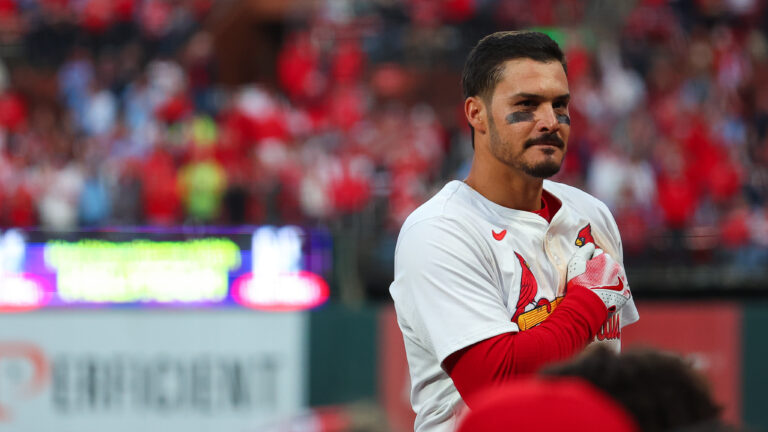
On Tuesday morning, the St. Louis Cardinals and Arizona Diamondbacks agreed to a trade that sent potential future Hall of Fame third baseman Nolan Arenado to the desert along with a lot of cash in exchange for minor league right-handed pitching prospect Jack Martinez.
This trade helped both parties in significant ways, but perhaps the Diamondbacks got the better end of the stick.
Mainly, Arizona is on the hook for just $11MM over the next two seasons for Arenado. Considering the price of high-profile contracts being handed out this offseason, Arenado has ample opportunity and ability to provide extreme value for Arizona at that price.
If Arenado could bounce back to provide 1-2 WAR apiece per season, he could give Arizona in excess of $30MM of value that would make the trade a win.
Plus, this trade gives Arizona a hungry veteran who wants to win and compete for a couple of years. He not only stabilizes third base, but he can also be a model that young players can mimic and learn from in terms of how a professional plays baseball.
Arenado walks the walk instead of talking the talk. He can be a clubhouse leader for Arizona, especially on the field, while doing things the right way with a burning passion to win in the dugout. That’s value that doesn’t show up in the box score that will be greatly beneficial for Arizona moving forward.
Arenado chose Arizona as well by waiving his no-trade clause. He wants to play for them, as he lived in Scottsdale for many years. He wants to win in Arizona, and the D-Backs are hungry to get back to the postseason. It’s a picture-perfect match, and Arenado will be a big piece in getting the Diamondbacks back to October baseball.
How Does Arenado Help Arizona?
The 34-year-old (35 in April) brings a steady presence to Arizona’s defense and lineup. First, let’s discuss the defense, as that’s Arenado’s calling card and perhaps the attribute that will get him into Cooperstown.
Over 880.2 innings at the hot corner, he recorded just five errors in the 2025 season. He had +6 defensive runs saved and +3 outs above average, two very strong numbers. While they aren’t Gold Glove-caliber, they clearly indicate that he’s still a high-quality defender that could perhaps give Arizona the best defense at third base that they have ever had in franchise history at that position.
Arenado recorded 0.9 dWAR per Baseball reference, while also ending the year with +2 Fielding Run Value according to Baseball Savant. His arm strength remained around league average with an average of 83.4 mph.
Overall, he will be able to cement his spot as the starting third baseman and help improve the defense for Arizona. In return, that will help the pitching as fewer runners will reach base.
Acknowledging the Declining Offensive Production
Now to address the elephant in the room: What’s to make of Arenado’s steadily declining offense?
Well, 2025 was the worst offensive season of his career. However, can it be taken just on its face? Could there have been some mitigating factors? Before judging the surface numbers, let’s take a look at some of those factors.
First, Arenado had a strong start to the season. He was the typical Arenado of old. Through 38 games and 144 at-bats, Arenado had an OPS of .766 with 10 doubles and four homers, along with only 17 strikeouts and 17 walks. From May 14 on, he started to struggle some.
Later in the season, it came out that Arenado was dealing with multiple injuries, including one to his right shoulder. That injury later caused Arenado to miss six weeks in the season. Now, it’s not known when the injury happened, but it could certainly explain the drop off in power and hitting from 2024 to 2025.
Arenado is far too talented to just drop off completely from a 103 wRC+ to an 84 wRC+ that quickly. It’s quite possible that the shoulder injury was impacting his swing, as his power output fell to career-lows. He was still maintaining other key attributes such as his strikeout rate.
Arenado struck out just 11.2% of the time, which was in the 96th percentile, while he whiffed only 17.9% of the time. He also made squared-up contact at an above-average rate of 28.8%. The power just wasn’t there. He did chase more than he has in his career at 33.9%, which led to a very low walk rate of 6.4%.
However, it’s certainly possible that the injured shoulder affected his ability to hit for power. Then, the Cardinals’ lineup was not exactly a juggernaut. Opposing teams could pitch to Arenado pretty aggressively since there was no one of note behind him. Willson Contreras and Brendan Donovan were the only protectors.
That will change with him on Arizona’s vaunted offense. With a strong foursome of Corbin Carroll, Ketel Marte, Geraldo Perdomo, and Gabriel Moreno, Arenado will be quite protected. Plus, Lourdes Gurriel Jr. will come back sooner, which will only further lengthen the lineup.
In addition, it’s quite possible, and perhaps even likely, that Arizona adds another bat to the lineup before spring training.
If Arenado can get healthy, that plus the improved lineup protection could certainly lead to a career rebound. That’s in addition to moving to a ballpark that is easier to hit for right-handed power at Chase Field than in Busch Park.
Not to mention he’ll get to play more games in Colorado now being in the NL West, and overall a change of scenery might be what the doctor ordered to get his play back on track.
Better Days Ahead in the Desert
While his base numbers were lackluster — just 1.3 bWAR, .237 batting average, .666 OPS, 12 home runs, 52 RBI, and only 28 walks — it’s fair to say that this season was just not good.
However, there were aspects of it that were encouraging, generating hope for the future if he’s able to stay on the field for 140-plus games.
He was unlucky to a certain degree, as he had a career-worst BABIP of just .241. For reference, his career average is .288. Even if he bumped that 2025 mark up to .260 or so, his rate stats would be far better.
He wasn’t overly pull-happy, despite that being where most of his hits landed. Plus, he lowered his ground-ball rate and raised his hard-hit rate from 2024, which is an encouraging sign.
Another promising part of his season is that he did far better against left-handed pitching. Over 102 at-bats, Arenado hit .294 with an OPS of .741 against southpaws. With Arizona having struggled in recent years against left-handed pitching, Arenado will certainly assist them in improving there.
Plus, if he can just make a bit more damage, those numbers could leap off the page should he be near a .294 average again.
Then, one final factor that could see Arenado do better this season and seriously help the D-Backs offense is his history at Chase Field. Although Arizona brought him in for his defense and leadership, any improvement in offense is a cherry on top and could help catapult Arizona back into the playoffs.
Over 77 games at Chase Field, Arenado has hit .280 with an OPS of .841. He has 13 homers, 25 doubles, and 54 RBI. He has 84 hits and a slug of .507. Clearly, he is comfortable with Chase Field and able to hit there. It doesn’t end there, either. To dig even deeper, check out this post below that better highlights his advanced marks at Chase Field:
Overall, while there has been valid concern regarding his declining bat, there’s plenty of reason to believe that better days are ahead for Arenado with his new ball club. He gets a chance to reset and get back on track with a team looking to compete for a World Series title, and the D-Backs will hope he can be the spark that gets this team back to the postseason.
Final Thoughts
The Arizona Diamondbacks needed a veteran leader and a third baseman. They were able to accomplish that in one fell swoop by acquiring an eight-time All-Star and 10-time Gold Glover.
He can add to his 57.8 career bWAR and complete his Hall of Fame resume in the desert. Not only can he be the team’s best defensive third baseman perhaps of all-time, but, as was just mentioned, his bat clearly plays at Chase Field.
Not to mention that there is a lot of hope for him to improve upon his 2025 numbers in 2026. He is far better than that output. Plus, at the rate Arizona is paying him, he needs only to be around league average offensively with plus defense to be a strong standout player for Arizona.
He’s the latest piece that general manager Mike Hazen has acquired in his push to get back to the playoffs in 2026 after missing them the last two years. On the surface level, this move looks to be a slam dunk for Arizona.

Written by
Jake Oliver is a Baseball Reporter covering the Arizona Diamondbacks for Just Baseball. He is a former reporter and prospect writer for Diamondbacks On SI and…