
Keep an Eye on the Mariners’ Back-End Bullpen Trio
Headlined by one of the best relievers in MLB, the Mariners have one of the premier back-end bullpen trios in baseball heading into 2026.
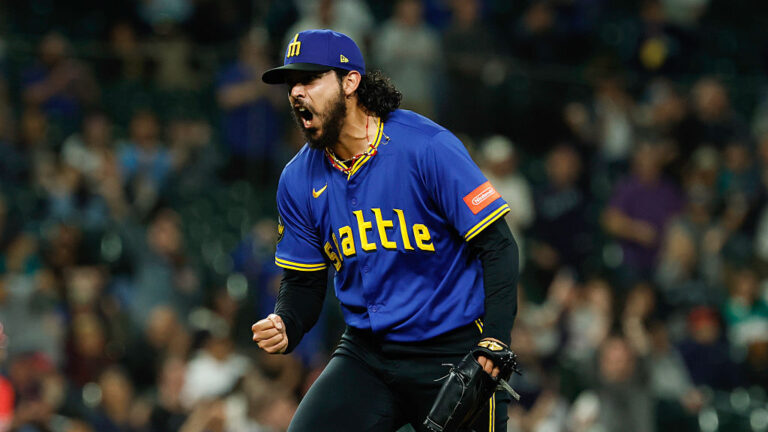
Fresh off an American League West title in 2025, the Seattle Mariners remain one of Major League Baseball’s top teams. Led by Cal Raleigh and Julio Rodríguez, the squad remains hungry and will be back in the hunt for their first World Series title in 2026.
That crusade may be led by the aforementioned stars, as well as one of the league’s strongest rotations. But an overlooked part of Seattle’s roster may very well end up being the most important: their bullpen.
Although the bullpen held a 3.72 ERA this past season, it was one of Seattle’s biggest weak points in close games. They’ve attempted to remedy that trouble this offseason with the additions of LHP Jose A. Ferrer and LHP Robinson Ortiz, who will join the already established set of Eduard Bazardo, Gabe Speier, Matt Brash, and Andrés Muñoz.
With several high-leverage arms, the Mariners’ bullpen is one of immense potential, especially at the back end. Let’s dive right into why you might want to keep an eye on this bullpen trio.
Seventh Inning — Jose A. Ferrer
Back in December, Seattle bolstered their bullpen with the addition of Jose A. Ferrer, one of the more underrated relievers in the game. Now, heading into the 2026 season, the 26-year-old left-hander looks to be a key part of the Mariners’ bullpen.
If you look at Ferrer’s stats from this past season, nothing immediately jumps off the page. After all, a 4.48 ERA isn’t the most impressive of feats. But if you were to dig deeper, you’d see that the Mariners found a gem. During that same season, Ferrer managed a 3.03 FIP, 3.09 xFIP, and 3.56 xERA.
So, why was there such a gap in Ferrer’s expected outcomes and his actual performance? The answer: an abysmal Nationals infield defense.
Ferrer is one of the best ground-ball pitchers in the game, inducing grounders 64.3% of the time in 2025, which ranked in the 99th percentile.
His exceptional ability to keep the ball on the ground was met with a Nationals infield that managed -35 outs above average (OAA), one of the worst marks across all of Major League Baseball. The situation Ferrer found himself in wasn’t exactly his fault, which is why expected stats appear so favorable.
As for his pitch mix, Ferrer relies primarily on his sinker, which sits at 97.7 MPH, and frequents the offering 61.8% of the time. He also utilizes a changeup (21.9%), four-seam (8.8%), and slider (7.5%).
Those offerings break well, with Ferrer inducing more than 2.9 inches of horizontal break above average on his four-seam, sinker, and changeup. The three pitches tunnel well off each other and serve to fool opponents.
With a more sound infield defense behind him, Ferrer forecasts as an above-average reliever for 2026. If he can live up to his potential, the big lefty will be a problem for opposing hitters and provide the perfect segue into the rest of the Mariners’ bullpen.

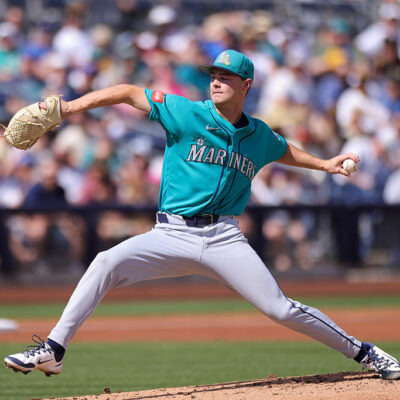
Eighth Inning — Matt Brash
After missing Matt Brash for the entirety of the 2024 season as he recovered from Tommy John surgery, the Mariners welcomed back one of their most lights-out relievers this past May. Even with 581 days between outings, Brash didn’t look rusty at all, and he even looked like the pre-surgery pitcher that Mariners fans know and love.
In 53 outings and 47.1 innings pitched, Brash sported a 2.47 ERA, 3.05 FIP, and 3.03 xFIP, all while striking out 29.1% of opposing batters. He also excelled at limiting damage, allowing hard contact just 30.6% of the time and holding average exit velocity to 86.9 MPH.
Brash’s ability to avoid hard contact is largely a result of his movement profile, with each of his offerings playing off each other in a way that causes confusion for hitters at the plate.
The right-hander’s slider is one of the best in the game, breaking 15.8 inches glove side. Brash held opponents to a .250 xWOBA with the offering while inducing swing-and-misses 36.0% of the time. While Brash relies on the slider heavily (60.6% usage), he complements his go-to pitch with a sinker (21.5%), changeup (11.9%), and four-seam (5.2%).
Those other offerings tunnel well, with each having above-average movement relative to the same pitch types from other right-handed pitchers. Brash also excels at limiting pulled fly balls, with opposing hitters’ pull-air rate never exceeding 12.7% in a season.
After squaring up against Ferrer, opposing lineups will be met with another challenge in the eighth inning once Brash steps to the mound. All signs point toward repeated success for the 27-year-old heading into 2026 — a great sign for the Mariners, and something for the rest of the league to dread.
Ninth Inning — Andrés Muñoz
For years now, Andrés Muñoz has been hailed as one of the best relievers in Major League Baseball. The 27-year-old right-hander isn’t letting up anytime soon and will be the final arm seen by opposing hitters in a duel with the back end of the Mariners’ bullpen this coming season.
Since becoming the ninth-inning option for the Mariners, after Paul Sewald was dealt at the 2023 trade deadline, Muñoz has shut down opponents and helped secure several key victories. This past season, Muñoz truly excelled in the role, securing 38 saves (third most in the majors) while pitching to a 1.73 ERA.
The majority of that success can be attributed to his advanced pitch mix, which contributes to some of the highest strikeout numbers among all relievers. Muñoz attacks hitters with four offerings: his slider, which he uses 50.4% of the time, four-seam (35.1%), sinker (12.4%), and changeup (2.1%).
The slider is far and away Muñoz’s best pitch, racking up 15 Run Value and a 51.4% whiff rate. Muñoz also induced 3.2 inches more of vertical break than the average righty, as well as an additional 1.3 inches of induced horizontal break.
Relying on his signature pitch, Muñoz managed a 32.7% strikeout rate (96th percentile), a .194 xBA (94th percentile), and limited average exit velocity to 86.9 MPH (94th percentile). Oh, and I should also mention that his four-seam sits at 98.2 MPH.
Muñoz is one of the toughest arms to hit in the league, and it doesn’t look like anything is changing heading into this season. He’ll still hold down the ninth inning for Seattle, and he’ll still mitigate hard contact just like he has been since 2022.
There really isn’t anything to look forward to when stepping into the box against Andrés Muñoz.
Outlook
As I said before, Seattle’s bullpen is one of the bigger roster questions heading into the season. However, with the back end offering an uphill battle for opposing hitters, they’re definitely a trio to watch.
Muñoz is a proven anchor holding down the ninth, Brash is an elite arm who doesn’t seem poised to slow down anytime soon, and Ferrer is a guy who looks like he can unlock his best self with the Mariners.
If the three back-end relievers manage to maintain their best stuff heading into 2026, they could very well end up as one of the league’s best one-two-three combos and help carry Seattle back to the postseason.
Become a Member of Just Baseball
Subscribe and upgrade to go ad-free!
* Save 25% by subscribing annually.

Written by
Mason Linken first began writing about baseball after founding FBC Reports, and contributing to SABR's book "Henry Aaron". At Just Baseball, Mason is responsible for covering…