
Julio Rodríguez Is Retroactively Earning His All-Star Nod
After a slow start to the season, Julio Rodríguez has caught fire since the All-Star break.
 | |
| | 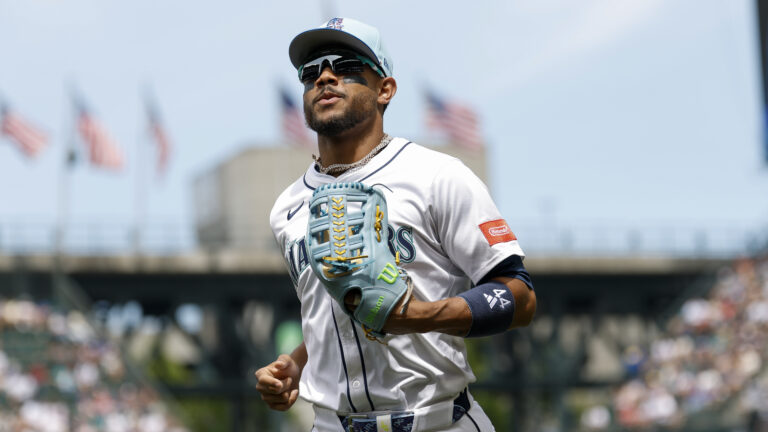
Death, taxes, and Julio Rodríguez kicking it into gear in the second half of the season.
For years now, this has been a narrative that has surrounded the Seattle Mariners’ star center fielder. The talent is off the charts, and when things are going right he’s one of the most electrifying players in the sport. However, it’s generally been a tale of two halves for the 24-year-old.
Coming off the worst year of his young career in 2024, Julio came into 2025 in need of a bounce-back season offensively. But he once again got off to another slow start at the plate, creating a rather puzzling image for one of the game’s most gifted athletes.
Julio went into the All-Star break slashing .252/.313/.417 for a .731 OPS, and those numbers were boosted at the last minute by him leaving the yard in the three contests leading up to the break. Heading into that last three-game set to close out the first half, he was slugging just .386 with a .687 OPS.
Despite those subpar numbers, Rodríguez questionably earned the third All-Star nod of his career a few weeks back. Many believed he wasn’t deserving of the honor this time around, as those numbers are clearly far from All-Star quality.
But as we’ve seen him do time after time, he’s once again taken his game to new heights in the second half of the season and has caught fire on a Mariners team that is looking to make a postseason push.
Second-Half Julio Rodríguez
Don’t look now, but Julio is now within the top 15 in baseball in fWAR at 4.3, and he’s 25th in the AL with a 122 wRC+. Those marks might not fly off the page, but that’s rather impressive given where his numbers were at heading into the Midsummer Classic.
But this is nothing new for Julio. Throughout his four-year MLB career, turning the dial up after the All-Star break has become the new norm. The table below highlights his splits between the first half and second half of the season dating back to his rookie year:
| Season | First Half | Second Half |
|---|---|---|
| 2022 | wRC+: 137; OPS: .814 | wRC+: 170; OPS: .937 |
| 2023 | wRC+: 105; OPS: .721 | wRC+: 158; OPS: .941 |
| 2024 | wRC+: 105; OPS: .690 | wRC+: 137; OPS: .818 |
| 2025 | wRC+: 109; OPS: .731 | wRC+: 161; OPS: .833 |
| Career | wRC+: 114; OPS: .737 | wRC+: 156; OPS: .908 |
Having these splits in one season could be considered an outlier. Them occurring in two seasons may be a coincidence. But the fact that this has happened in each one of his big-league seasons suggests that this is a legitimate trend for Julio.
What we’ve seen out of him for the past few weeks of play is a reminder of just how impactful he can be when he’s firing on all cylinders. He’s returned to stardom for Seattle, and he’s retroactively earning his suspect All-Star nod.
The Power Is Back
Back in June, I wrote about Julio’s slow start at the plate, specifically highlighting the power sap that he was experiencing. It was puzzling to see a player of his caliber go through such a prolonged stretch of diminished power dating back to his aforementioned down year at the plate in 2024.
But as of late, Julio has regained his power stroke that was on full display across his first two big-league seasons in which he slugged .495 with 60 homers.
One area that has stood out among the rest is Julio’s steady climb in bat speed. He’s always had some of the fastest bat speed in MLB, sitting in the 96th percentile or higher in that category in each of his last three seasons.
However, his bat speed took a dip to start the year, and his quality of contact followed suit.
| Month | Avg. Bat Speed | Fast Swing%* | Avg. Exit Velocity | Hard-Hit% | Barrel% |
|---|---|---|---|---|---|
| Mar/Apr | 75.4 mph | 53.0% | 91.5 mph | 47.7% | 9.1% |
| May | 76.0 mph | 61.5% | 91.4 mph | 41.7% | 7.3% |
| June | 75.9 mph | 60.6% | 89.1 mph | 42.4% | 5.9% |
| July | 76.8 mph | 69.8% | 93.3 mph | 54.2% | 13.9% |
| August | 77.8 mph | 72.1% | 93.6 mph | 56.1% | 15.8% |
Across the first three months of the season, Julio had an average bat speed of 75.7 mph. That’s a strong mark compared to the league average, but it was a step back from where that number has been in years past.
In turn, he simply wasn’t generating the same degree of power. He ranked 99th in MLB in slugging percentage and was tied for 100th in Isolated Power (ISO) through the month of June. That’s a far cry from what fans were used to seeing.
Since the beginning of July, however, Julio has seen a substantial uptick in average bat speed, and that has led to a drastic increase in exit velocities too.
In the month of August, his average bat speed is up to 77.8 mph, and he’s producing a season-high average exit velocity of 93.6 mph and hard-hit rate of 56.1%. What’s more, since July 1, he’s ninth in baseball in ISO (.309) and 12th in slugging percentage (.580).
After hitting 14 home runs in 431 plate appearances pre-All-Star break, he already has 11 in 139 plate appearances since the Midsummer Classic.
That leap in bat speed — and exit velocities — has led to much more damaging contact on a per-swing basis. Before the All-Star break, Julio had a barrel rate of 7.9%. Now he is seemingly barreling up everything, increasing that mark to 15.6% in the second half.
| Month | Whiff% | In-Zone Whiff% | wOBA | xWOBA | SLG | ISO |
|---|---|---|---|---|---|---|
| Mar/Apr | 35.1% | 28.2% | .301 | .345 | .372 | .165 |
| May | 24.3% | 16.0% | .339 | .367 | .464 | .182 |
| June | 32.3% | 21.1% | .307 | .303 | .386 | .096 |
| July | 30.1% | 19.7% | .343 | .343 | .519 | .283 |
| August | 18.2% | 9.4% | .429 | .423 | .667 | .347 |
On top of improving his quality of contact, he’s making more contact in general, which has always been key to unlocking more consistency at the plate. He’s getting the bat on the ball at a substantially higher rate in August, and the results speak for themselves.
He’s slashed his overall whiff rate this month to 18.2%, nearly a 12% improvement from his number in July. More importantly, his in-zone whiff rate dropped over 10% from July and is down to an incredible 9.4% this month.
As a result of these improvements, it’s no surprise to see his wOBA (and xWOBA) jump over 100 points from his marks in June, a sign that things are really clicking for him right now.
Since the All-Star break, Rodríguez is tied for ninth in MLB in wOBA (.394), sixth in OPS (.933), and fourth in wRC+ (161). That is the type of production that fans know Julio is capable of, and Mariners fans sure are glad to see their face of the franchise get his mojo back at the plate.
A Bumpy Road To Elite Results
Inconsistency has plagued Julio for years now in more ways than one. On top of his glaring first-half/second-half splits, his production away from T-Mobile Park has also gotten more drastic over the years as well.
| Season | Home | Road |
|---|---|---|
| 2022 | wRC+: 162; OPS: .892 | wRC+: 134; OPS: .820 |
| 2023 | wRC+: 125; OPS: .785 | wRC+: 131; OPS: .850 |
| 2024 | wRC+: 99 ; OPS: .655 | wRC+: 131; OPS: .805 |
| 2025 | wRC+: 91; OPS: .681 | wRC+: 149; OPS: .910 |
Not only has Julio been a slow starter, but he’s also a player who has historically been a much different hitter when he is away from his home ballpark.
T-Mobile has gained a reputation for being a difficult park for players to hit in. That’s a theory that is backed up by Statcast’s park factors, where T-Mobile Park has the second-lowest park factor at 92 this season. In fact, over the last three seasons, T-Mobile has the lowest park factor in baseball at 91 (the next closest is Oracle Park at 96).
So, perhaps his struggles in his home ballpark make it difficult for him to find a rhythm, contributing to his offensive woes in the early going. At the same time, it makes what he’s been able to accomplish to start his major-league career that much more impressive.
With 25 homers and 23 steals on the season, Julio is now the only player in MLB history to begin their career with four straight 20/20 seasons. Moreover, he’s on pace to flirt with yet another 30/30 season in 2025, a feat only three hitters accomplished last season (Shohei Ohtani, José Ramírez, and Bobby Witt Jr.).
Point being, while it may be a tale of two halves for Julio, there’s no denying the type of season-long results he’s consistently put up throughout his young career. While it may be a bumpy path to get there, don’t take for granted what Julio brings to the table on a yearly basis.
Stats and rankings taken prior to play on August 22.
Written by
Joey Peterson is a graduate of the University of Wisconsin-Madison and an editor for Just Baseball. Joey covers the Milwaukee Brewers, along with general MLB topics…