
Do the Astros Have Enough Pitching To Make a Run?
Houston is sitting atop the AL West right now, but holding on to a playoff spot with so little pitching depth is going to be difficult.
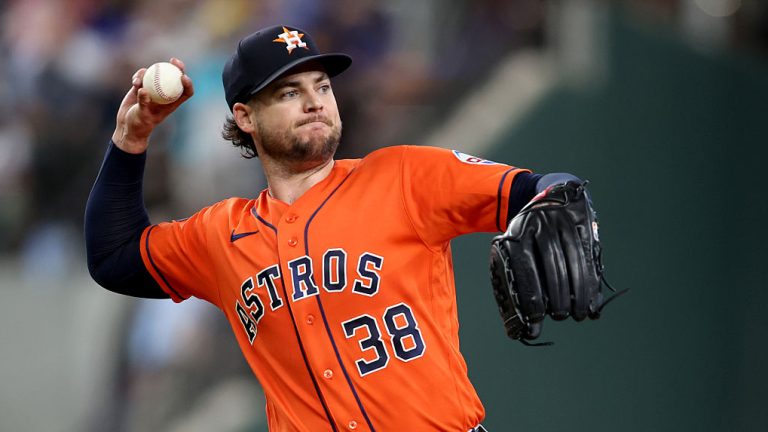
The Houston Astros were a team that many were questioning heading into the trade deadline. Would they sell? Did they even have the pieces to be buyers? How would they address their need for pitching? Well, the trade deadline came and went, and the Astros only made one move.
Starter Spencer Arrighetti was shipped off to Toronto in exchange for center fielder Daulton Varsho and his expiring contract. A move that helped their outfield, but hardly a move that changed the trajectory of their team. I like Varsho, don’t get me wrong, but does adding a great defender with a wRC+ over 100 just once in the past four seasons move the needle?
Many would argue the biggest need for Houston was pitching, and instead of acquiring an arm, they traded one away. I did not view Arrighetti as an impact arm, so moving him, specifically, was not the problem. But, not bringing in any pitcher who could improve the Astros’ chances tells us that they think they have enough pitching internally.
Questions in the Rotation
The Astros’ most productive starter this season has been Peter Lambert. A Rockies cast-off who spent last season in the NPB before joining the Astros and pitching to a 3.11 ERA and 3.82 FIP across 21 starts. Not only has Lambert been an excellent find for Houston, but he’s been their most important arm in 2026.
Where would the Astros be without Lambert? A sentence I never expected to type that tells the story of the Astros rotation’s woes. It’s not a knock on Lambert, either. But how confident are you in Lambert leading the way and starting a playoff game? I think answers would vary.
Houston’s rotation was supposed to be headlined by Hunter Brown. Brown dealt with injuries earlier in the season but has rebounded nicely, giving the Astros roughly what they would have expected from him.
His 4.95 BB/9 and 4.45 FIP look mediocre on the surface, but you can point to a three-game stretch in July that inflated his baseline stats. Overall, I still view Brown as a high-end pitcher that Houston can rely on down the stretch and into a potential playoff race. Lambert has shown enough, to me, to join him in that discussion.
From there, the rest is unknown. Tatsuya Imai was brought over from Japan to be one of the stalwarts in Houston’s rotation, but he has not met expectations. His stuff can be lethal, but locating it has been a challenge, leading to high pitch counts, early exits, and a change of role to a bulk bullpen arm or post-opener option.
The next wave of starters comes with even more questions. Cristian Javier, Ronel Blanco, and Hayden Wesneski. At one time, Javier looked like the next ace in Houston. That time is starting to feel longer and longer ago. Injuries have forced him to miss so much time, and at this point, the best you can hope for is a back-end option.
Although it has only been 32.1 innings, some out of the bullpen, Javier’s 6.68 ERA and 5.62 FIP with only a 6.96 K/9 doesn’t give me much confidence. I think his stuff is still good enough to find a way to success, but I’m not so sure that will happen this season.
A similar enough story can be told about Blanco. An Astro who posted a great season at one point in time has dealt with injuries and has not been able to get back to his previous level. He’s currently only going about four innings and has yet to surpass 90 pitches, partly due to building up and partly due to his 7.71 ERA and 6.94 FIP.
Can you count on either Javier or Blanco? Can one of them turn into an answer? I’d like to think so, but that’s me mostly leaning on their past, as nothing I have seen this season would lead me to believe they can become a reliable option soon enough to make a difference.
One arm that could, even if my confidence is low, turn into an answer is Wesneski. Stop me if you have heard this before. An arm with promise that had a significant injury limiting his innings the past couple of years. Starting to feel like a qualification in Houston.
Wesneski is a player I have always liked. He has a sweeper that is a joy to watch, paired with above-average command that makes up for his decent stuff. I don’t think he’s going to take a Lambert track to frontline starter, but the Astros need solid innings, and he could provide that. He’s yet to really find his footing in the majors and comes with a limited ceiling, but as a back-end option he’s perfectly fine.
See, that’s my problem. “A perfectly fine back-end option” is a descriptor I would label as my most realistic expectation for too many arms in the Astros rotation. Heck, I’d even say the best-case scenario, for the 2026 season, is a back-end option for a couple of these names.
The rotation is going to be a mess. An answer is not waiting in the wings in Triple-A or set to return from the IL soon. You have what you have, and to me, it is not nearly enough. What Houston could do, similar to the 2024 Detroit Tigers, is lean into an unorthodox approach by leaning on their bullpen more than their rotation.
Added Pressure on the Bullpen
Houston has a bullpen with a number of veterans I have grown to trust. You don’t often get to say that about teams; Houston has earned it in my mind. Josh Hader has been dominant in his limited innings, which helps shorten games for the Astros.
Steven Okert has been a quality leverage arm while Bryan King and Bennett Sousa give them a total of four lefties who have a track record and enough success in 2026 to make me comfortable. From the right side, Enyel De Los Santos is pitching better than his 4.24 ERA and is someone I would trust down the stretch.
Obviously, Bryan Abreu is the wild card. After years of being a reliable high-leverage arm, he’s taken a significant step back this season. A 6.55 BB/9 and slight drop in his stuff has led to a 4.50 ERA and 4.95 FIP. However, he has looked like a different pitcher in the second half, striking out 17 batters across 13 innings while only walking six.
If I close my eyes, I don’t have to try too hard to imagine a scenario where Abreu is lights out the rest of the way. We have seen a lot more good Abreu than bad over the past five years. To think he might have found something and could be an impact arm from here on out is not unreasonable.
Where things start to get interesting is when you get to the bulk innings. This is where I see the Astros getting creative, and they already have, but mixing and matching their bullpen bulk arms with their less reliable starters to make up for the lack of star power in the rotation.
AJ Blubaugh becomes a chess piece Houston could use in multiple situations. We have seen him fill two innings early in the game, fill a middle relief role, and even saw him earn his first save earlier this month. A useful arm that can go multiple innings gives the Astros an ability to pull the starter after two times through the order and allow hitters to get a new look without draining the bullpen too much.
Imai is another option who could be used after an opener or in a similar bulk role, eating three innings at a time. Miguel Ullola and Kai-Wei Teng are two options in the minors who could come up and eat innings as well. Teng had a good stretch earlier in the season and landed in Triple-A after a poor stretch in June pushed him to the bullpen.
While it is not the most sturdy or bulletproof plan, it can work. If you are able to strategically build the non-leverage bullpen arms with a few arms who can go multiple innings, you can make up for some deficiencies by giving the other team fewer looks at the same pitcher within a game.
It’s not a plan that you can deploy over 162 games, but with an expanded roster coming in September, you can certainly lean into it for a month. If anyone knows this, it’s the Astros, who saw a similar strategy used by the Tigers in 2024 knock them out in the first round of the playoffs.
Not ideal, but the Astros don’t have a better option.
Final Thoughts
If you are still reading, you likely know my answer to the question headlining this article. No, I do not think the Astros have enough pitching. The number of scenarios that would need to play out in their favor in order to give Houston at least a level playing field from a pitching side, game in and game out, is not in their favor. The lineup is not as good as it was at their peak, and making up for the lack of pitching is going to be difficult.
The Astros have a resume of winning that few can match over the past several years. While I won’t emphatically count them out, I do think the 2026 season is another turn in the wrong direction.
Become a Member of Just Baseball
Subscribe and upgrade to go ad-free!
* Save 25% by subscribing annually.

Written by