
Freddy Peralta Could Be Right Back on the Trade Block Soon
As the Mets' season slowly slips away, Freddy Peralta could be one of the top arms available on the trade market in the coming months.
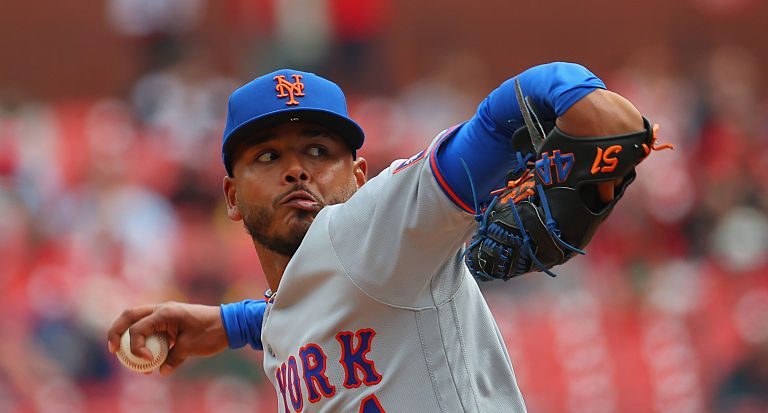
Freddy Peralta‘s name was frequently mentioned in trade rumors during his time with the Milwaukee Brewers. After years of speculation, the right-hander was dealt to the New York Mets back in January.
Just five months later, Peralta finds himself in a similar situation. Due to their struggles, the Mets could be postined as sellers at the trade deadline. Peralta is set to hit free agency for the first time in his career this winter.
His impending free agency increases the likelihood that New York could look to move him if it decides to sell off pieces at the deadline. Adding to that possibility, Peralta reportedly expressed interest in re-signing with the Mets this upcoming offseason whether he is traded or not. That makes a potential deadline deal even more logical for New York.
If the Mets are out of contention by the deadline, moving Peralta makes all the sense in the world. The club would have an opportunity to acquire prospects and replenish its farm system while capitalizing on the value of one of its top trade chips.
Let’s take a look at Peralta’s season so far in New York and what a potential trade package could look like.
Mediocre Mets Start
Thus far, Peralta has not been the ace that the Mets hoped they were acquiring prior to the season. He has not been bad by any stretch of the imagination, but has also not dominated in any sense of the word.
Through his first 12 starts with the Mets, Peralta owns a solid 3.55 ERA in 66 innings of work. In those 66 innings on the bump, the 29-year-old has only recorded 68 strikeouts.
Peralta’s primary issues have been his command and a decline in his ability to generate swings and misses. His lack of control has created traffic on the bases and driven up his pitch count throughout the season.
His strikeout rate dropped from 28.2% in 2025 to 23.9% in 2026. Peralta has long been a pitcher who can struggle with walks, and that has once again been the case this season. However, the decline in strikeouts has made the issue appear even more significant.
Looking under the hood, there is reason to believe that the strikeouts could begin to come as the season progresses. Peralta has struggled to find consistent success with his breaking pitches in 2026. His curveball, which he throws 12.1% of the time, appears due for positive regression.
Both the expected batting average and expected slugging percentage against the pitch are noticeably lower than the actual results. In addition, Peralta generates whiffs on roughly one-third of swings against his curveball.
If the curveball begins to perform more in line with its underlying metrics, Peralta’s strikeouts numbers could rise in a hurry.
One consequence of his tendency to issue walks is the amount of traffic he has to manage on the bases. However, when opponents have threatened with runners in scoring position, Peralta has risen to the occasion. Opposing hitters are batting just .138 against him in those situations, and he has yet to allow a home run.
While it has not been the picture-perfect start that some expected from Peralta in orange and blue, there is plenty of reason to believe he can still show flashes of the dominant form that made the Mets pay the price they did for his services this past offseason.
What Could a Trade Package Consist of?
As mentioned in the introduction, New York would need to be well out of contention for them to decide to be sellers at the trade deadline. Currently, the Mets sit six games out of the final wild-card spot in the National League.
Despite their putrid April, the Mets played signifcianlty better in May. With more consistent winning, they could flip the switch to being buyers come the August deadline rather than sellers.
For the sake of this hypothetical, however, let’s assume New York fails to turn things around. In that scenario, the Mets should prioritize acquiring either controllable major-league talent or prospects who fit their long-term plans.
While their outfield looks solidified for years to come with the likes of rookies Carson Benge and AJ Ewing, along with Juan Soto under contact through 2039, New York lacks long-term solutions in the infield. If Peralta were to be traded, targeting athletic and versatile infield prospects would be the club’s best course of action.
That approach becomes even more important when when considering that several of the organization’s top infield prospects, including Mitch Voit, Elian Peña and Wandy Asigen are all still multiple years away from being ready for the major-league level.
The Mets should use the package the they sent to Milwauke for Peralta as a baseline for what they should seek for in return. In exchange for Peralta and Tobias Myers, the Brewers received Jett Williams and Brandon Sproat. A major-league ready arm and versatile position player who could provide long-term value for their organization.
Given that Peralta’s performance has slipped a bit through the first half, and that he doesn’t come with quite as much control, the package will be lighter. Still, he’s a proven arm in this league, he comes with postseason experience, and he can net the Mets a significant prospect should David Sterns and company make him available.
There is no telling how the remainder of the season will unfold for the Mets. However, if they continue to struggle and find themselves out of contention by the deadline, they may be forced to move their most valuable trade asset in Peralta. Doing so could help position the club better off for 2027 and beyond.
Become a Member of Just Baseball
Subscribe and upgrade to go ad-free!
* Save 25% by subscribing annually.

Written by
Joe Browne is an aspiring sports journalist and is currently a sophomore at St. John's University. Joe is a lifelong Mets fan who is also passionate…