
Five Things To Watch for in This Year’s BBWAA Hall of Fame Election
The BBWAA ballot for the 2026 Baseball Hall of Fame election was released today. Here's what to look for in this voting cycle.
The 2026 BBWAA National Baseball Hall of Fame ballot has officially been released. Twelve newcomers join the 15 returners, as Cooperstown awaits its newest residents.
For the next two months, you will see a slew of writers publishing their picks on your Twitter or Bluesky timeline. All of it will culminate in an election, with the results announced on Tuesday, January 20 at 6:00 p.m. EST.
Some candidates on this year’s ballot are looking to put the finishing touches on their climb to the immortal 75% threshold and earn their induction. Others will look to continue their journey, while others still are just hoping to earn more time on the ballot. Here are some of the stories to watch for in this year’s election cycle.
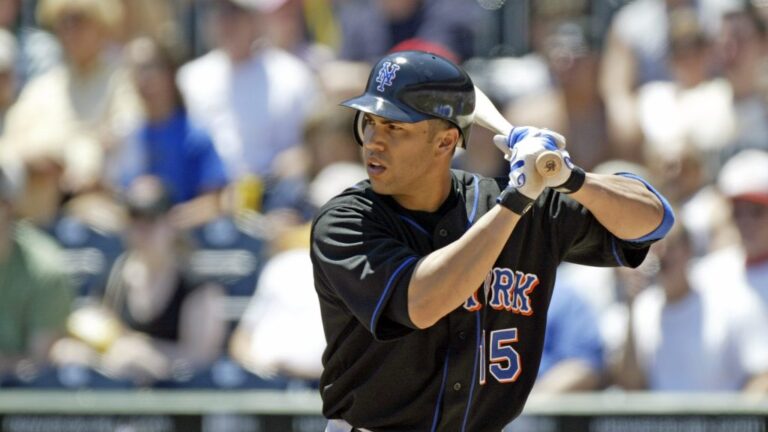
The Year of Carlos Beltrán
Ever since Carlos Beltrán debuted on the BBWAA ballot by getting 46.5% of the vote in 2023, it appeared clear that he was destined for the Hall of Fame. It seems like 2026 will be that year. After gaining more than 10% of the vote in both his second and third years on the ballot, he finished 2025 with a strong 70.3%, missing induction by just 19 votes.
To put that in perspective, Beltrán earned a net gain of +31 and +38 new voters in 2024 and 2025, respectively. His 2026 induction would require him to flip around half that number of voters. That doesn’t even account for first-time voters, who have marked Beltrán’s name at a growing rate in each of his three election cycles.
All those factors make Beltran’s 2026 enshrinement in Cooperstown almost a certainty. But how did we get here?

Going into the 2025 election, Beltrán needed to land at a number that set him up for a stress-free 2026 voting process. He got there by winning over voters who were more transparent and voters who were more secretive about the names they checked off.
Ultimately, this kind of coalition is practically required to reach 75% of the BBWAA vote, and to see Beltrán making strong gains with voters across the spectrum was a good sign that this would be his year.
There are three types of voters in this process. The majority of the electorate will publicly release their ballots before the results are revealed, a smaller subset will wait until after the election to share their ballots, and an even smaller group of voters’ ballots will never see the light of day.
The latter of those are the ones who didn’t vote for obvious candidates like Ichiro, Derek Jeter and Ken Griffey Jr. Essentially, they are the biggest gatekeepers in the BBWAA.
Beltrán actually saw a drop in support amongst this group of roughly 60-70 voters between his first and second year. Yet, instead of doubling down, this group came out with much more support for him than ever in year three.
At the same time, the ballots we knew of were changing their tune on Beltrán more than just about anyone. His +31 net gain of votes in 2024 was the second highest of any player returning to the ballot that year. He trailed only Gary Sheffield, who at the time was in his last year on the BBWAA ballot. The next year, Beltrán’s +38 net gain was the most of any returner.
It’s easy to see the appeal for Beltrán. His 67.4 career fWAR is the fifth highest for any primary center fielder since the league integrated 78 years ago.
The only center fielders he trails in that category are Willie Mays, Mickey Mantle, Mike Trout and Griffey Jr. – three inner-circle Hall of Famers and one soon-to-be. He also stands alongside Barry Bonds, Alex Rodriguez, Mays and Andre Dawson as the only players with 400 career home runs and 300 career stolen bases.
Beltrán’s comfortable election in his fourth year on the ballot will have implications far down the road. The former 2017 Houston Astro is linked to the infamous sign-stealing scandal that may have guided the team to its first World Series title.
While there have been conflicting reports over the years regarding Beltrán’s alleged role in the scandal, this induction would set the precedent that this scandal is not the deal-breaker that the writers have made alleged steroid use and gambling out to be.
This would mean a sigh of relief for Beltrán’s former Astros teammates like Jose Altuve, Carlos Correa, George Springer and Alex Bregman as they look to one day build their cases for Cooperstown.
This year, expect Beltrán to be sitting between 82-84% of the vote when the clock strikes six on election night and all the pre-results ballots are in. This would be a relatively small gain from his 80.5% of the pre-election vote last year, but at this point, there is very little of that cohort left to convert.
This is what we typically see from candidates on the doorstep of the Hall of Fame.
In 2023, Scott Rolen was on the fringes of 75%, and it was the post-election vote that made the final push to get him over the line. That year, Rolen gained 10 voters from the pre-election crowd and 11 from the smaller post-election group. A year later, Todd Helton, needing to gain just 11 votes from the previous year, gained 4 votes before the election and 14 after.
The pre-election ballot-revealers have already done enough to get Beltrán to the Hall. His 2026 induction will depend on him continuing to make inroads with the more picky post-election ballot-revealers.
Will the Writers Keep Andruw Jones Waiting?
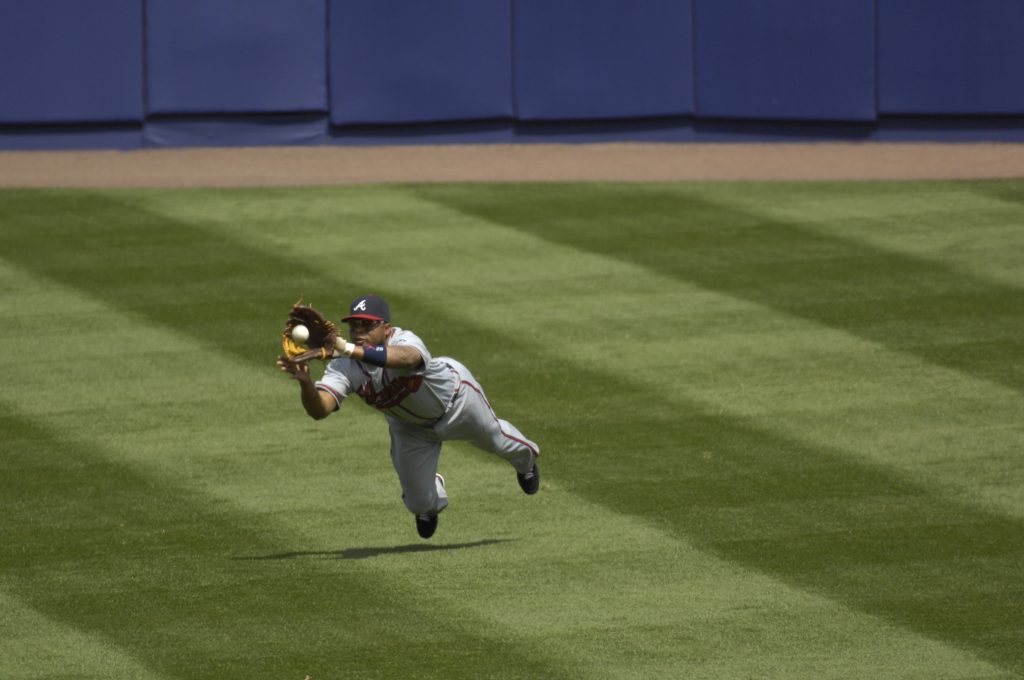
Andruw Jones is entering his ninth year on the BBWAA ballot. After receiving 66.2% of the vote last year, he has two more years to gain 9% of the vote.
The first eight years of Jones’ time on the ballot have been nothing short of a roller coaster. There were three years where he jumped more than 10% between years, and three more where his gains were fewer than 5%.
While Jones’ eventual induction appears highly likely, the jump in support for his candidacy has waned in the past two election cycles, with him only gaining a combined net +23 voters in that time.
In 2025, the former Braves center fielder was dropped by seven writers who had previously voted for him, tied for the second most of any returner. Unfortunately for him, none of those seven drops were made in an effort to make room for others on a 10-player ballot, meaning it’s not certain that any of those votes will be picked back up.
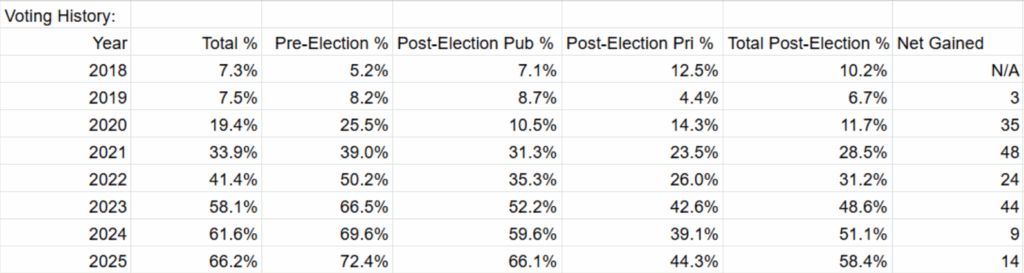
As mentioned earlier, Jones has two more years to earn another 8.8% of the vote. In the last two election cycles, he has gained just 8.1% of the vote. While his underwhelming gains in 2023 were the product of a difficult year to gain votes as a returner, it was the sluggish performance last year that caused concern.
Returning players on the 2025 ballot combined for a gain of 178 votes. Even with multiple first-ballot Hall of Famers debuting on last year’s ballot, Jones should have been hoping for more. He had the fifth highest net gain among returners.
Ideally, last year would have been the year that Jones gained enough to comfortably set him up for a 2026 induction. Instead, he may be staring down the maximum amount of time on the ballot.
Jones has shown to be unpredictable in the time the writers have spent reviewing his case. While he underperformed in an otherwise good year for returners last year, he also had a huge gain in 2022, the worst year for returning players since ballots have been tracked. Truly, anything can happen this year. Jones might climb the mountain and get to 75%, or he could fall short once again.
Even if he doesn’t get in this year, Jones will likely benefit from the 10th-year boost that players typically see on their final year on the ballot. This final push should be comfortably enough to get him over the line in 2027 if it comes to that.
At the very least, Jones should go into the election above the 75% mark. While it would take much more than that to actually finish the job, being above the line with the pre-election ballot-revealers would, at the very least, be a sure sign for a 2027 induction regardless of what year he would be on.
The appeal for Jones is similar to that of Beltrán. Remember when I mentioned that Beltrán ranked fifth in fWAR among center fielders since integration? Just behind Beltrán on that list, trailing by 0.4 fWAR, is Jones. According to FanGraphs, his 278.8 defensive runs above average is more than 100 points higher than the next best in the history of the position.
There is precedent for this situation. In 2023, Billy Wagner finished his eighth year on the ballot with 68.1% of the vote, just 6.9% shy of induction. After missing 75% by just 27 votes that year, it seemed like he would be a lock for induction in 2024, despite a bad environment for returning players that year.
Instead, Wagner fell short in year nine, finishing with 73.8%. Just five votes short. Although this felt like a disappointing outcome at the time, it at least paved the way for Wagner’s induction in 2025. Jones is in a similar spot. His percentage after year eight was 2% shy of where Wagner’s was at the time, but he is entering year nine in a more returner-friendly environment than Wagner did.
Don’t be surprised if this goes down to the wire. After Jones missed election by 35 votes last year, it feels like his margin within 75% will be a single-digit number of votes in 2026. If it’s not this year, a 2027 election feels all but given.
Make or Break for Andy Pettitte
It can be argued that this year’s election is more important to Andy Pettitte than anyone else on the ballot. The biggest surprise of the 2025 election, along with a writer leaving Ichiro off their ballot, was the surprise surge we saw from Pettitte. After hovering between 11-17% from 2020-2024, Pettitte saw a sudden jump to 27.9% in his seventh year on the ballot.
Considering that he still needs to gain 47.1% of the vote in the next three years, his eventual induction via the BBWAA still seems unlikely. But it’s been done before – and as long as there’s precedent, there’s hope.
In 2017, Larry Walker finished his seventh year on the ballot with just 21.9% of the vote. Like Pettitte, his case seemed dead in the water at that point.
But suddenly, the tide started turning. Walker then turned in 34.1% in 2018, 54.6% in 2019, and narrowly scraped the magic number in 2020, achieving 76.6% of the vote. Unlikely as it is, Pettitte kept this dream alive with his big rise last year.
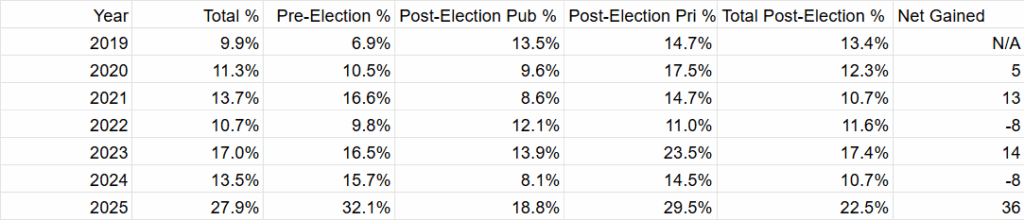
Out of nowhere, Pettitte nearly doubled his career high in pre-election percent, and way more than doubled his career high in net votes gained. His 36-vote net gain was second only to Beltrán on last year’s ballot. Post-election, voters followed the same trend, toppling his career highs in the public and private vote by considerable margins.
Pettitte also appeared attractive to first-time voters last year. After never receiving more than 18% support from rookie voters in his first six years, a remarkable 60.9% of the 23 first-timers checked Pettitte off in 2025. Despite having the ninth highest vote total last year, Pettitte ranked tied for sixth in support from these new voters.
Of course, Pettitte needs to keep gaining at this rate going forward to even have a chance. But last year’s rise should benefit him going forward. Any writers who didn’t vote for Pettitte will ideally take that as a reason to give him another look, as is what happened with Walker. As support grows, so does curiosity.
It’s understandable why Pettitte hasn’t had a strong support system throughout this process, but there’s reason to believe that could change.
There is only one Hall of Fame pitcher who logged between 3,000-3,500 career innings with an ERA+ between 115-120, the ranges Pettitte’s numbers fall into. That pitcher is Dennis Eckersley, who made it to Cooperstown because of his work as a reliever.
Last year, Pettitte’s former Yankees teammate CC Sabathia made it to Cooperstown in his first year on the ballot. As a fellow Yankee lefty who is remembered for postseason success, the comparison may play in Pettitte’s favor, as Sabathia adds a recent precedent for a guy of that archetype getting in.
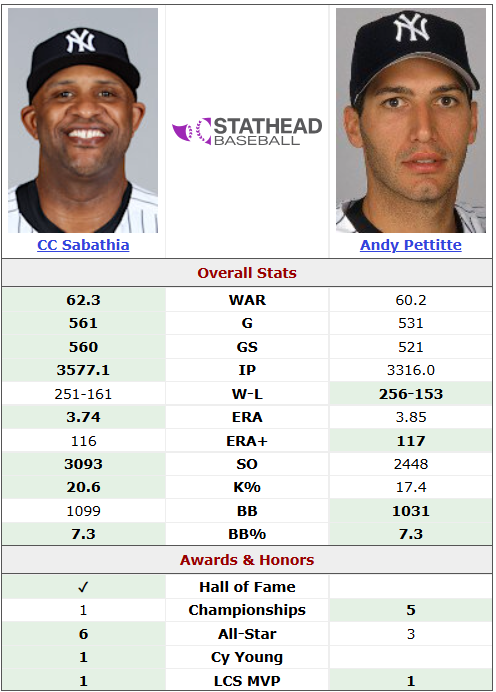
Do these stats justify the difference between a first ballot Hall of Famer and a guy with less than 30% of the vote in year seven? I don’t think they do. Sabathia was certainly the better pitcher, but his immediate induction begs the question that maybe Pettitte has been overlooked by the writers over the years.
Writers will fill out ballots this year with the knowledge that Sabathia is a Hall of Famer. Could it make the case for Pettitte stronger? We will see. But Pettitte’s meteoric rise in last year’s election leaves hope. Ultimately, it seems like anything short of another massive gain this year will close the book on his case.
An Underwhelming First-Year Class
Understandably, none of the game’s greats wanted to retire after the pandemic-shortened 2020 season.
After seeing guys like David Ortiz, Adrian Beltre, or Ichiro debut on the ballot in recent years, it makes it hard to get excited about anyone who is starting, and likely finishing their time on the ballot in 2026.
Headlining this year’s first-year class is former Phillies left-handed starter Cole Hamels. With 59 career bWAR, Hamels holds the lowest mark for someone leading a Hall of Fame first-year class since Bernie Williams in 2012. While this doesn’t necessarily mean Hamels is an automatic no for the Hall of Fame, it does put in perspective how weak this class is.
The players joining Hamels as rookies on this ballot include Ryan Braun, Alex Gordon, Edwin Encarnación and more.
Hamels is the only candidate in this group that has a chance of attaining 5% of the vote and remaining on the ballot going forward, and I don’t even know if that’s a guarantee. But what does this lackluster group mean for the rest of the guys on the ballot?
A Big Year for Returners
There are two factors that can forecast big gains made by returners to the ballot: lots of players from last year leaving, and a weak first-year class. In 2026, we have the perfect storm.
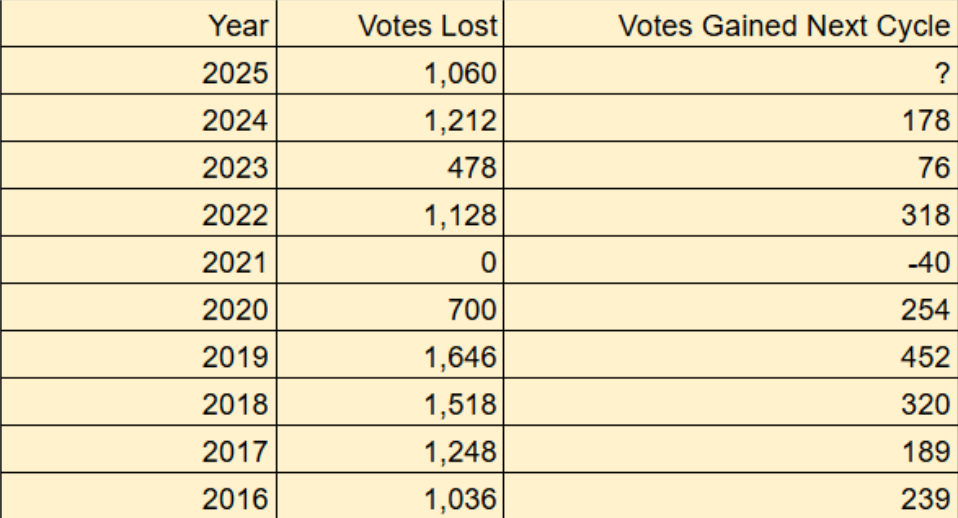
Historically speaking, returners tend to have a strong year when there are lots of departing votes to be redistributed. In 2025, writers returned to their ballots with over 1,200 votes lost from Helton, Beltre, Joe Mauer entering the hall and Sheffield falling off the ballot. 776 of those votes (64%) went to players in their first year of eligibility.
With first-ballot Hall of Famers like Sabathia and Ichiro, along with candidates like Felix Hernández and Dustin Pedroia earning votes, returning players didn’t get a lot of those vote shares.
Now, with the 1,060 Ichiro, Sabathia and Billy Wagner votes leaving the ballot, returners should get a large portion of those redistributed votes with the weak first-year class.
This is what gives Jones a chance to reach the 75% mark this year despite his declining gains in his last two elections. As the returner who received the second-most votes in 2025, he will likely be getting an immediate look from many of the writers who left him off their ballots last year.
But there are other candidates looking to make big steps in their climb to 75% this year that will likely thrive in these conditions. The person who may be most likely to benefit is Chase Utley.
Utley debuted with 28.8% of the vote in 2024 and jumped to 39.8% in 2025, which brings us to now. If Utley could gain 11% of the vote in a year where returners weren’t performing as well, the ceiling is very high for him this year. A gain at the same rate would get Utley past the 50% mark in just his third year. But 55% might be a better goal for him, given the circumstances of this year.
As mentioned earlier, these conditions are ideal for Pettitte, who needs a big gain for his eventual BBWAA election to remain in the realm of possibility. With the precedent of Sabathia, Pettitte’s strong year in 2025, and the anticipated good year for returners, another big year could push Pettitte above the 40% mark with two years to go.
This year also offers a much-needed big gain opportunity for Bobby Abreu. After six years on the ballot, Abreu is likely to cross the 20% threshold for the first time after receiving 19.5% last year.
Throughout his time on the ballot, Abreu’s largest year-to-year gain was in 2023, when he jumped by 6.8%. A rise equal to that in 2026 would get him to 26.3%. Given the implications of this year, a jump to the 30% mark would constitute a huge year that could revive hope in his campaign.
Other returners looking to make gains this year include Mark Buehrle, Félix Hernández, Torii Hunter, Dustin Pedroia, Manny Ramirez, Alex Rodriguez, Francisco Rodríguez, Jimmy Rollins, Omar Vizquel and David Wright.

Written by
Daniel Curren is a writer with Just Baseball. He loves sabermetrics, baseball history, and the Hall of Fame.