
Could Cole Young Be the Mariners’ Answer at Second Base?
The Mariners have been searching for stability at second base since they traded Robinson Canó. Can Cole Young be the answer?
 | |
| | 
If I asked you to name the Seattle Mariner who hit the farthest home run in the 2025 season, a few answers might come to your head.
You may first think that, surely, with the 60 home runs Cal Raleigh swatted in his record-breaking season, he would be the one. If not him, power threats like Julio Rodríguez or Eugenio Suárez could be the answer.
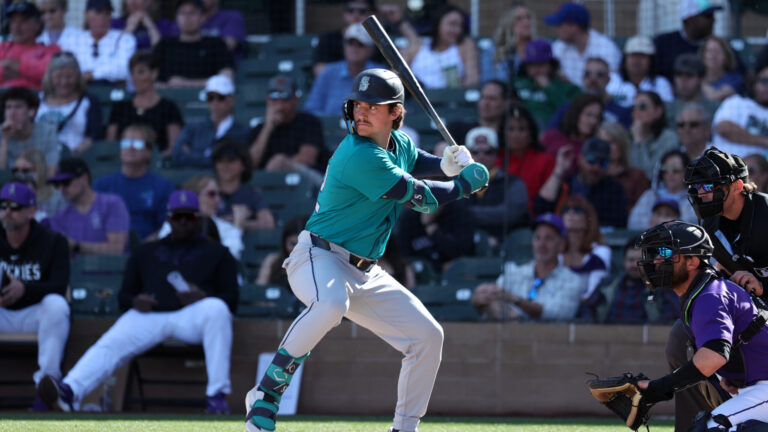
Someone who probably wouldn’t come to mind is 21-year-old rookie second baseman Cole Young, who tallied just four home runs and a 5.6% barrel rate in 257 plate appearances. But, sure enough, he is the answer. On July 31, Young tattooed a 456-foot shot against Kumar Rocker. A bomb longer than any hit by Raleigh, J-Rod, or anyone else in a Seattle uniform.
Moments like this from Young’s rookie season made one thing clear: the talent is there. But, he finished the season with a .211 batting average, a .607 OPS, and -0.3 fWAR, going 3-for-51 in his final 21 games.
With Brendan Donovan sliding in as Seattle’s new third baseman following the Feb. 2 trade that sent him over from St. Louis, it looks as though Young will get another shot at second. It’s a position where the Mariners have long searched for an answer.
Seattle’s Second Base Struggles
Since the trade that sent Robinson Canó to the New York Mets ahead of the 2019 season, the Mariners have yet to find sustained success at second base.
In fact, they’ve put out a different Opening Day second baseman in each season since the trade. Players like Dee Strange-Gordon, Shed Long Jr., Dylan Moore, Adam Frazier, Kolten Wong, Jorge Polanco, and Ryan Bliss have all been part of the carousel with little success.
Since 2019, Mariners second basemen rank 24th in fWAR (8.4) and 29th in OPS (.651). They rank in the bottom three in batting average (.225), OBP (.298), and slugging percentage (.354).
Over this time, Jorge Polanco’s 2.6 fWAR season in 2025 was the best of any Mariner at the position – and he only played 38 games at second base. Polanco is also the only Seattle second baseman since Canó to break the 2.0 fWAR barrier in a season. Like Canó, Polanco has also left town for Queens, New York.
The Mariners have tried to couple numerous options with J.P. Crawford in the middle infield, but have not found an answer. With Young slated to be their eighth Opening Day second baseman in the last eight seasons, a breakout at the position could make him the finishing touch to one of the most dynamic lineups in the sport.
Where There’s Hope
Young stepped on the field as a big-leaguer for the first time on May 31 of last year, making his debut at 21 years and 306 days old. Fitting for his name, he became the most youthful Mariner to fill the second base position since Ketel Marte nearly a decade ago. He even recorded a walk-off RBI in his first Major League game.
And for some time, things were starting to look good. From July 8 through Aug. 15, Young played in 26 games and slashed .292/.427/.486/.913 for a 166 wRC+.
Among the 259 hitters to log at least 90 plate appearances over this period, Young ranked fourth in OBP and 14th in wRC+. He also led the list in walk rate (18.9%) while owning the 20th lowest strikeout rate (12.2%). Young joined Geraldo Perdomo, José Ramírez and Marte as the only members of this list with a BB/K ratio above 1.5.
During his first stint in the majors, he recorded four of the 10 hardest hit batted balls by a Mariners second baseman since Canó’s departure. This included the top two hardest hit balls — the aforementioned 456-foot homer, hit at 114.1 mph, and a 113.4 mph double on July 12.
At season’s end, Young was one of 28 hitters with at least 250 plate appearances able to maintain a walk rate above 10% and a strikeout rate below 20%. His 23.6% whiff rate also stayed below the league average.
Young also showed promise in his batted ball profile. With a 38.3% groundball rate and 28.9% fly ball rate, he was keeping the ball off the ground and putting it in the air at a rate well above the MLB average. More importantly, he was pulling it.
Fly balls that are hit to the pull side are roughly 30% more likely to result in home runs than those hit straightaway or to the opposite field. The average pull rate on fly balls in 2025 was 27.6%. For Young, it was 32.7% on 52 fly balls.
He became just the fifth player in the Statcast era to record a 30% pull rate on fly balls in their age-21 season or younger (min. 50 fly balls) joining 2017 Cody Bellinger, 2025 Junior Caminero, 2023 Francisco Alvarez and 2022 Julio Rodríguez.
Where Young Needs To Improve
Despite all the positives listed above, Young finished the season as a below-replacement-level player with an 80 wRC+ for a reason. He needs to make a lot of adjustments to take the next step in 2026.
During his final 21 games of the season, in which he hit .059 with a .287 OPS, his batted ball profile took a turn for the worse.
Before Aug. 16, Young had been sitting on a 36.6% groundball rate on the season. From Aug. 16 on, it jumped to 43.9%, a 7.3-point increase. His line drive rate suffered as a result, dropping from 25.8% to just 9.8% in the same timeframe. Of the 398 hitters with at least 25 batted balls from Aug. 16 on, Young’s 9.8% line drive rate was tied for the lowest.
Throughout the season, Young struggled mightily against four-seam fastballs, and pitchers took notice.
41.8% of total pitches thrown to Young in 2025 were four-seamers, the ninth highest rate among the 308 hitters to see at least 1,000 pitches throughout the year. When you look at his metrics against four-seamers, it’s easy to see why he was spammed with them.
| Cole Young vs. 4-Seam Fastballs | Rank Among 261 Hitters W/ 100+ PA’s Ending Against 4-Seamers |
| .185 AVG | 248th |
| .207 xBA | 240th |
| .250 SLG | 258th |
| .356 xSLG | 238th |
| .253 wOBA | 257th |
| .296 xwOBA | t-243rd |
| -1.9 RV/100 | t-256th |
Young struggled to keep up against the pitch he saw the most of. And it wasn’t just four-seamers, it was all kinds of fastballs, including cutters and sinkers.
Young’s -5.6 RV/100 against all fastballs last year was the second lowest among 294 hitters with at least 150 plate appearances that ended against heaters. On that same list, he ranked third lowest in batting average (.182) and second lowest in slugging percentage (.234).
These kinds of numbers are not compatible with offensive success at the big league level. For Young to be the Mariners’ solution at second base, his results against fastballs will need to greatly improve.
Speaking of playing second base, Young’s defensive metrics were not much better than his showing against velocity. He tallied -9 Outs Above Average and a -7 Fielding Run Value in his 73 games at the position. He graded out as one of the three worst defensive second basemen in baseball by both metrics.
Young posted -4 OAA when coming in on the ball and -6 OAA when moving to his right, both some of the worst numbers among those to play the position. Like his performance against fastballs, these numbers will need to improve for him to become a mainstay up the middle.
Conclusion
Cole Young is only 22 years old and still has a lot of growing to do. But after just 77 career big league games, it’s clear that Mariners fans have reason to feel optimistic about him.
After a heartbreaking loss in Game 7 of the ALCS, the Mariners responded by re-signing Josh Naylor, upgrading the lineup with Donovan, and strengthening the bullpen by adding Jose A. Ferrer.
If Young is able to produce at the bottom of the lineup, this team has a chance to be the class of the American League and compete to bring the World Series to the Pacific Northwest for the first time.
Written by
Daniel Curren is a writer with Just Baseball. He loves sabermetrics, baseball history, and the Hall of Fame.