
Why the Red Sox Shouldn’t Give up on Masataka Yoshida
Though Masataka Yoshida hasn't lived up to his contract since coming to MLB, the 32-year-old can still be an important piece of Boston's offense in 2026.
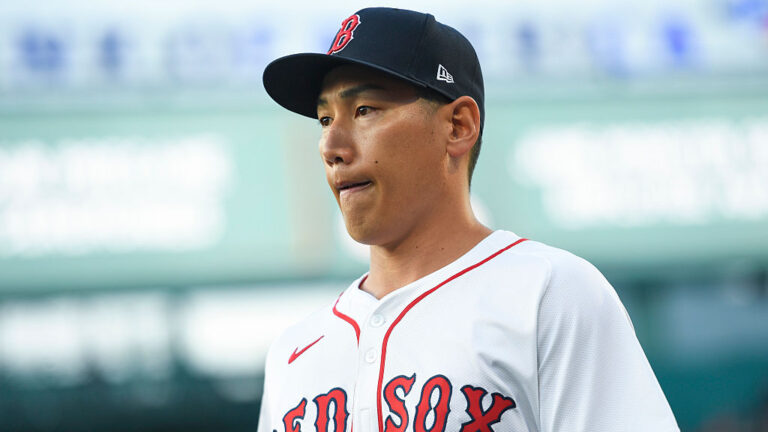
Since his rookie season concluded in 2023, it’s seemed designated hitter and outfielder Masataka Yoshida has been out of favor with the Boston Red Sox.
Before that year, he signed a five-year contract worth $90 million, plus his posting fee. It was considered an overpay at the time, but it’s looking even worse now. Yoshida hasn’t been bad, but a career 109 wRC+ and 1.5 fWAR in 303 games is hardly a good return on that investment.
But entering his age-32 season, Yoshida should still be in the team’s plans. It’s likely impossible for him to become worth his contract at this point, but it’s still salvageable.
He’s been in a bizarre situation since jump street. Transitioning to a completely new part of the world is hard enough. But doing so in a year where he also missed precious team building because of the World Baseball Classic throws a wrench in things.
Then in 2024, he wasn’t an outfielder anymore. By the time he’d shown he was adjusting to the new role, he hurt his hand and missed six weeks. After re-acclimating himself, he slashed .303/.369/.458 with a 134 wRC+ in his final 295 plate appearances.
He followed the 2024 season with surgery to repair a torn labrum, thus sidelining him until July. He finally started hitting in September but couldn’t fix his already lost season. However, he did come through with a game-winning, two-run single for the Red Sox in Game 1 of their Wild Card Series against the New York Yankees.
It’s been a wild ride for Yoshida since coming stateside. A ride that’s featured several instances where it looked the Red Sox wanted to move on from him. However, they still need Yoshida for many reasons. Let’s dive into his impact.
An Elite Bat-to-Ball Hitter
Among 348 hitters with at least 200 plate appearances, Yoshida ranked tied for 16th with an 11.7% strikeout rate. He also ranked in the top 35 for whiff rate.
Not striking out doesn’t make his hit tool elite, but it keeps the opposition on its toes. In 2025, Yoshida came to bat with a runner at third with less than two outs just 12 times. He drove in the run each time. Obviously it’s a small sample size, but he was way above the league average conversion rate of 51 percent.
In 2024, he was the Red Sox’s best situational hitter. He led the team in wRC+ with runners in scoring position (134), RISP and two outs (234), and runners on in general (164).
Therein lies the top reason Yoshida is needed for the Red Sox; He keeps the pressure on the defense to make plays. A lot is made of his ground-ball rate, and for good reason. However, the aforementioned 295-plate appearance sample had him with a ground-ball rate of just 41.3 percent.
He’ll never be a power bat, but does he need to be? A guy with great bat control, who hits the ball hard, will always have a home in a big-league lineup. He’s not the stereotypical designated hitter who will hit 30-plus homers, but he’s a good bat. Taking that for granted would be silly.
Yoshida Handles Fastballs
In 2025, the Red Sox ranked 27th in xwOBA on fastballs 95 mph or faster. That flaw proved fatal in their winner-take-all Game 3 against Cam Schlittler, who dazzled for eight brilliant innings.
The Yankees right-hander gave up five hits in that start — two belonged to Yoshida. The Japan native went 4-for-7 in the series, driving in two runs, and looked among a small few Red Sox ready for the moment of postseason baseball.
Again, small sample, but Yoshida has handled velocity since coming to MLB in 2023. In that span, 463 batters have finished 250 plate appearances with a 95+ mph heater. Yoshida ranks tied for 12th in whiff rate and tied for 14th in batting average.
His .336 xwOBA is much more middle of the pack, but that’s sixth among Red Sox in that span.
| Red Sox | Masataka Yoshida (Team Rank) | |
| Slugging Percentage | .387 | .452 (2nd of 16) |
| Batting Average | .244 | .315 (1st) |
| xwOBA | .306 | .336 (6th) |
| Whiff Rate | 24.4% | 9.4% (1st) |
Yoshida’s success against fastballs also extends to the top of, and above, the strike zone. In the same span, he’s a .311/.387/.425 hitter against velocity near the top of the zone. The league-average hitter slashes .190/.310/.307 on such pitches.
It shouldn’t come as a shock that the two teams in the World Series were top 10 in batting average against velocity. The World Series champion Los Angeles Dodgers ranked first at .268. For the Red Sox to return to that pantheon, they should covet guys who can hit fastballs, not subtract from their already small contingent who can.
Their lone offensive addition is first baseman Willson Contreras. The veteran doesn’t handle velocity from an average standpoint (.249), but he does from a damage standpoint (.448 slug, .379 xwOBA).
There Isn’t a Roster Limit on Good MLB Hitters
Obviously, there is since teams can’t exceed 13 hitters, but dropping a good hitter for only being good is a bit weak.
Yoshida is a weird player. He’s not truly considered part of that outfield logjam, but he’s not a traditional designated hitter. However, those reasons combined with his contract also make him an unattractive trade chip.
To move off him, the Red Sox would have to pay him down significantly, which wouldn’t be beneficial to them either.
But he’s a good hitter, plain and simple. Even as a platoon bat, that’s a weapon. Even as a bench bat, getting more playing time in the event of injury, that’s a weapon. Sure, he doesn’t possess an uber-versatile skillset, but what he brings is of immense value to a postseason-hopeful lineup.
Right now, it seems the Red Sox are likely to return outfielder Roman Anthony to the leadoff spot next season. But if the team wants to get him into more run-producing situations, perhaps hitting him second, with Yoshida leading off, makes sense.
| vs. RHP | vs. LHP |
| Masataka Yoshida | DH | Romy Gonzalez | DH |
| Roman Anthony | LF | Roman Anthony | LF |
| Willson Contreras | 1B | Willson Contreras | 1B |
| Jarren Duran | CF | Trevor Story | SS |
| Trevor Story | SS | Nate Eaton | 3B |
| Wilyer Abreu | RF | Wilyer Abreu | RF |
| Carlos Narvaez | C | Carlos Narvaez | C |
| Marcelo Mayer | 3B | Nick Sogard | 2B |
| Ceddanne Rafaela | 2B | Ceddanne Rafaela | CF |
With Yoshida in the mix, he serves as yet another weapon Alex Cora can deploy for a team looking to get back to the postseason. His career hasn’t been what Red Sox fans were hoping for to this point, but that doesn’t mean he shouldn’t have a role on this team in 2026.

Written by