
Barry Larkin Makes a Strong Case for Why the Orlando Dreamers Deserve an MLB Franchise
Speaking at the Winter Meetings, the Hall of Famer laid out the myriad reasons why Orlando is a natural fit for an MLB team.
 | |
| | 
Expansion in Major League Baseball has never been closer in recent years, and the Orlando Dreamers have a pitch that’s hard to ignore.
Less than 11 months from now, the collective bargaining agreement will expire on December 1. The next CBA — when that gets agreed upon is anyone’s guess — is expected to have details pertaining to the league expanding from 30 to 32 clubs.
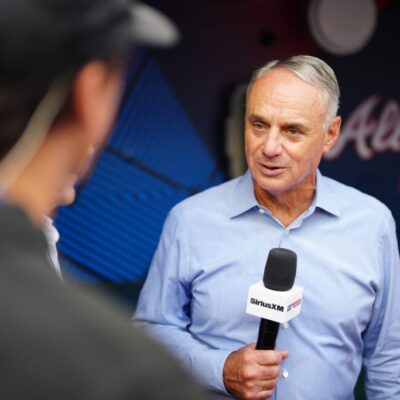
Commissioner Rob Manfred has said multiple times that he would like to see the details on expansion hammered out before his term expires in January 2029. With this being the last CBA in which he will have such a prominent voice, expect his wish to be granted.
Manfred wasn’t the only one at the 2025 Winter Meetings to make an appearance with hopes and dreams on full display. Amidst the usual collection of baseball scribes, minor league employees and recently graduated college students who descended upon a single hotel last month was a contingent from one hopeful expansion group.
As Scott Boras held court to highlight his clients as the top free agents of the winter and podcasters grabbed various personalities from the sport for content, there was also real baseball business taking place at the Hilton Orlando Bonnet Creek, like the Baseball Hall of Fame’s Eras Committee election, the draft lottery and the Rule 5 draft.
All the while, an undercurrent of buzz about the first expansion since 1998 vibrated throughout the pockets of groups scattered throughout the hotel.
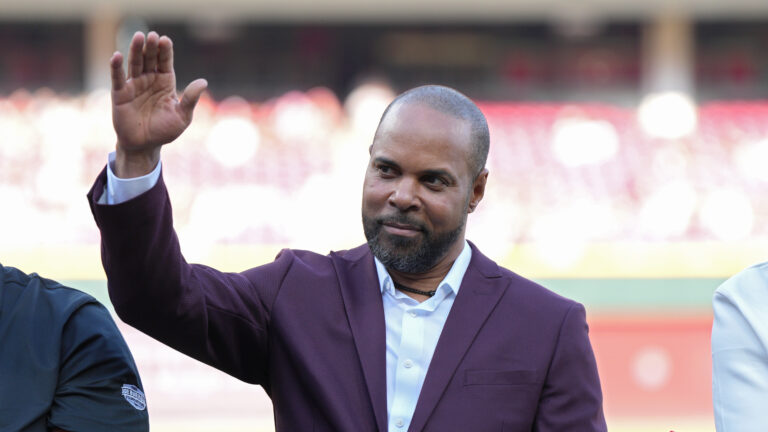
At the center of many of these conversations was Hall of Famer Barry Larkin.
An Orlando resident for the past 25 years, the Cincinnati Reds legend walked the halls with one goal in mind: bring awareness to the Orlando Dreamers.
Larkin, MLB ambassador for the Dreamers, is attempting to fill the void for Pat Williams following his death in July 2024. Williams, integral in getting the National Basketball Association to award the Orlando Magic a franchise, was aiming to launch another in MLB.
The goal for Larkin and his crew from the Dreamers was simple: make their presence felt.
“Just let people know that we’re here, that we have done a lot of the heavy lifting, that we are prepared for either a relocation or expansion slot [and] just to be present,” Larkin said. “There’s something to be said about putting in the time and having the presence. I felt like that was important for us to be here.”
Larkin took interviews with anyone interested in hearing his pitch. During that time, the 61-year-old outlined the myriad reasons why a team is a natural fit for Orlando.
The Challenges
MLB’s experiment in Florida has largely been a failure. Two random World Series victories for the Marlins franchise aside, both Miami and Tampa Bay have failed to capture the excitement of their local fan bases as the two clubs are consistently at the bottom of the league in terms of attendance.
Of the 28 teams that played the 2025 season in a major league ballpark, Miami ranked last with 1.2 million buying a ticket to their 81 home dates. Tampa Bay managed only 786,750, mostly due to playing at George M. Steinbrenner Field following damage from Hurricane Milton to Tropicana Field.
Once the Rays get back their home ballpark in St. Petersburg for 2026, expect the average crowds at The Trop to be around 16,000, much like in 2024.
Only once has Tampa Bay reached the two million mark in attendance, and that was their expansion season of 1998. A trip to the 2008 World Series couldn’t even get them past 1.8 million.
Miami has surpassed two million in attendance twice, and once was the first season of Marlins Park in 2012. For four consecutive 162-game seasons from 2018-22, fewer than one million came out to support their hometown nine.
By comparison, the Orlando Dreamers expect an anticipated 3.2 million in attendance during their first year.
Take Opening Day 2008 for the Rays, their first year after removing “Devil” from their nickname. Game 1 that year still outsold the first ever postseason game in franchise history. Rays fans showed up after that on the run to the World Series, but a few years later, during the 2013 American League Division Series, fan support was not enough for a sellout.
One of the biggest obstacles for the Orlando contingent is that it’s located only a little more than 100 miles northeast of the Rays’ home in St. Petersburg. A preference towards placing a franchise in a new region rather than one already with a team would rule out Orlando; however, many other pairs of clubs have similar proximities.
The Los Angeles Dodgers, Los Angeles Angels and San Diego Padres are situated in a band of 125 miles off the coast of California. Traverse I-94 along the western shores of Lake Michigan, and you can see the Milwaukee Brewers, Chicago Cubs and Chicago White Sox, many times on the same weekend.
Before 2025, the San Francisco Giants and Oakland Athletics were separated by the San Francisco Bay. A bridge over the East River also connects the New York Yankees and New York Mets in New York.
Less than 40 miles on the Baltimore-Washington Parkway separates the Orioles and Nationals. Then there’s the Philadelphia Phillies, situated smack dab in the middle between the pair of clubs located in the Mid-Atlantic and the Big Apple.
It’s one of the reasons why Larkin mentions relocation as much as expansion when it comes to the means by which Orlando should get a team.
“There is no negative to having a third team in Florida, if it’s Orlando. Now, if you go to some other site where you don’t have the 80 million tourists, then okay, you can go, well, it doesn’t make much sense to say, put it in some other city in Florida, right?” Larkin said. “Because I know Miami is struggling. I’ve been to games in Miami where there’s more people in this lobby than at games. I’ve been to The Trop, I’ve played in The Trop. Probably more people in this lobby than I’ve seen at the games when I was playing there.”
The Potential
MLB is on the verge of having a franchise in Las Vegas, even if we don’t exactly know what that team will be called.
However, the 80 million tourists that descend upon Walt Disney’s playground are nearly double that of Las Vegas. In addition, those visiting Orlando are also more likely to be families with future big league fans in the form of children in tow.
The qualities that are reinforced in baseball are tenfold, but the one constant for so many fans is the family aspect of the sport.
“I know when I was a kid, my mom and dad brought me and my brothers together, and the only commonality that we had was sport,” Larkin said. “Everybody had their individual thing that they loved to do. However, the one thing that my mom and dad did is church and sports, and so we spent time together, eating around the table, talking about sports.
“So you think about the Orlando franchise and people, and the mindset of people that actually come to Orlando. That dynamic of tourists that comes to Orlando, for the most part, is families.”
By comparison, Las Vegas will likely not manage that. The crowd may be older, and while they’ll be flush with finances to splurge, that spending will end with them specifically. With a family, the next generation of the sport will be served.
“I don’t know if you’re getting that younger fan base as much in those 40 million visitors that are going to Las Vegas,” Larkin said.
While MLB may want to grow the sport globally, the footprint of where the game is played is a completely different topic. The NFL and NBA are already considering some kind of expansion to Europe, but there are some within the MLB Players’ Association who would rather not think about those broader markets.
“I think there’s going to be some realignment, along with expansion,” Larkin explained. “There’s going to be a realignment in the game of baseball. One of the things that the players, at least the players I’ve spoken to, have talked to me about is less travel.”
Take the Seattle Mariners, who travel further than any other club. The AL West pennant winners will be the only team to eclipse the 50,000 miles traveled mark in 2026. Only five others – all from California – will travel at least 40,000 miles.
By comparison, Larkin’s Cincinnati Reds will be at 29,453 miles, 22nd-most next season. The Pittsburgh Pirates, with just 26,839 miles to travel, will spend the least amount of time in the sky.
“[The Mariners] lose a day. Their off days are travel days,” Larkin said. “My off days playing in Cincinnati were with my family. We don’t get many of them as baseball players.
“So one of the things in this collective bargaining agreement that is going to be asked, or at least I’m told, is less travel. If there’s going to be less travel, there’s going to have to be closer proximity of teams. I believe this also: I believe interstate rivalries are real. They increase the fan base. The rivalries are natural, and it’s been shown that attendance increases, which at the end of the day is money, dollars.”

The Facts and Figures
The largest media market without an MLB team is Orlando at no. 15. Steady population growth has some prognosticators thinking the area will become the 14th largest market in 2026, possibly 13th the following year.
That’s better than all of the other cities making noise about bringing an expansion franchise to them: Raleigh (22), Portland (23), Nashville (26), Salt Lake City (28) and Austin (34).
Orlando has the second fastest growing metro among the top 30, once again better than all other expansion options.
Then there’s the simple fact that the peak family vacation season coincides with baseball season, and that the situation with the Tampa Bay Rays’ new stadium — or lack thereof — is still in limbo.
“Orlando as a site and financing [is] already prepared to the tune of close to $2 billion for a stadium,” Larkin said. “It’s a dome stadium. The play won’t be affected by the weather.”
The stadium is slated to fit between 40-45,000 seats. At its max, the ballpark would be the seventh-largest in MLB, just ahead of Oriole Park at Camden Yards. Even at 40,000, it would be bigger than nine other current facilities.
Orlando also has its share of history as a baseball town. It has served as a Double-A affiliate for the Minnesota Twins (1973-1992), Chicago Cubs (1993-97), Seattle Mariners (1998) and the aforementioned Rays (1999-2003). Hall of Famer Ryne Sandberg plied his trade at Double-A in Orlando, as did 2010 AL MVP Josh Hamilton and four-time All-Star Carl Crawford.
Much of those three decades in Orlando were played at Tinker Field, named for another baseball legend.
Joe Tinker, who owned and managed the Orlando Tigers team that won the Florida State League in 1921, helped establish several developments and commercial buildings in the town following his playing days. He passed in 1948 and is buried in Greenwood Cemetery, three miles from the former site of Tinker Field on a site that is now the Citrus Bowl.
The Dream
The Orlando Dreamers aren’t just talking the talk or dreaming the dream. They’ve put in legitimate work to check off all the boxes MLB will want to see when they sign off on any expansion or relocation.
They’ve committed more than $1 billion under Letter of Intent for stadium construction. The stadium site has been selected within the tourist corridor. Through use of the Tourism Development Tax (TDT), they’d have the ability to publicly finance over 50% for the proposed 45,000 capacity domed stadium.
One thing owners and players alike will appreciate is that Orlando commits to never being an MLB revenue-sharing recipient. Earn money, spend money and never have the issues of their Florida siblings in Tampa Bay and Miami.
More are jumping aboard the O-Town hype train. Johnny Damon, an 18-year MLB veteran with two World Series rings and 2,769 career hits, has been added to the roster of former big leaguers who call Orlando their home and would like to see the city have Major League Baseball.
In a press release announcing Damon’s role as an MLB strategic advisor, Dreamers co-founder Jim Schnorf stated, “We will be ramping up local community engagement efforts, and having Johnny Damon’s strategic assistance will be invaluable as we plan to greatly increase our visibility.
“We had over 15,000 local fans immediately express interest in season tickets when we announced our intentions of pursuing an MLB franchise for the area. This response was generated from only a public announcement and a rudimentary website—no marketing, no social media.”
A lot will need to happen when the dominoes fall for Orlando to be one of the final 32 clubs standing. It may even require a bit of luck, but good luck is a residue of design.
One thing is certain: Barry Larkin and the Orlando Dreamers have put in the work.
Written by