
Top Notes From the Athletics’ ZiPS Projections for 2026
The A's roster is looking pretty set. Here's what the ZiPS projections have to say about their outlook for the 2026 campaign.
 | |
| | 
The Athletics‘ front office has been putting in work to change the narrative they were responsible for building around this team in recent years. Signing free agents, making trades, handing out pre-arbitration extensions, and hitting on a number of draft picks have quickly turned them into an intriguing team heading into 2026.
Their young and blossoming core will be joined by veteran Jeff McNeil, whom the A’s brought over in a recent trade with the Mets. McNeil adds experience, versatility, and a batting title to a team that needed a seasoned leader in its lineup.
Outside of the McNeil addition, the A’s have done essentially nothing. A couple of minor league signings and adding Mark Leiter Jr. to a bullpen that needs a lot more than, well, Mark Leiter Jr. Although there’s still time to pull off a trade or sign a free agent, the A’s roster is looking pretty set.
So, now that the roster construction discussions that have filled the past few months are all but wrapped up, let’s turn our attention to everyone’s second favorite offseason topic: projections.
Today, I want to focus on the ZiPS projection system, a system created by Dan Szymborski of FanGraphs that has been refined over the past two decades.
ZiPS utilizes information such as a player’s past performance and general aging trends to help paint a picture of the type of season that player might have. For a more detailed outline, I suggest reading this article.
Although projection systems are not bulletproof, they can help us understand the bigger picture of where a certain team stands relative to other teams held to the same projection system.
Athletics ZiPS: Position Players

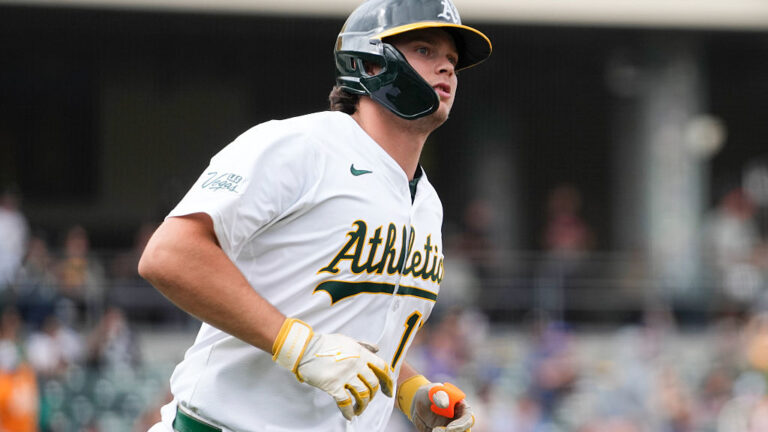
Highlighted by reigning Rookie of the Year Nick Kurtz, the A’s lineup is packed with power and potential. Of their nine projected starters, six have accumulated two years or fewer of major league service time.
That’s the good news. The bad news is that McNeil is the only outside addition for a team that won 76 games. I get it, though. The Athletics are still in an evaluation period and are banking on a number of their players taking a step forward to improve on their 2025 record.
Let’s see if ZiPS thinks that will be the case. Here are my top takeaways:
- Power Drives the Offense – Home runs being the main source of the A’s runs should not come as much of a surprise. Last season, they had four players reach or exceed the 25 home run mark: Kurtz (36), Langeliers (31), Rooker (30), and Soderstrom (25). The same four are projected to post over 25, with Lawrence Butler and Colby Thomas projected at 21 and 19.
In fact, Thomas is projected to post a .435 slugging percentage, which would really help to balance a lefty-heavy lineup. The righty corner outfielder has posted plus numbers throughout the minors, and his projected 103 OPS+ would be a welcome addition to lengthen the lineup.
The projection also has Jacob Wilson finishing with 10 home runs after posting 13 last season. Although Wilson is in no way a power hitter, I do think the 15 home run range is well within reason, especially as he plays half of his games in a minor league park.
- Tyler Soderstrom‘s Defense Declines – When Soderstrom was listed as a finalist for the Gold Glove, a lot of the baseball community had questions. I did a deeper dive into the work he did to earn that nomination, which can be found here.
Currently, ZiPS has Soderstrom projected for a negative defensive value (-5), which has pulled his projected fWAR down to 1.0. I’m sure sample size plays a part in this projection, but an offseason of work and more reps in the outfield should only help him improve, in my opinion.
- Brent Rooker has a Better Season Than Nick Kurtz – Okay, this caught me by surprise, but I get why the system thinks Rooker has the slight edge (138 OPS+/3.7 WAR vs. 135 OPS+/2.9 WAR). Rooker has a much larger sample in the majors, which helps stabilize these projections, and the system struggles to understand projecting Kurtz’s insane rookie year out for year two.
Both are great players, but I think I’d lean Kurtz. Rooker has done a ton of work to cut his strikeout rate down, and he should get credit for that. But, what we saw from Kurtz is special. He’s not just a power hitter but a great all-around bat. Another offseason working on pitch recognition should help him drop his strikeout rate.
- Third Base Has a Surprise – The one position that is truly up for grabs is third base. Max Muncy, Darell Hernaiz, and Brett Harris are the three options that project to play the most, with Hernaiz as the best of the bunch.
I am a bit surprised to see Hernaiz get a 91 OPS+ and 1.9 fWAR projection. His bat does not offer much upside, and I view him as the primary backup at short, but the projections are the projections. Harris edges out Muncy, which I could see as a possibility.
I have always thought that Harris did enough things at around an average level to stick as a major leaguer. You will not think he’s great at any one thing, but not awful at anything, either. Regardless, none of the three are projected to finish above league average, offensively.
Athletics ZiPS: Pitching Staff
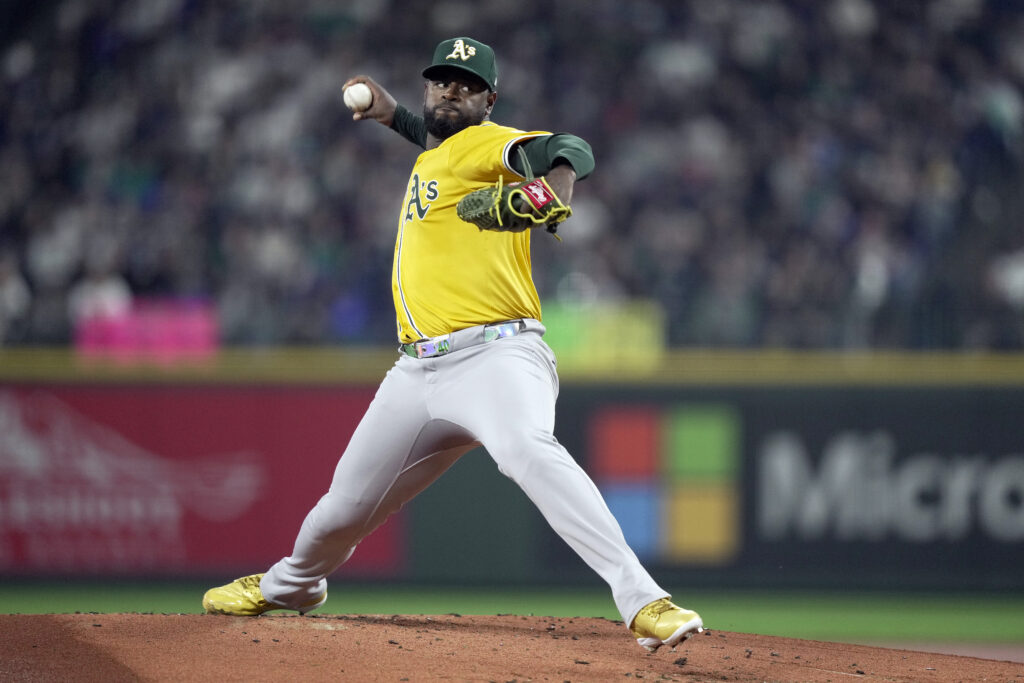
If you follow the Athletics, you will have a good idea of where this is going. By far the biggest issue with the A’s last season was anyone on the mound was wearing their jersey. Dramatic, yes, but not by much.
The A’s did have a number of unproven arms come up and have outings that looked promising. Jacob Lopez, Luis Morales, and, to a lesser extent, J.T. Ginn all looked like potential major league options. I have faith that the rotation can avoid being at the bottom of the league, but the bullpen gives me worries.
Here are my top takeaways:
- The Rotation Will Struggle To Fill Innings – There is not a single starter on the current roster projected to finish with 150 or more innings. Jeffrey Springs is projected for 142, Luis Severino 139, and Morales 121. While projection systems have some trouble and flukes when it comes to predicting playing time, I think the story being told is true.
Severino and Springs have both had major injury issues in the past. Morales is a 23-year-old who needs to build up to a 30-start schedule, and Lopez pitched a career high of 92 innings last season.
Although their sheer number of starters should help the A’s meet their innings needs, I think the team needs more inning eaters. Piecing together five or six youngsters to round out a rotation is a risky game. Just ask the Angels.
- Gage Jump Has a Successful Rookie Season – Jump has been flying up prospect rankings, landing at no. 59 on Just Baseball‘s most recent update. The lefty has some deception to his delivery, and batters have talked about how hard he is to read, even if the velocity isn’t top-notch, thanks to a high IVB.
ZiPS projects Jump to post a 4.17 ERA with 97 strikeouts across 108 innings. That type of production does not win Rookie of the Year, but it would show he is a big leaguer with potential and room to grow.
- The Bullpen Remains a Weakness – Out of the options currently listed for the A’s bullpen on RosterResource, only one pitcher is projected to have an ERA under 4.00: Justin Sterner at 3.94.
I wouldn’t say this is much of a surprise. FanGraphs currently has the Athletics and their bullpen options tied for 26th out of 30 by fWAR. It might seem like I’m being hard on a bullpen that had a few guys put up solid baseline numbers (such as ERA) in 2025, but the advanced metrics were not too kind.
I will say a few pitchers, such as Elvis Alvarado, caught my eye as potential pitchers to outperform their projections. If the Athletics put Jack Perkins in the bullpen, I do think they could have three or four reasonably trustworthy options. I see Perkins as a potential closer for this A’s team.
- No Real Breakout Pitcher – Usually, the projection models do not favor young players simply because they do not come with a track record that helps the system better understand their talent. A breakout from, let’s say, Luis Morales, is absolutely possible, but not in the eyes of ZiPS, which gives him a 4.29 ERA and 8.2 K/9.
As noted before, Jump is getting a favorable projection, but not to the level of a breakout. Jacob Lopez has a case with a projected 3.98 ERA, although I struggle to classify that as a breakout, either.
Part of the issue is sample size, and part is high-level talent that will be starting from day one. Simply by the nature of the A’s roster construction, I think the most likely breakout would come from a relative unknown out of the bullpen.
Athletics ZiPS Final Thoughts
The specific names and their projections might not 100% align with what you think of individual players. Now, think of the product as a whole and see if you agree with where the system projects the pitching staff and lineup.
An obvious strength? The top half of the lineup. The weakness? Lineup depth and a subpar pitching staff. At the end of the day, when we look back on this season in October, I think the story of the 2026 A’s will mostly align with these projections.
Keep in mind, A’s fans, projections don’t always judge young players well. If you want something to dream on, let it be that.
Written by