
5 Pitchers Who Need a Second-Half Turnaround the Most
Regardless of under-the-hood metrics, there are established starters in dire need of a turnaround in the second half. Here are 5 of them.
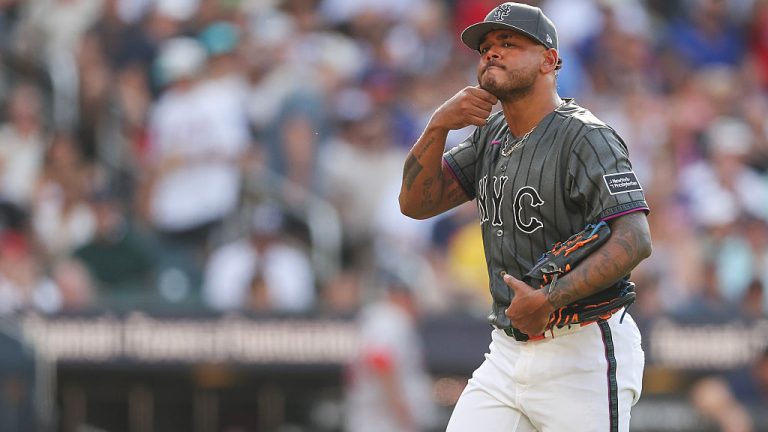
Major League Baseball is at a point in its season where the numbers tell pretty much the whole story.
Sure, there are still plenty of players underperforming under-the-hood metrics. While that is more indicative of quality of performance, with some predictive measures for second-half performance, these guys still need a complete reversal of luck to counteract the early season struggles.
Regardless of under-the-hood metrics, there’s certain established starters in dire need of a turnaround in the second half. For some, their teams need it to soar in postseason contention. For others, it may be a contract season, so their second-half could make-or-break their next pay day.
Looking toward the second-half, here are five arms who need to turn it around the most.
All stats updated prior to games on Saturday, July 18
Aaron Nola, Philadelphia Phillies
Nola’s performance shouldn’t preclude the Phillies from adding a starter at the deadline. However, his performance goes a long way in establishing a ceiling for this group.
Historically, the 33-year-old right-hander was something of a peripheral darling. Think back to years like 2021, where he made 32 starts. That year, he had a 24.6% strikeout-to-walk rate and 4.4 fWAR. Yet, he had a 4.63 ERA thanks in large part to 1.3 homers per nine innings.
This year, he’s still underperformed expected data. His 5.68 ERA is the third-worst among qualified starters, but his 4.18 expected ERA is closer to the middle of the pack. Unfortunately for him, he’s allowing 2.01 homers per nine innings, and his strikeout stuff is the worst of his career, save for his rookie season in 2015.
The Phillies have a Cy Young hopeful in Cristopher Sánchez, as well as another ace at the front in right-hander Zack Wheeler. When they re-signed Nola after 2024, they’d hoped to completely shore up the top three arms in their rotation. Unfortunately, injuries and struggles have faltered those plans in a major way.
The Phillies, thankfully, have overcome Nola’s issues and remain 10 games over .500. They’re even within three games of the Atlanta Braves for the National League East division. Again, Nola’s performance shouldn’t alter any plans for the deadline, but him turning the season around would go a long way in giving them a World Series ceiling.
Zac Gallen, Arizona Diamondbacks
It’s been tough sailing for Gallen for two years now. Last year was more up-and-down, and he signed a one-year “prove it” deal to stay in Arizona for 2026. Yet, he’s having by far his worst season.
His 6.34 ERA is the worst among qualified staters, and his 13.9% strikeout rate is the lowest as well. A guy who just two years ago was one of the steadiest right-handers in the league is now among a class unbeknownst to him at a critical point of his career.
More than just his individual need to improve, the D-backs need it badly. Merrill Kelly has a 5.20 ERA despite being one of the game’s steadiest arms historically as well. Moreover, as dominant as Eduardo Rodriguez was in the first-half, he’s got a 5.07 expected ERA and just an 8.7% strikeout-to-walk rate.
Yet the Diamondbacks remain in the thick of playoff contention. Entering play Saturday, they’re two-and-a-half back of the third wild-card spot, are still a game over .500, and are 6-4 in their last 10. But there’s a ton riding on the turnaround of their top two arms. Gallen especially, who’s inarguably been the worst pitcher in the league this year getting consistent burn.
Freddy Peralta, New York Mets
It’s not been a great inaugural season in Queens for Peralta, who entered 2026 a dark horse candidate for NL Cy Young.
Through 20 starts, the 30-year-old has a career-worst 8.97 strikeouts per nine innings and 4.66 ERA. The latter is his worst with a minimum of 20 starts. What’s saving the right-hander is his under-the-hood metrics lend a little toward positive regression in the second half.
The achilles’ heel for Peralta, however, is his lack of volume. He’s remained healthy, but he’s not getting deep into games. He’s pitched at least six innings just six times in 20 starts this year, down from 13 across 33 starts a season ago. The problem with not going deep into games is it puts a lot of pressure on Peralta to avoid any sort of damage early in outings.
Not only that, in two of his six starts logging at least six innings he didn’t do well enough to even meet a quality start. He gave up four earned against the Miami Marlins in seven innings on May 23, and six earned across six innings against the St. Louis Cardinals on June 9.
It’s just not the same dominant level performance we’re used to seeing out of the right-hander, who has a lot riding on his second half. Staring down his first trip through free agency, one that’s positioned to be stymied some by the looming labor negotiations, it’s imperative he turns a corner the rest of the way. He’s more than talented enough to do it, but it’s not always easy to translate talent into production.
Mitch Keller, Pittsburgh Pirates
The Pirates are having a very good season compared to expectations, but remain a game-and-a-half out of a playoff spot as the deadline draws near. Offensively, they’ve scored the second-most runs in the NL and are fifth in differential.
Their pitching rotation is sixth in the majors in fWAR, thanks in large to Paul Skenes’ 3.2 and Braxton Ashcraft’s 2.8.
The major disappointment for them on the mound, however, is Keller. He’s never been something of a star-caliber arm, but he’s always been steady. This year, his 5.14 ERA is the worst among all Pirates who’ve started a game in 2026.
He’s also reverted to a career-worst 37.9% ground ball rate and 17.4% strikeout rate. Consequently, he’s got a strikeout-to-walk rate of just 9.5 percent, also a career-worst.
Getting back to pre-2026 habits would go a long way in getting Pittsburgh back to the postseason for the first time since 2015. Not only that, it’d help secure the Pirates their first deadline as buyers since the controversial trade for right-hander Chris Archer in 2016.
This is a talented group, defying expectations despite lacking serious star power in the lineup. Brandon Lowe and Ryan O’Hearn have been beautiful additions to their offense, with an incredibly talented pitching staff to boot. Getting Keller back on track could make things incredibly interesting in the wild card race down the stretch.
Moreover for Keller, he’s a guy who’s been around the Pirates organization since 2014 and in the majors since 2019. He’s never experienced postseason baseball in his career. Knowing he’s got a major hand in helping return them to October is tremendous pressure. The question remaining is can he meet that pressure with production?
Time will tell, but the Pirates, and Keller, need it.
Robbie Ray, San Francisco Giants
The southpaw’s 2026 is a weird one for a few reasons. His ERA is strong, but his peripherals are not. He’s also a guy known for racking up the strikeouts, and this year he’s logging just a 20.3% strikeout rate.
He’s slated to become a free agent after the season and is already 34 years old. With how metrically inclined organizations are, especially when it comes to paying pitchers, it’s hard to fathom a long-term, or high average annual value coming his way in 2027. That aside, him turning a corner into the more dominant version of himself could position himself well as a trade target this deadline.
Organizations are always looking for more pitching at the deadline, and lefties are always at a premium. If Ray shows he’s capable of missing bats with more frequency, there’s an alleyway for him to end up on a potential World Series hopeful.
Even a return to last year’s self, where he struck out 24.6% of hitters and had 2.2 fWAR across 32 starts, goes a long way in both establishing himself as a hot target this winter, and at the deadline.
Become a Member of Just Baseball
Subscribe and upgrade to go ad-free!
* Save 25% by subscribing annually.

Written by