
Athletics Top 15 Prospects
Now that Nick Kurtz and Jacob Wilson are established in the big leagues, a slew of arms is aiming to join them in the not-so-distant future.
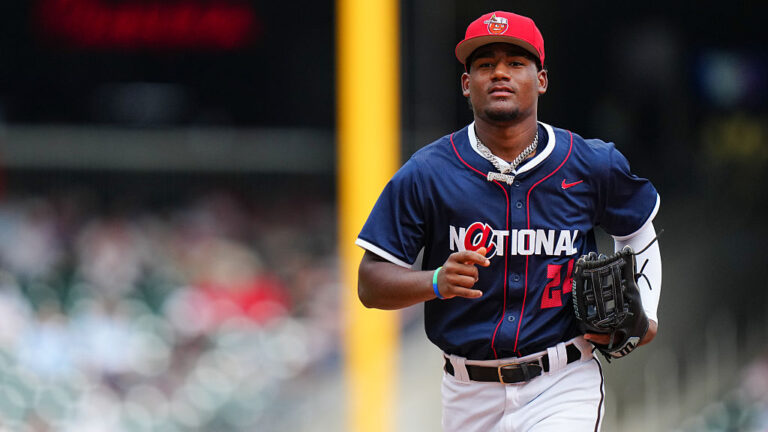
When you graduate elite prospects like Nick Kurtz and Jacob Wilson, the farm system is of course going to take a little bit of a hit, but that’s the whole point! That said, as the Athletics have found franchise cornerstones at the highest level, the system continues to provide plenty of upside and intrigue.
Trading Mason Miller will help with that, acquiring one of the best overall prospects in baseball in Leo De Vries, along with several intriguing arms to supplement. Longtime Director of Scouting Eric Kubuto deserves a lot of credit as the Athletics consistently reload talent via the draft, supplemented by positive developments in the Pacific Rim.
1. Leodalis De Vries – SS – (Double-A)
Height/Weight: 6’1″, 190 | Bat/Throw: S/R | IFA: $4.2M – 2023 (SDP) | ETA: 2028
| HIT | PLATE DISC. | GAME POWER | RUN | FIELD | FV |
| 45/55 | 50/60 | 45/55 | 55/55 | 40/50 | 60 |
De Vries is a switch-hitting shortstop with an extremely advanced hit and power combo. The Athletics did not slow his timeline down after acquiring him as the headliner in the Mason Miller trade, promoting De Vries to Double-A shortly after where he continued to thrive. He should climb through the Minor Leagues relatively quickly with the potential to be a star.
Hitting
Utilizing slightly different setups from each side, De Vries starts more open from the left side with his feet about shoulder-width apart and his bat resting on his shoulder. He pushes his hands upwards in tandem with a toe tap. He has quieted his hand movement more over time with his upper and lower half much more in sync. He’s extremely advanced for a teenage hitter, already using his lower half well, along with a swing path that generates consistent lift.
From the right side, his hands start higher with a small stride. He does not quite utilize his lower half as effectively from the right side as the left, which hampers his raw power some. His Hard Hit rate was roughly 5% higher from the right side in 2025 with a three MPH gap in 90th percentile exit velocity.
De Vries has become slightly more aggressive as he has aggressively climbed levels, which is entirely understandable as the youngest prospect at each stop. He still has a fantastic feel for the strike zone–especially from the left side–walking at a 12% clip overall in the 2025 season.
With more room to fill out as he matures, De Vries should easily tap into above average power given his advanced feel to elevate. The feel for the barrel translates into the ability to spoil tough pitches and battle as well. There’s potential for at least above average hit and power with the plate discipline to complement.
Defense/Speed
Like many young, projectable shortstops, there’s a chance De Vries could fill out and lose a step, preceding a move to third base. That said, he has the components to be able to stick at the position with good instincts. He is comfortable throwing on the run and from different angles, but lacks desired carry on his throws, which can run to his arm side or sink. He can get too nonchalant at times, fielding balls off to the side or with stagnant feet which inflates the error totals. As he hones in on the fundamentals, the case for him to stick at shortstop should be stronger. An above average runner, De Vries should be a decent stolen base threat capable of grabbing at least 10-15 bags, but has struggled with efficiency.
Outlook
One of the youngest players in full season ball for the 2024 season, De Vries needed a few months to get his feet wet before really hitting his stride. It was a similar story for De Vries in 2025, even with a block buster trade and Double-A promotion in between, posting to an OPS well over .800 in his final 50 contests.
The bat is understandably ahead of the glove, but De Vries has flashed what it takes to stick at shortstop, assuming he can continue to refine the more fundamental components in the field in his age 19 season. Should De Vries slide over to third, there is more than enough offensive production to accommodate the move.
His strong finish to the season at Double-A makes a big league debut prior to his 20th birthday not seem so far fetched. For a player of his age, De Vries has the foundation to be a star, but his present skill set already gives him a great chance of at least being a quality big leaguer or a long time.
2. Luis Morales – RHP – (MLB)
Height/Weight: 6’3″, 200 | Bat/Throw: R/R | IFA: $3M, 2022 (OAK) | ETA: 2026
| FASTBALL | SLIDER | Curveball | CHANGEUP | COMMAND | FV |
| 60/60 | 55/55 | 55/55 | 60/60 | 45/45 | 55 |
Morales set the record for strikeouts in Cuba’s 18u league before defecting to Mexico in 2021 where he continued to train and solidify himself as one of the more intriguing international free agent arms in 2023. His electrifying four pitch mix has quickly made him one of the higher upside arms in the Minor Leagues.
Arsenal
A four pitch mix headlined by a fastball that sits in the upper 90s, Morales boasts loud stuff that should result in a much higher strikeout rate as he refines his command. The fastball sits 96-98 mph with above average induced vertical break from a 5.7 foot release height. The velocity and characteristics combination could make Morales’ heater a double plus pitch, especially if he could consistently locate it at the top, but he misses over the heart of the plate too frequently.
Morales has two quality breaking balls however it is his changeup that has emerged as his most dominant pitch in 2024. He maintains his arm speed from his long arm action well, making it extremely difficult for hitters to pick up. The pitch features 11 mph of separation from his fastball with impressive fade.
When he is locating it, his slider flashes plus and is right there with his changeup. It averages more than 15 inches of sweep and will flirt with 3,000 RPM. The sweepy action of the pitch makes it more effective to righties, but it is sharp enough to back leg lefties. The pitch breaks so much that he struggles to locate it consistently; his long arm action may play a part in that too.
Morales prefers his curveball with two plane break at 81 mph against left-handed hitters who frequently swing over it. He commands the pitch slightly better than his slider though both have registered a strike rate in the mid 50% range.
Outlook
Still just 21 years old for the entirety of the 2024 season, Morales has plenty of time to reach his mid-rotation ceiling and took a step forward with his secondary command. With improvement to his fastball command, his secondaries should play up further along with his fastball likely performing far better. Like many young, electrifying arms, Morales has a realistic fallback of a nasty high-leverage arm, but his four pitch mix belongs in the middle of a rotation. It just comes down to whether he can sync his long arm action and delivery more consistently.
3. Gage Jump – LHP – (Double-A)
Height/Weight: 6’0″, 200 | Bat/Throw: L/L | CB-B (73), 2024 (ATH) | ETA: 2026
| Fastball | Sweeper | Curveball | Changeup | Command | FV |
| 60/65 | 55/60 | 50/55 | 30/40 | 50/55 | 50+ |
One of the most biggest breakout arms of 2025, Jump has seen his fastball velocity climb by two ticks as a pro while finding a much better feel for his breaking balls.
Arsenal
Jump’s fastball leads the way, now sitting in the mid 90s with plus carry, averaging 18 inches of induced vertical break from a below average release height. He also has a slight hesitation in his delivery that seems to only add to the uncomfortable nature of his fastball for hitters. The velocity and life it features makes it a big whiff pitch within the zone as well as a chase pitch at the top.
Working off of his plus fastball is a pair of breaking balls with the sweeper leading the way at 82-84 MPH. Jump’s breaking ball shapes have some variance that seems to be unintentional, but he still has little trouble landing them for a strike consistently. Sometimes it’s more of a true sweeper, other times it’s shorter horizontally with a bit more depth vertically.
Jump’s curveball is a bit more consistent shape wise, featuring two-plane break at 79-81 MPH. He prefers to throw it to righties, showcasing a good feel to back door it as well as bury it towards the back leg of hitters.
Lagging well behind is Jump’s changeup, which he only mixes in around five percent of the time with a strike rate below 50%.
Outlook
Jump’s uptick in stuff and improved pitchability helped him breakout in a big way in the early going of the 2025 season and he did not miss a beat after quickly being pushed to Double-A. His standout fastball will easily be a plus pitch at the highest level and with a pair of breaking balls that he has developed a great feel for to go with it, Jump now looks like a potential No. 3 starter who should at least land as a quality No. 4 option.
4. Jamie Arnold – LHP – (CPX)
Height/Weight: 6’1″, 200 | Bat/Throw: L/L | 1st Round (11), 2025 (ATH) | ETA: 2027
| Fastball | Slider | Cutter | Splitter | Command | FV |
| 55/60 | 60/60 | 40/50 | 40/50 | 35/45 | 50 |
Viewed as the top arm in the class heading into the 2025 season, Arnold posted identical numbers from a run-prevention standpoint, but the command backed up some. As a result he “slipped” to the Athletics at pick No. 11 who were thrilled to add a high-upside arm to the fold.
Arsenal
Technically a five pitch mix, Arnold’s usage is dominated by a pair of fastballs and his slider. Arnold’s fastballs sit 93-94 MPH, topping at 97 from a very low three-quarters slot. He naturally creates plenty of arm side run, particularly on the sinker, which averaged 18 inches of horizontal break. He gets plus extension which helps the velocity play up, but the inconsistent shape and command resulted in more damage against his fastballs than desired.
His mid 80s slider is his best pitch, with horizontal action that plays up from his slot. It’s a natural throw for Arnold, landing it for a strike north of 70%. His ability to locate it to his arm side made it effective to both lefties and righties with gaudy zone-whiff and chase numbers.
Arnold mixed in both a splitter and cutter, but struggled to locate either enough to be reliable. The cutter looks like a more realistic option heading into pro ball, offering a good bridge between his fastball and slider. The splitter seams like a difficult pitch to find for Arnold from his slot, with the tendency to lose it arm side most of the time he would throw it. That said, the shape is impressive, making it an offering worth being patient with.
Outlook
Arnold did a good job of limiting free passes even as his command backed up in 2025, but his tendency to fall behind in counts with a strike rate of roughly 60% on his fastball, made things difficult for him against stronger lineups and could similarly present challenges in pro ball if he does not execute more consistently. His release point just seemed to be relatively inconsistent in 2025, but Arnold is a good athlete on the mound and should find more consistency from a command perspective as he refines his mechanics further.
The stuff will play up from Arnold’s arm angle and extension, so even just an average cutter or changeup should give the southpaw middle-rotation upside.
5. Jack Perkins – RHP – (MLB)
Height/Weight: 6’1″, 210 | Bat/Throw: R/R | 5th Round (154), 2022 (ATH) | ETA: 2025
| FASTBALL | SWeeper | Cutter | CHANGEUP | COMMAND | FV |
| 60/60 | 65/65 | 50/50 | 40/45 | 40/45 | 50 |
Perkins adjusted his arm angle heading into the 2024 and his stuff made a huge leap, enjoying career-best numbers across the board in Double-A. Perkins was hurt to start the season, but picked up right where he left off in May, dominating in the hitter-friendly PCL before impressing in his MLB debut.
Arsenal
A four pitch mix, Perkins has always featured a short arm action, tweaking it to be more horizontal in 2024, which helped his fastball and slider play up while creating more defined shapes between his cutter and breaking balls. It may have been a matter of getting back to what was a more natural arm slot for Perkins, who previously was more horizontal with his release before because he also saw his fastball velocity jump nearly a tick along with his overall ability to fill up the strike zone. His entire arsenal jumped by an average of around 200 RPM.
The fastball averaged 96 MPH for Perkins, topping out at 99 MPH with life. The perceived ride plays up even further from his adjusted release point, pairing with a fair amount of run, really taking off into the upper inside quadrant to righties. His in-zone whiff rate on fastballs nearly tripled from 2023, climbing from 14% to 39% and while those rates expectedly dropped at Triple-A and the big league level, he still generated above average whiff.
His adjusted arm action also allowed for him to more easily get on the side of his sweeper, featuring more sweep and creating around 20 inches of horizontal separation from his fastball. He commands the new-looked pitch as well as he has commanded any offering as a pro, landing it for a strike nearly 70% of the time. Given its sweeping action, it dominates right-handed hitters, but his feel to locate it makes it effective to lefties, with opponents posting an OPS south of .400 in 2025.
Another pitch that benefitted from a tweaked shape is Perkins’ low 90s cutter which now features more gyro action, giving him a needed ground ball pitch and pitch count mitigator, especially to lefties. Perkins low 80s curveball is more distinct from his slider now as he was able to cut the horizontal break by two inches while double the vertical break of the pitch. While more effective than before, it is still more of a change of pace pitch or early strike stealer.
Outlook
Looking at the shift in trackman data, individual pitch performance and hitter reaction on video, it was easy to buy into the improvements Perkins made in Double-A, and even with a shoulder issue in between, the stuff stood out at the highest level. Lat and shoulder issues have limited him some the last two seasons.
His fastball, slider combination could play at high leverage, but the Athletics hope that he can execute well enough to stick as a starter. The command is spotty, with the aforementioned injuries only making things harder. Even if it’s just fringy command, Perkins could be a strong No. 4 option who flashes more.
6. Braden Nett – RHP – (Triple-A)
Height/Weight: 6’3″, 190 | Bat/Throw: R/R | NDFA, $10K, 2022 (SD) | ETA: 2026
| FASTBALL | SLIDER | Cutter | Curveball | Changeup | COMMAND | FV |
| 55/55 | 50/55 | 50/50 | 50/50 | 50/50 | 40/45 | 45+ |
Signed as a non-drafted free agent in 2022 out of St. Charles Community College, Nett broke out in 2024 behind an uptick in velocity and step forward in the command department. Command is still the key variable that could determine whether Nett sticks as a starter.
Arsenal
Nett has six pitches, mixing them all in well. His four seam fastball sits 95-97 MPH, though its stock shape and his tendency to leave it over the middle have resulted in the pitch getting hit hard through stretches. Mixing in a sinker has also helped the efficacy of his fastballs, as has his slightly improved execution. The sheer velocity and spin rates imply that the pitch should be more effective and with better command and spin efficiency, it can play closer to a plus heater.
A supinator, Nett’s slider averages roughly 2,800 RPM with late bite in the mid 80s and his cutter is a natural throw for him at roughly 90 MPH. He commands his slider and cutter best of the pitches in his arsenal, both of which look like they can be above average offerings.
Nett’s 78-80 MPH curveball features two-plane break at 3,000 RPM, but he struggles to land it consistently for strike, especially to left-handed hitters, limiting it more to just an average pitch. The changeup is a similar story, though even more inconsistent for Nett, resulting in the lowest usage of his entire arsenal.
Outlook
While the command has trended in the right direction for Nett as he has tossed more innings at the upper levels, he likely needs to improve another notch to fight off the swingman/reliever risk. Arsenal wise, Nett’s stuff borders on middle-rotation quality, undermined by inconsistent shapes and execution.
A former basketball player, Nett fits the bill of the athletic pitchers that the Padres like to target, lending some optimism that the positive strike throwing trend can continue for the right-hander. If he does move to the bullpen, Nett’s stuff would likely play well at leverage as a Swiss army knife of sorts.
Part of the Mason Miller return, Nett joins an Athletics organization that is more likely to be patient with him and continue to give him runway as a starter, which he earned with his 2025 performance. He likely lands as a volatile back end arm in aggregate, who teases middle-rotation upside but also frustrates with inconsistent execution at times.
7. Henry Bolte – OF – (Double-A)
Height/Weight: 6’3″, 200 | Bat/Throw: R/R | 2nd Round (56), 2022 (ATH) | ETA: 2026
| HIT | Plate Disc. | GAME POWER | RUN | FIELD | FV |
| 30/35 | 50/55 | 45/55 | 60/60 | 50/55 | 45+ |
An electrifying power/speed combination enticed the A’s to shell out nearly $700K above slot to sign Bolte away from a Texas commitment. The tools have been on display through Bolte’s first two pro seasons, putting up impressive numbers, but not without concerning swing and miss figures as well. Bolte 2025 season was a step in the right direction in that regard, cutting his strikeout rate by nearly 6% between Double-A and Triple-A as a 21-year-old.
Hitting
Bolte starts with his feet a little bit more than shoulder-width apart and his hands just above his back shoulder before utilizing a small hand load and moderate stride. It’s a simple operation, with Bolte relying on his athleticism and strength to generate impact. His lower half is now more effectively involved in his swing, getting into his back side more easily with more fluidity to his operation, aiding his ability to turn around velo while being adjustable to secondaries.
He’s still wrestling with a flat swing path, hampering his game power despite easy plus raw power. His ground ball rate continues to hover near 60%, but more than a 10% gain in contact rate between Double-A and Triple-A is ultimately a prevailing positive for a hitter in his age 21 season.
The next step for Bolte will be finding some more loft in his swing without it coming at the expense of his improved bat to ball. The swing decisions are sound, especially against spin, but he will likely need to be plus in that department to hedge a below average hit tool. The most likely path to big league regular production for Bolte skews towards the three true outcomes, where if he can even just get the ground ball rate reasonably in check, should result in more than 20 homers given his near 70 grade raw power.
Defense/Speed
A plus runner, Bolte chews up plenty of ground in the outfield with long strides and good closing speed. With reads that are a work in progress, he relies on his wheels perhaps a little too much at this point which was more evident in his starts in centerfield. There’s a chance he can develop into a passable defender up the middle, though he most likely projects best as an above average corner outfielder who relies on his athleticism and strong arm. Bolte is one of the most effective base stealers in the Minor Leagues, swiping 44 bags on 46 tries in 114 games between Double-A and Triple-A in 2025.
Outlook
Easy plus raw power with room for some more and plus wheels makes it easy to get excited about the offensive upside Bolte could possess. That said, he will need to make swing adjustments to succeed at the highest level. The good news is, he has plenty of time to do so, already reaching Triple-A in his age 21 season. There’s a Tyler O’Neill type of game to dream on if it all works out or a toolsy platoon piece if the hit tool stalls.
8. Mason Barnett – RHP – (MLB)
Height/Weight: 6’1″, 210 | Bat/Throw: R/R | 3rd Round (87), 2022 (KC) | ETA: 2025
| FASTBALL | SLIDER | Curveball | Splitter | COMMAND | FV |
| 50/50 | 60/60 | 45/45 | 50/50 | 45/50 | 45 |
Acquired in the Lucas Erceg deal at the 2024 Trade Deadline, Barnett tweaked his fastball location and pitch usage following the trade and dominated down the stretch of the season in the same Texas League. He struggled to get acclimated to the hitter-friendly PCL in 2025, his fastball shape backing up some didn’t help, but he still projects as a back end arm.
Arsenal
A four pitch mix headlined by a quality fastball, slider combination, Barnett is a supinator who naturally cuts the baseball. His heater sits 93-96 MPH generating cut-ride action, while maintaining a flatter vertical approach angle than most pitchers throwing from his release height. The aforementioned characteristics create a difficult angle for hitters particularly at the top half of the zone, something Barnett started to leverage much more effectively in the second half of the 2024 season, buzzing the top of the zone at a much higher clip. Barnett’s fastball lost a couple inches of vert in 2025, resulting in less whiff and it being hit harder. If he can regain his 2024 shape, it can play like an above average fastball.
Making hitters respect the fastball more helped his slider play up even further, tunneling well off of it at 85-87 MPH. The sweepy action it features makes it predominantly a weapon to right-handed hitters who he throws it nearly exclusively to picking up strong whiff and chase rates with a consistent feel for it (66% strike rate).
Barnett will lean on his changeup and curveball to supplement his fastball against lefties, using the two pitches evenly. The changeup was more consistent from both a strike throwing and whiff perspective. While it does not have the most impressive shape in a vacuum, the arm side fade plays up due to the horizontal separation he creates from his cut-ride fastball.
Rounding out the arsenal is a fringy curveball that features decent shape at 79-81 MPH, but can pop out of his hand from a more elevated release height, making it an easier take for hitters than his other offerings. The pitch plays closer to average against left-handed hitters and could be a solid “show me” pitch if he can land it for a strike a bit more consistently.
Outlook
Things really seemed to click for Barnett once he shifted his course of attack in the latter half of the season. Including his two postseason starts at Double-A, Barnett finished the year with a 1.93 ERA over his final 14 outings, striking out 99 in just 79 1/3 innings. His fastball/slider combination give him the floor of a big league reliever, but Barnett’s arsenal and improved execution give him a good chance to stick in the back of a rotation where he could be a solid No. 4 option.
9. Steven Echavarria – RHP – (High-A)
Height/Weight: 6’2″, 175 | Bat/Throw: R/R | 3rd Round (72), 2023 (ATH) | ETA: 2027
| FASTBALL | SLIDER | Curveball | Changeup | COMMAND | FV |
| 60/65 | 60/60 | 40/40 | 40/45 | 40/50 | 45 |
A priority in the 2023 draft class, the Athletics shelled out first round money ($3 million) to sign Echavarria away from the University of Florida. After a bumpy first pro season, Echavarria hit his stride in the second half of 2025, throwing more strikes with sharper stuff.
Arsenal
A four pitch mix, it’s the fastball and slider that lead the way for Echavarria. The fastball sits in the mid 90s, touching 99 MPH. He generates decent carry on the heater, but his over-the-top release can put it on an easier plane for hitters when throwing it in the bottom half of the zone. That said, it plays quite well at the top.
Echavarria’s best swing and miss pitch is his mid 80s slider with short, but sharp bite. His feel for it only got better as the 2025 season progressed, registering a strike rate right around 65% on the season with an OPS allowed just above .400. Though he mixed it in far less frequently against left-handed hitters, Echavarria posted strong results against hitters of both handedness with the pitch.
Left-handed hitters saw much more of the two pitches that are a work in progress for Echavarria: the curveball and changeup. The slurvy curveball’s inconsistent shape and location made it difficult to rely on while the changeup flashed more down the stretch of the 2025 season. Echavarria experimented with both a traditional changeup and splitter, the latter potentially playing well from his over-the-top slot, but it was the former that he started to find a bit more of a feel for down the stretch. Still a firm pitch, it has a chance to be an average third offering with more refined feel.
Outlook
Echavarria’s fastball slider combination paired with improved command in his age 19 season has helped raise his floor as a guy who at least looks like he could land as a big league reliever, but with his arm talent and positive trends, there’s still rotation upside to dream on. He could be a candidate for another uptick in velocity, which could push his ceiling beyond that of a volatile No. 4 starter and at 20 years old for the majority of the 2026 season, Echavarria has some time to get there.
Ultimately, more diversity in his arsenal beyond the fastball and slider will be more important than an uptick in velocity as he a lack of a reliable third pitch would likely shift to a bullpen role where his velocity should jump anyways. If that’s the case, he could have late-inning stuff.
10. Henry Baez – RHP – (Double-A)
Height/Weight: 6’3″, 180 | Bat/Throw: R/R | IFA: $125K, 2022 (SD) | ETA: 2026
| FASTBALL | SLIDER | Curveball | Changeup | COMMAND | FV |
| 50/50 | 45/50 | 50/55 | 40/45 | 45/50 | 45 |
There’s not a clear plus pitch for Baez, but he has a well-rounded arsenal that could slot into the back of a rotation if the execution is there. Baez was part of the five prospect package headlined by Leo De Vries that sent Mason Miller to San Diego.
Arsenal
Baez’s release seems to create inconsistent shapes with both his fastball and breaking ball, though he is around the zone consistently enough for it to work to his advantage as hitters struggle to game plan for his unintentional variance. The fastball sits 93-95 MPH, with what mostly averages out to dead zone shape, but some heaters will get a little bit more horizontal than vertical and others vise versa, allowing his fastball to be more effective than the typical “dead zone” fastball.
There’s similarly variance in Baez’s curveball which will sometimes feature more sweep while other times it is more of a slurvy pitch. Even with the mixed looks, he fills up the zone with it at a decent clip, keeping hitters off balance. The pitch flashes above average.
Baez will mix in a low 80s gyro slider that flashes average and is a decent third offering, picking up plenty of contact on the ground. Rounding things out is a changeup that more consistently flashed average in 2024 but has backed up on him in 2025 with the usage being cut down.
Outlook
While Baez’s shape variance can cause him to miss his targets within the zone (command), he fills the zone up enough to keep the free passes in check (control) and the effective wildness within the zone helps him keep hitters out of sorts despite lacking a plus pitch. Baez has a great chance of at least landing as a depth arm or swingman, but his ability to get ground balls and miss just enough bats gives him the upside of landing as a No. 5 starter.
11. Josh Kuroda-Grauer – SS/2B – (Triple-A)
Height/Weight: 6’0″, 190 | Bat/Throw: R/R | 3rd Round (75), 2024 (ATH) | ETA: 2026
| HIT | Plate Disc. | GAME POWER | RUN | FIELD | FV |
| 60/60 | 40/45 | 20/30 | 55/55 | 50/50 | 40+ |
Kuroda-Grauer’s great bat to ball skills translated into a .428 batting average in his draft year at Rutgers, showcasing more of the same elite contact in his first full pro season. The question will just be whether there’s enough pop and value in other facets of his game to be a regular.
Hitting
Starting upright and slightly open with his bat rested on his shoulder, Kurada-Grauer gathers with a medium-sized leg kick while pulling his hands upward. He hikes his elbow up with his hand load and does not gain much ground with his stride, creating somewhat of a crowded operation, leaving separation on the table that could probably create some more impact.
His feel for the barrel is his biggest strength, with fantastic hand-eye and the maneuverability to get to pitches in different spots. He is extremely difficult to strike out, running a zone-contact rate near 95% in 2025 while hitting nearly .300 when down to two strikes.
His average exit velocity of 86 MPH would put him towards the bottom 15 qualified hitters in the league, but at least surpasses the barrier to entry. For reference, Athletics shortstop Jacob Wilson sported an average exit velocity of 85 MPH in 2025.
The hope is that Kuroda-Grauer can work the gaps well enough to pile up doubles and if he can increase his average launch angle on Hard Hit balls at least a few degrees from the roughly three degree figure it sat at in 2025, he may be able to sneak out a handful of homers.
Defense/Speed
A smooth defender up the middle, Kuroda-Grauer mitigates his fringy arm with good accuracy and the ability to get the ball out quickly, making him capable of getting by at shortstop. His hands and instincts help his case as well, but he projects best at second base, where he could be an above average defender. An above average runner, Kuroda-Grauer should be a threat for 20 bags annually.
Outlook
A high-floor prospect, Kuroda-Grauer at least looks the part of a big league bench piece. As the glove has come along at shortstop enough to at least be able to get by there, there’s more appeal to Kuroda-Grauer’s versatility, with the Athletics even mixing in reps at third base late in the 2025 season.
There’s a lot of pressure on the hit tool, but if Kuroda-Grauer can convert more of his ground balls into line drives, there’s an Xavier Edwards type of outcome on the high end. It’s most likely that his is a useful utility infielder who rarely strikes out.
12. Wei-En Lin – LHP – (Double-A)
Height/Weight: 6’2″, 180 | Bat/Throw: L/L | IFA: $1.3M, 2024 (ATH) | ETA: 2027
| FASTBALL | Cutter | Cuveball | Splitter | COMMAND | FV |
| 50/55 | 55/60 | 40/40 | 45/55 | 45/55 | 40+ |
Signed out of Taiwan for $1.3 million in 2024, Lin dominated lower level hitters with superb command of his low 90s fastball and a unique splitter/cutter combination. The A’s managed Lin’s workload as his age 19 season progressed, working him mostly in long relief at High-A before finishing the season with a pair of Double-A starts.
Lin generates some sneaky run and ride on his fastball which paired with his ability to execute the pitch, helps it play up, even as it just sits in the low 90s. His mid 80s cutter has late bit, flashing plus, with hitters struggling to pick it up. The splitter looks like it can be an above average third pitch with more consistent execution. The way Lin flew through multiple levels as a 19-year-old in his pro debut was quite impressive. He may have room for more velocity and the feel to pitch is advanced for his age. Lin is a breakout candidate for 2026 if he can add some strength and improve his feel for the splitter.
13. Kade Morris – RHP – (High-A)
Height/Weight: 6’3″, 180 | Bat/Throw: R/R | 3rd Round (101), 2023 (NYM) | ETA: 2026
| FASTBALL | Slider | Curveball | Sweeper | CHANGEUP | COMMAND | FV |
| 50/50 | 50/55 | 45/50 | 45/45 | 40/45 | 50/55 | 40+ |
Acquired from the Mets in exchange for Paul Blackburn around the 2024 Trade Deadline, Morris compensates for his lack of standout stuff with a kitchen-sink approach and a good feel to pitch. Morris locates his four seamer and sinker well, picking up plenty of ground balls on the latter while picking the right spots to elevate his mid 90s four seamer and generate more in zone whiff than the pitch data may imply.
Morris’ slider is probably his best secondary at this point, with gyro action that makes it effective against hitters of both handedness. He will also mix in a curveball, sweeper and changeup with the curveball looking like the best of the trio. For Morris to reach his ceiling of a back end starter, he will need to see his changeup progress as lefties have consistently put up strong numbers against him. He has the fallback of a long relief or swingman type who could see his stuff play up in shorter spurts.
14. Devin Taylor – OF – (Low-A)
Height/Weight: 6’1″, 220 | Bat/Throw: L/R | 2nd Round (48), 2025 (ATH) | ETA: 20283
| HIT | Plate Disc. | GAME POWER | RUN | FIELD | FV |
| 35/45 | 45/55 | 45/55 | 45/45 | 40/45 | 40 |
A smooth left-handed swing with above average power potential, Taylor does not provide a ton of vaue beyond the bat, but has the offensive upside to carve out a bulk platoon role. Taylor does a good job of getting the ball up in the air to the pull side against righties with above average exit velocities, helping him slug 18 home runs in 55 collegiate games followed by six homers in 28 Low-A games to start his professional career.
Taylor’s above average plate discipline helps supplement a hit tool that is likely to be fringy. He has the power to hit around 20 homers if he can hit enough with passable defense in a corner.
15. Gunnar Hoglund – RHP – (MLB)
Height/Weight: 6’3″, 180 | Bat/Throw: R/R | 1st Round (19), 2021 (TOR) | ETA: 2025
| FASTBALL | Slider | Cutter | CHANGEUP | COMMAND | FV |
| 50/50 | 45/50 | 45/45 | 50/50 | 50/55 | 40 |
A two-time selection in the first 40 picks of the MLB Draft (36th overall by the Pirates in 2018 and 19th overall by the Blue Jays in 2021), the Ole Miss product was added to the Athletics’ 40-man roster ahead of this month’s protection deadline and validated the move with six excellent starts at Triple-A to being the season before being called up to the big leagues.
The right-hander saw mixed results in his first six MLB starts before going down with a hip impingement which would require season-ending surgery. Injuries had unfortunately been a theme for Hoglund before rattling off over 130.2 innings in 2024.
He may not miss a ton of bats, but Hoglund fills up the strike zone a four seamer and sinker that sit 93-95 MPH with an above average changeup and average slider off of it. He looks the part of at least a depth arm, but Hoglund has a decent shot at maneuvering his way through lineups enough to be a No. 5 starter.
16. Gavin Turley – OF – (Low-A)
Height/Weight: 6’1″, 220 | Bat/Throw: R/R | 4th Round (110), 2025 (ATH) | ETA: 2028
| HIT | Plate Disc. | GAME POWER | RUN | FIELD | FV |
| 30/35 | 40/50 | 45/55 | 55/55 | 45/50 | 40 |
Swing and miss concerns dropped Turley to the fourth round of the 2025 draft despite putting up an OPS north of 1.000 in back to back seasons at Oregon State. The raw power paired with his ability to hit the ball in the air gives him above average power potential. Though he’s not a massive stolen base threat, Turley offers above average wheels and a plus arm in a corner. It’s all going to come down to whether Turley can hit enough.
Other Names to Watch
Edgar Montero – SS – (DSL): Signed for $1.2 million out of the 2024 class, Montero turned in a decent first pro season at the DSL before repeating the level in 2025 where he put up an OPS north of 1.000. A switch-hitter who is now flashing above average pop, Montero is an intriguing bat with the patience to supplement. There’s some swing and miss in his game, which will be tested as he makes the leap stateside in 2026. If he is able to maintain decent contact rates as he gets to the Complex League and Low-A, he could be a big riser in the system.
Ryan Lasko – OF – (Triple-A): A second round pick in 2023, Lasko has put up slightly below average numbers in pro ball, but has exciting defensive tools. His plus speed and arm with an impressive ability to pursue the baseball make him a well above average defender in centerfield and the bat has at least been competent as a pro, giving him decent floor. There’s a fourth outfielder’s outlook if he takes another step forward offensively.
Shotaro Morii – SS/RHP – (CPX): A two-way Japanese prospect who was the headliner of the Athletics 2025 IFA class when he signed for $1.5 million, Morii can run it up to the mid 90s on the mound and offers an intriguing offensive skillset. We have yet to see Morii pitch at the pro level, but he impressed in spurts at the plate during his season at the Arizona Complex League. There’s above average power to dream on with a good approach and a shot to stick at shortstop if the actions continue to get better considering his easy plus arm. He should make his pro debut on the mound in 2026 where his low 90s fastball and decent feel for a splitter and slider provide even more intrigue.
Eduarniel Nunez – RHP – (MLB): Acquired in the Mason Miller return, Nunez boasts a fastball that averages 98 MPH with a power curveball in the upper 80s that gives him a second plus pitch. It’s all about command for Nunez, walking north of 13% of batters in 2025. If he can throw more strikes he easily has the stuff to be a leverage arm, punching out 35% of batters between Triple-A and the big leagues in 2025.
Daniel Susac – C – (Triple-A): Drafted as a bat-first backstop, Susac has not provided as much of the offensive impact that may have been expected from a first round pick, however the glove has progressed enough at catcher to give him a shot at being a primary backstop. He will need to shore up his swing decisions and blocking ability to get there, otherwise he most likely projects as a part-time catcher who carves out a niche value with his production against LHP.
Will Simpson – 1B – (Double-A): Simpson led all qualified minor leaguers in the A’s organization in wRC+ in 2024, posting a 144 mark in 550 plate appearances between High-A Lansing and Double-A Midland. The A’s selected him in the 15th round in 2023 after his senior season at the University of Washington, and his .872 OPS with 44 doubles, 24 home runs and 113 RBIs in his first 163 MiLB games indicate that he may have very well been one of the steals of the later rounds.
Zane Taylor – RHP – (CPX): A fifth round pick out of UNC-Wilmington in 2025, Taylor’s stuff ticked up in his senior season and he simply overmatched CAA hitters. Up nearly three ticks from 2024, Taylor maintained his fantastic command, combining for one of the best K-BB rates in the entire country (25.8%). Taylor finished his collegiate career with 22 consecutive scoreless innings and heads to pro ball with some intrigue as an underrated arm in the system.
Tommy White – 3B – (Double-A): Big power has always been the calling card for Tommy Tanks, launching 75 homers in 187 collegiate games, but there’s some question as to whether he will be able to do enough damage in pro ball as well as mitigate his poor swing decisions. White may be an outlier who can overcome his unusual mechanics on sheer bat speed and hand-eye coordination, but he seemed to unravel against sharper stuff. His chase rate has sat north of 30% as a pro.
He made improvements defensively, giving him a shot to stick at third base, but the defense is likely to be fringy. White will have to really slug to be an everyday big leaguer and it seems like that could be a difficult proposition given his current mechanics and approach.
Chen Zhong-Ao Zhuang – RHP – (Double-A): Already 25 years old, Zhuang entered the 2025 season having just logged just 128.0 IP in the minor leagues after signing out of Taiwan in 2022 and missing all of 2023 with a shoulder injury. However, those 128 innings were superb, tossing to a 2.95 ERA, a 1.02 WHIP, and issuing just 21 walks compared to his 127 strikeouts. He turned in more solid results in 2025 at the Double-A level, pitching to a 4.08 ERA in 145 2/3 innings with a solid 17.6% K-BB rate.
He fills up the strike zone with his low 90s fastball which features some late carry thanks to its high spin rate. His changeup and slider look like solid secondary offerings as well giving him a chance to be a solid strike-throwing No. 5 starter.

Written by
Aram Leighton is the Co-Founder and Executive Editor for Just Baseball. A Syracuse University grad, Aram is one of the hosts of the Just Baseball Show…