
Understanding a Very Surprising Trade: Connelly Early for Curtis Mead
The Boston Red Sox shocked us all by trading Connelly Early in a deal with the Washington Nationals for breakout infielder Curtis Mead.
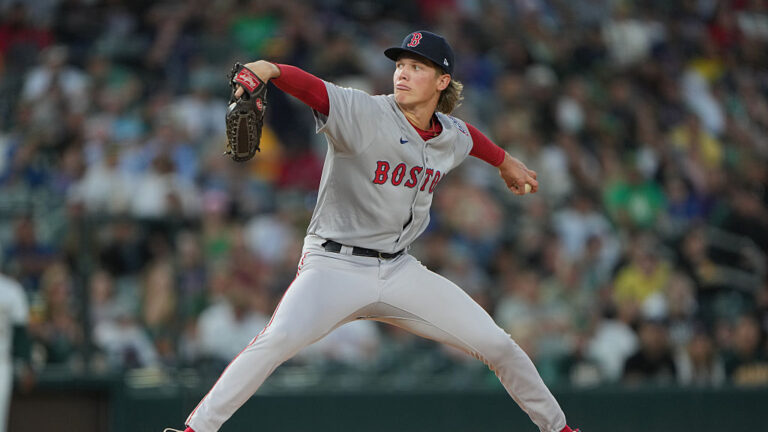
We have our first real move of the trade deadline. Late Saturday night, Jeff Passon reported that the Boston Red Sox were trading lefty starter Connelly Early to the Washington Nationals for infielder Curtis Mead. A move that caught many by surprise, even causing confusion, although the deal does make sense for both sides.
There’s some familiarity between the Nationals and Red Sox, with front office members in Washington previously working in Boston and the two teams swapping Jake Bennett for Luis Perales back in December.
A mere seven months after Washington traded away a lefty starter to Boston, they are getting one back.
Boston just ended their 15-game winning streak that has propelled them into one of the final wild card spots while the Nationals, a surprising 53-52, sit just two games back of a wild card spot of their own.
A major leaguer for major leaguer trade is something we all love to discuss but rarely see, and I doubt many had tabbed these two names as potentially on the move.
So, why does this trade make sense? OR, does it? Let’s dive in.
The Red Sox Side
If there’s one thing the Red Sox have it’s lefty starters. Garrett Crochet is the star, and is set to return from injury at some point this season. Ranger Suarez was a big free agent addition this past winter. Payton Tolle and Jake Bennett are the promising young southpaws, with Patrick Sandoval being a veteran back-end arm.
No matter what type of lefty you like, the Red Sox have it.
Trading from a clear strength is something the Red Sox should have done, but I would still say this move is surprising for Boston. Connelly Early, 24, was electric in his short stint last season and has followed that success with a 3.44 ERA, 4.61 FIP, 9.13 K/9, and 3.34 BB/9 this season.
A true six-pitch mix that won’t light up radar guns but comes with a plus movement profile, good command, and a great baseline to grow from. Not to mention he is under team control through the 2032 season. The type of young and promising arm that many would have put in packages to bring back truly established big leaguers with a more comfortable track record than Curtis Mead.
That’s not a knock on Mead, who’s been great in Washington.
A .256/.351/.505 slash with 17 home runs and a 135 wRC+ is a version of Mead you could have hoped for in his prospect days, but many didn’t expect after his early career struggles. Finding a spot in Tampa was challenging, and his late ’25 stint with the White Sox was rather awful.
However, Mead has looked like a different player. A better approach has doubled his walk rate to 11.5%, improved his strikeout rate, and tripled his ISO to an impressive .249. By all means, Mead has been an impact bat even if the 86-game sample is relatively small compared to his lackluster 152-game sample prior to this season.
Not to mention two of the Red Sox biggest offseason additions were Wilson Contreras (1B) and Caleb Durbin (3B), who play the two positions Mead plays. Alex Speier of the Boston Globe reported earlier on Saturday that Durbin would be open to moving to second base if the Red Sox acquired a third baseman, which is interesting timing considering the move went down a few hours later.
With Trevor Story, Marcelo Mayer, and Isiah Kiner-Falefa all being shelved due to injury, the need for an infielder was clear. Although Mead was probably not the infielder many Boston fans had in mind. To use one of your biggest trade chips on a player who has more bad baseball than good in his career certainly is a risk.
If Mead’s adjustments are true, the Red Sox have added the type of bat they needed to boost their lineup and added a player with team control until 2031. I’m sure Red Sox fans will be wary of getting too excited about this trade until the sample size grows.
The Nationals Side
Washington’s new front office has already banked a “win” with how they made out in the MacKenzie Gore trade. Back in March, they acquired Mead from Chicago in a trade for Boston Smith, ironically named.
Turning what looked like a failed top prospect in Mead into a legitimate trade piece in the matter of months was a great ID by the front office and phenomenal work by Mead, along with Washington’s coaching staff.
What Washington needs the most is rotation help. Foster Griffin is another win for the front office, but could be cashed in at the deadline. Cade Cavalli is looking like the best version of himself, and Andrew Alvarez has been a pleasant surprise, but Zack Littell and Miles Mikolas isn’t going to cut it.
Adding Early gives the Nationals a promising young arm to pair with Cavalli and potentially Jarlin Susana and Travis Sykora down the road. Adding a lefty helps balance a rotation that could see their best southpaw depart (Griffin) and takes pressure off Alvarez to be the only answer from the left side.
Usually, when a trade looks lopsided like this one, it should cause us to pause and see what we are missing.
Is Early not as good as most think? Is Mead much better than we think? Time will tell.
But, although the sample size is small, I am quickly gaining trust in Washington’s ability to identify talent and get the most out of their players. Add that trust to the fact that I think Early is already a good pitcher with room to get better, and I love this deal for Washington.
Trading away Griffin to continue to improve the farm system now is easier to stomach. Washington fans are not subtracting one of their best players without a real addition that can still help the team push forward toward the playoffs in 2026.
Control, upside, and enough proof of major league success is something fans should always be excited about.
Now, filling the shoes Mead’s departure leaves is a different story, especially if Luis Garcia Jr. is on the trade block. If he stays first base is taken care of. Third base, Mead’s primary position in Washington, is not.
Andres Chaparro and Jorbit Vivas can play third but I think Brady House will be given the biggest opportunity.
The 23-year-old former first-round pick struggled in his debut last year and was better in 2026 but not good enough to stick and had to return to the minors. In Triple-A he’s slashed .300/.344/.498 with eight home runs and a 115 wRC+. Good numbers, but Triple-A is much different from the majors.
Perhaps the Nationals add, conservatively, at the deadline. Someone who can play third but will not cost them much in terms of prospect capital. Could Eugenio Suarez, who’s struggled in Cincinnati but has started to look more like himself lately, be a fit? I don’t think the cost will be too much.
Regardless, the Nationals turned a castoff into a pitcher who has the ability and upside to plug into the middle of their rotation for years to come. To me, that’s good business.
Final Thoughts
The more I think about the trade, the more I like it for Washington. Early is the type of pitcher I did not think the Nationals would be able to target this season and the move still allows the Nationals to trade one of the better rental arms on the market. But, I don’t dislike the move for Boston nearly as much as I am seeing online.
Is it risky? Yeah, more so for Boston than Washington. But you traded from an area of extreme strength and were able to get a young bat with plenty of control. A team that can sign Suarez when you already have this many quality lefties can afford to move one and take a risk.
I’m not sure how I expected the deadline to be kicked off, but I know it wasn’t like this. I like it, this is fun. If we get more intriguing moves throughout the next week and change we could be looking at one of the more unique deadlines in recent years.
Become a Member of Just Baseball
Subscribe and upgrade to go ad-free!
* Save 25% by subscribing annually.

Written by