
Kyle Tucker Has Been As Average As It Gets
Hiding in the deepest lineup in baseball, Kyle Tucker's collapse in his quality of contact has turned him into baseball's most expensive passenger.
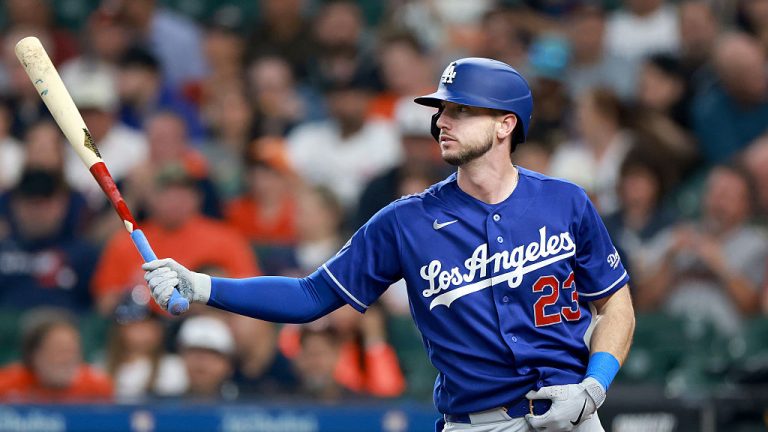
I was highly skeptical when the Los Angeles Dodgers emerged as the highest bidder to win the Kyle Tucker sweepstakes this past winter. While it is admittedly premature to judge a player who hasn’t even logged half a season in blue, the early returns on his historic four-year, $240 million contract are uninspiring.
The record-breaking agreement, which guarantees an average annual value (AAV) of $60 million ($57.1 million adjusted for luxury tax), includes a massive $64 million signing bonus, opt-out clauses after the second and third years, and $30 million in deferred payments.
If the Dodgers had pivoted away from Tucker, they likely would have landed Bo Bichette, who, on the surface, has been far more disappointing to start his tenure with the New York Mets.
Instead, Los Angeles is left with a version of Tucker who has been completely ordinary. He hasn’t been a disaster, nor has he been a spark plug, but simply an invisible man in a powerhouse lineup.
During his pursuit of this contract, fair questions were raised regarding his daily motor and passion for the game. Those doubts are looking more realistic by the day. Possessing immense natural skill with unorthodox mechanics, Tucker looks content with his financial security.
So far, he has mostly hidden within the deepest batting order in baseball. After starting the season in the premium No. 2 hole, manager Dave Roberts has recently penciled him as low as No. 6.
Stats were taken prior to play on June 9.
The Contrast to an Elite Track Record
To understand how staggering this drop-off is, you have to look at the elite resume that earned him this contract in the first place.
Tucker was a 2022 World Series champion with the Houston Astros, a Gold Glove winner, a two-time Silver Slugger, and a four-time All-Star, including a starting nod in 2025 during his one-year stint with the Chicago Cubs before calf and hand injuries slowed his second half.
In 2023, he finished fifth in MVP voting after posting a 5.5 bWAR, a .284 batting average, an .886 OPS, 29 home runs, and an American League-leading 112 RBIs.
The drop-off in production across his 63 games this season is starkly apparent:
| Metric | 2026 Season | Career Baseline (9 Seasons) | Drop-Off / Impact |
| Slash Line | .233 / .332 / .379 | .270 / .356 / .497 | Lowest AVG by 24 points; lowest SLG by 85 points |
| OPS | .711 | .853 | A 120-point drop from his previous career low |
| OPS+ | 102 | 137 | Exactly 2% better than league average. His previous career low was 124 |
| wRC+ | 104 | 131 | Hovering right at the baseline of an ordinary regular |
A Statcast Deep Dive
The underlying metrics from his Baseball Savant profile suggest this is not a case of bad luck or structural misfortune, which support the surface-level decline.
Here are Tucker’s 2026 Statcast Batting Percentiles:
- xwOBA: .327 – 55th percentile
- xBA: .252 – 52nd percentile
- xSLG: .381 – 36th percentile
- Barrel %: 5.6 – 26th percentile
- Hard-Hit %: 38.9 – 39th percentile
- Exit Velocity: 88.9 MPH – 42nd percentile
The core issue lies in the complete evaporation of his power profile. His 5.6% barrel rate this season is nearly half of his 10.4% career average. Furthermore, his flare and burner contact rate has spiked to 29.4% compared to his 24.7% career baseline, indicating he is miss-hitting balls he used to drive.
While his line-drive rate has reached a career-high 27.2%, his average exit velocity has fallen to 88.9 mph, down from 90.1 mph in 2025 and 90.2 mph in 2023. He is hitting more ground balls than at any point since 2023, while his fly-ball rate has bottomed out to its lowest mark since 2020.
The contrast between this season and his peak years illustrates a hitter who has lost his edge:
- 2023 (Houston): 95th percentile in xwOBA (.386), 93rd percentile in xSLG (.533), and a 45.9% hard-hit rate.
- 2025 (Chicago): 93rd percentile in xwOBA (.372), 83rd percentile in xSLG (.483), and a 10.8% barrel rate.
- 2026 (LA Dodgers): 55th percentile in xwOBA (.327), 36th percentile in xSLG (.381), and a 5.6% barrel rate.
His pitch-tracking metrics expose an inability to damage premium offerings. In 2025, Tucker provided elite value against fastballs, sinkers, and changeups. In 2026, he has managed a so-so .431 slugging percentage against fastballs and has logged a -4 run value against offspeed pitches, hitting just .182 against changeups and splitters.
Bizarre Splits and Defensive Liabilities
The structural issues bleed heavily into his defensive performance:
- Fielding Run Value: -2 (19th percentile)
- Range (OAA): -5 (4th percentile)
Tucker’s strong arm value (94th percentile) keeps him from being an absolute liability, but his lateral quickness and reaction times have degraded significantly, matching a bottom-tier sprint speed that sits in the 27th percentile (26.4 ft/s).
His offensive performance also features some of the most extreme, head-scratching splits in baseball this season. He has completely flipped his historical vulnerabilities while displaying wild variance based on environment and time of day:
- Platoon Splits: He has actually been excellent against southpaws, slashing .250 with an .831 OPS in 58 at-bats. Conversely, he has been an anchor against right-handed pitching, stumbling to a sub-.225 average and a sub-.670 OPS across 174 at-bats.
- Home vs. Road: Dodger Stadium has been a house of horrors for the newcomer. Tucker is hitting an abysmal .184 with a .580 OPS and just one home run at home. On the road, he looks like his old self, hitting above .280 with an OPS over .840.
- Day vs. Night: In 66 day-game at-bats, Tucker is tracking like an MVP candidate, hitting .348 with an OPS north of 1.000. In 166 night-game at-bats, he vanishes, hitting .180 with a sub-.600 OPS.
Kyle Tucker currently possesses just a 0.8 bWAR through 63 games, leaving him outside the top 100 in MLB batting average and OPS. He is walking at an elite clip (12.5%, 82nd percentile) and keeping his strikeouts down (19.2%), but the impact is totally absent.
For $60 million a year, the Dodgers expected a franchise cornerstone. Instead, they bought a highly compensated passenger.
Become a Member of Just Baseball
Subscribe and upgrade to go ad-free!
* Save 25% by subscribing annually.

Written by