
Who Will Win the 2026 College World Series?
With so many teams to choose from, let’s condense the field to the teams with the best chance to hoist the trophy in Omaha.
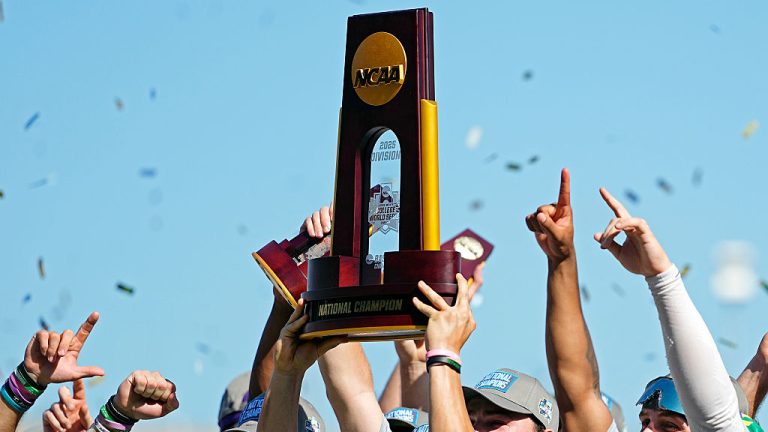
The field has been narrowed to 64, but only one can win it all. Regionals start on Friday, May 29, and a champion will be crowned no later than June 22.
With so many teams to choose from, let’s condense the field to the teams with the best chance to hoist the trophy in Omaha. We can lean on College Baseball Insiders for help, as their championship formula eliminates most teams that have historically failed to meet the criteria for a national title contender. From there, we can trim the field even further and focus on the true heavyweights.
You can find all of these picks on BetMGM. For all new customers, use code JUSTBASEBALL, because if your first pick loses, you’ll get it all back in bonus bets up to $1,500.
The Formula
The parameters laid out by the formula make a lot of sense.
The first is a road record above .500. The idea is simple: if a team can consistently win away from home, it has already proven it can handle hostile environments and different styles of play.
The second parameter is strength of schedule. The formula only includes teams with a top-25 strength of schedule, ensuring that contenders have been tested against elite competition throughout the season rather than piling up wins against weaker opponents.
The third focuses on pitching and uses a metric called SIERA, or Skill-Interactive Earned Run Average. Per FanGraphs, SIERA is “an advanced sabermetric statistic that estimates a pitcher’s underlying skill level by analyzing what they can control, while also accounting for the type of batted balls they allow.” Unlike ERA estimators such as FIP or xFIP, which primarily focus on strikeouts, walks, and home runs, SIERA also incorporates contact quality.
The formula filters for teams that rank inside the top 25 in SIERA, reinforcing the idea that elite pitching is essential for surviving the gauntlet on the road to Omaha.
The fourth and final parameter is wRC+, or Weighted Runs Created Plus. This metric measures offensive production while adjusting for ballpark factors and quality of competition. Traditional stats like batting average fail to distinguish between different types of hits (singles vs home runs), and even OPS lacks proper context for environment and opposition.
wRC+ is normalized to 100, which represents league-average offense. A team with a 110 wRC+ is producing offense 10% better than league average, while a 90 wRC+ indicates production that is 10% below average. By using this metric, the formula avoids penalizing teams that play in pitcher-friendly parks or regularly face elite pitching staffs.
To qualify, a team must post a wRC+ above 100, meaning it fields an offense that performs better than the national average.
The Nasty Nine
| Team | Road Record | Strength of Schedule | SIERA | wRC+ |
| UCLA | 24-1 | 25 | 3.33 (14) | 110 (20) |
| Georgia Tech | 18-5 | 15 | 3.45 (20) | 130 (1) |
| Georgia | 15-5 | 24 | 3.57 (22) | 124 (2) |
| Auburn | 17-9 | 1 | 2.93 (4) | 104 (75) |
| Texas | 11-9 | 9 | 2.68 (1) | 110 (20) |
| Mississippi State | 15-9 | 7 | 2.97 (5) | 114 (11) |
| Arkansas | 17-8 | 10 | 3.19 (14) | 103 (92) |
| Florida | 17-6 | 2 | 3.08 (6) | 104 (75) |
| Texas A&M | 12-8 | 17 | 3.60 (25) | 117 (5) |
Process of Elimination
Right off the bat, I’m eliminating three teams: Arkansas, Florida, and Auburn.
All three rank inside the top 25 in both SIERA and strength of schedule, but none profiles as a truly elite offensive club. Of course, any of these teams could get hot at the right time, but when picking a national champion, the goal is to find the most complete team in the field.
I’m also crossing off Texas A&M. The Aggies can absolutely mash, but they fall short in nearly every other category. They own the weakest pitching staff among this group, rank near the bottom in strength of schedule, and don’t have an especially impressive road record. Their offense gives them upside, but the overall profile simply doesn’t stack up with the top contenders.
That leaves us with UCLA, Georgia Tech, Georgia, Texas, and Mississippi State, five teams with very real cases to win it all. At this point, the margins become razor-thin.
Historically, I’m hesitant to back the No. 1 overall seed. Only two top overall seeds have gone on to win the College World Series in the last 25 years: Miami in 1999 and Tennessee in 2024. Unless the statistical case is overwhelming, I usually look elsewhere for value.
UCLA is certainly deserving of its spot at the top of the bracket, especially with projected number one pick in this year’s MLB draft, Roch Cholowsky, leading the way. But compared to the remaining contenders, the Bruins come up just short analytically. They don’t rank inside the top 10 in either SIERA or wRC+, and they also own the weakest strength of schedule among the teams still standing. That’s enough for me to eliminate them from championship consideration, especially knowing they have the shortest odds.
The Final Four
| Team | Road Record | Strength of Schedule | SIERA | wRC+ |
| Georgia Tech | 18-5 | 15 | 3.45 (20) | 130 (1) |
| Georgia | 15-5 | 24 | 3.57 (22) | 124 (2) |
| Texas | 11-9 | 9 | 2.68 (1) | 110 (20) |
| Mississippi State | 15-9 | 7 | 2.97 (5) | 114 (11) |
If you like Mississippi State or Texas to win it all, you won’t hear a peep out of me. Both teams boast some of the best pitching staffs in the country, paired with offenses that are comfortably above average. They’ve been battle-tested by elite schedules, and both have proven they can win away from home.
But there are levels to this.
We’re talking about separating great teams from the teams most equipped to win the whole thing.
There’s a reason Georgia and Georgia Tech are seeded ahead of Texas and Mississippi State. Georgia backed up its profile by winning the SEC Tournament, including another win over Mississippi State after already sweeping the Bulldogs during the regular season. Meanwhile, Georgia Tech stormed through the ACC Tournament, highlighted by an overwhelming win over a top-five North Carolina team.
Ultimately, offense tends to carry the day in this tournament, especially once the pressure ramps up and pitching staffs get stretched thin. And no matter how talented the arms are across the country, nobody has consistently slowed the two explosive offenses coming out of the state of Georgia.
Georgia Tech
Georgia Tech’s offense isn’t just elite, it’s historically dominant. In fact, it’s the best offensive team a Power 4 program has brought into the NCAA Tournament in the BBCOR era. Since the bat changes in 2011, no Power 4 offense has produced at the level the Yellow Jackets have this season.
There’s simply no break in the lineup. You can’t take a bathroom break when this team is at the plate. Georgia Tech averaged an absurd 10.8 runs per game this year, and over its last 10 games, including its ACC Tournament run, it’s outscored opponents by an average of eight runs per game.
EIGHT!!!
Despite being ranked as the No. 2 team in the country, there’s a very real argument that the Yellow Jackets should be No. 1. They enter the tournament as the hottest team in college baseball, pairing elite season-long production with dominant recent form.
And while the offense grabs the headlines, the pitching staff is more than good enough to support a championship run. Georgia Tech has four starters who have each logged at least 40 innings this season, and every one of them owns a SIERA below 3.40 outside of Carson Ballard, who still sits at a very solid 3.75.
They may not have one overwhelming ace, but they do have four dependable arms capable of keeping games under control long enough for the offense to do what it always seems to do: explode. It also helps to have Vahn Lackey, the projected No. 3 pick in next year’s MLB Draft, handling the pitching staff behind the plate.
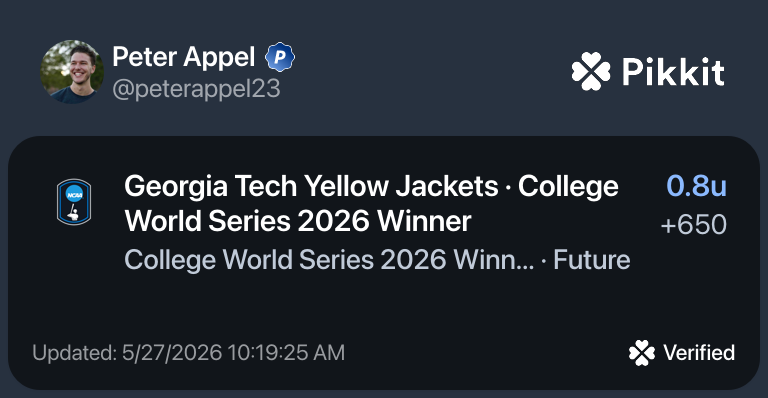
Even with the second-shortest odds to win the title, Georgia Tech is undervalued. It’s rare to get the opportunity to back the best offense of the last 15 years without paying an overwhelming premium. But because the Yellow Jackets don’t play in the SEC and don’t own the top overall seed, the market is still offering a very attractive price.
Georgia
Georgia has a similar case to Georgia Tech: a devastating offense paired with well-above-average pitching. And instead of Vahn Lackey behind the plate, the Bulldogs counter with Daniel Jackson, who has arguably been even better than his cross-state rival this season.
In many ways, the profile is almost identical. Georgia ranks second nationally in both wRC+ and OPS, trailing only Georgia Tech. The Bulldogs enter the tournament scorching hot as well, going 9-1 over their last 10 games while also running away with the SEC Tournament title.
The pitching staff fits the same winning formula. Georgia features three reliable starters, all carrying SIERA marks below 3.51. They may not dominate headlines individually, but collectively they do exactly what this offense needs: keep games under control long enough for the lineup to overwhelm opponents.
And that’s ultimately what separates these two teams from the rest of the field. College baseball simply doesn’t have enough elite pitching depth this year to consistently slow down either Georgia or Georgia Tech.
Neither lineup will have to navigate a staff comparable to LSU’s in 2025, featuring arms like Kade Anderson and Anthony Eyanson. Opponents may have one frontline starter capable of matching up, but nobody can roll out the kind of deep, high-end staff required to survive an entire series against these offenses.
The recent results reinforce that point. Texas exited the SEC Tournament in the opening round, while Mississippi State went 0-4 against Georgia this season. If you can’t mash, I don’t want to bet on you.
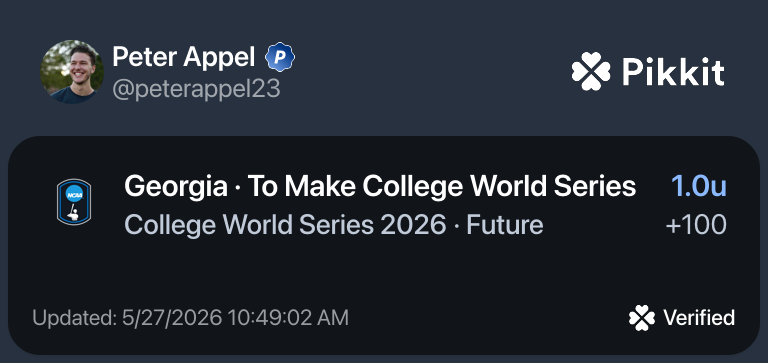
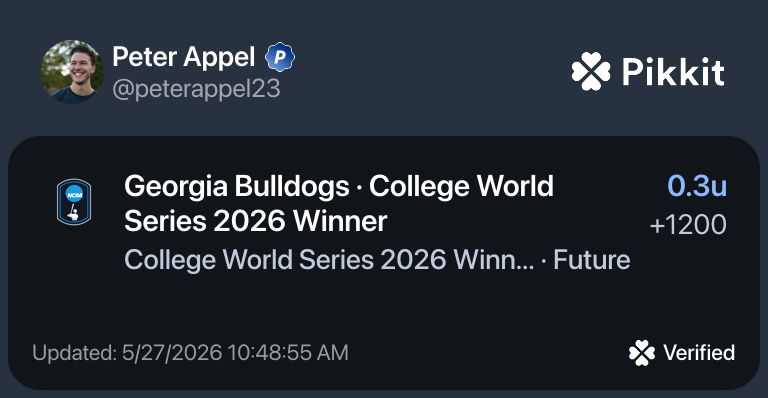
At the end of the day, offense wins in college baseball. That’s the conclusion the numbers keep pointing back to, and it’s why I power-rank Georgia Tech and Georgia as the two best teams in this tournament. Because of that, I’m backing both programs to make a serious run at the national title.
Gambling Problem? Call 1-800-GAMBLER.

Written by
Peter is the Co-Founder and Director of Content Strategy of Justbaseball.com and the Co-Host of the Just Baseball Show.