
Davis Martin Is Becoming the Rotation Answer the White Sox Needed
Martin has become an anchor for Chicago every five games. Just how real is this new version of the right-hander?
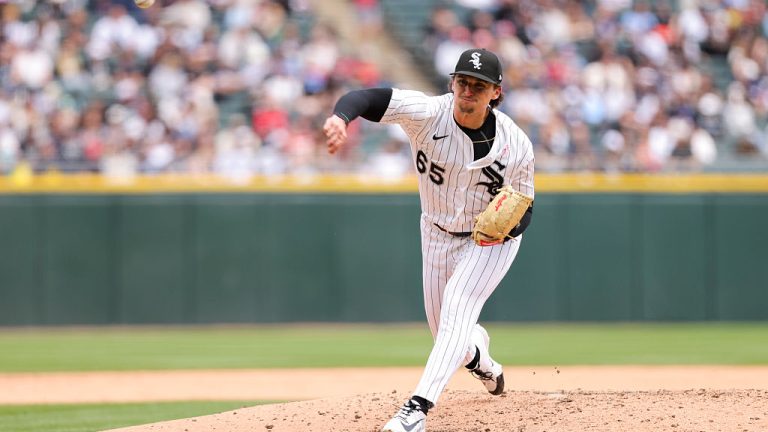
Davis Martin followed the best start of his career in Anaheim by holding Seattle to one run over six innings at Rate Field on Mother’s Day. He struck out nine and matched his career high with 19 whiffs while throwing a career-high 105 pitches. One start earlier, he struck out 10 over seven scoreless innings against the Angels.
Across those two outings, Martin posted a 0.69 ERA with 19 strikeouts in 13 innings. That run also earned him a mention among the notable AL Player of the Week performances. His season ERA dropped to 1.62, the second-lowest mark in baseball, and he extended his streak to 17 straight starts with three earned runs or fewer.
That is the longest such run by a Chicago White Sox starter since Garrett Crochet matched that number in 2024, and it sits one short of Mark Buehrle’s 18-start stretch in 2011, per Jim Margalus of Sox Machine.
The White Sox have needed every bit of it.
Martin has given them consistent innings since the season opened. His fastball does not overpower on its own, but the deeper arsenal has become harder to track. The cutter has given him another way to attack the zone, and the slider has become a real put-away pitch. Just as important, he has paired the whiffs with enough strike-throwing to avoid giving innings away.
The White Sox rotation has been in flux for most of the season, and Martin has become one of the few constants inside it. His place in the rotation feels settled. The bigger question is how much of this version can hold, and what that means for a staff that needed someone to steady it.
The Starts That Changed the Conversation
Facing the Angels, Martin threw seven scoreless innings, struck out 10, walked none, and generated 19 whiffs on 85 pitches. Martin had already been throwing strikes and limiting runs, but that start showed he could finish hitters without needing to be perfect along the black.
The slider generated nine of his 19 whiffs and forced chases even when it finished out of the zone. For a pitcher often viewed as more command-and-contact than swing-and-miss, it has been eye-opening. He had outdueled the best starter in the AL up until that point in José Soriano.
Sunday against Seattle was less efficient but more revealing. He needed 26 pitches to finish the first inning.
Seattle forced long at-bats and drove up his pitch count. Will Venable still gave Martin a chance to finish the sixth after a nine-pitch walk to Cal Raleigh pushed him past 100 pitches. Martin answered by striking out Randy Arozarena on three pitches, ending his day with nine strikeouts, three hits allowed, and one run over six innings.
Martin did not have his cleanest feel early, but he adjusted and kept the White Sox close until the offense broke through. Chicago turned a 1-0 deficit into a 2-1 win with Randal Grichuk’s homer, Drew Romo’s double, and Miguel Vargas’ go-ahead sacrifice fly.
Entering play on May 13, the White Sox have won five of their last seven series. Martin has been one of the main reasons they have stayed in games long enough for that to happen.
How Martin Is Putting Hitters Away
Martin’s cutter creates overlap with the slider and gives him another way to get into the zone before expanding. It changes the hitter’s read because it stays on a tighter lane and holds enough velocity to look firm out of the hand. When Martin gets ahead, that look helps the slider play later.
Among starting pitchers with at least 100 sliders thrown, Martin owns one of the top whiff rates in baseball. The shape gives him a chase weapon against right-handed hitters and a finishing pitch when he gets to two strikes.
Several of Martin’s pitches share enough early traits to keep hitters from committing on time. That is why the raw velocity undersells the way the arsenal plays. Martin can still reach 95 mph with the fastball, and the kick change has enough power to get into the low-90s while giving hitters a different look off the heater.
Pitcher List highlighted how Martin uses those shapes to set up hitters instead of simply showing variety for its own sake. He can work a sinker inside, follow with a slider down and away, then come back with a fastball while the hitter is still guarding against movement. That sequencing helps explain how Martin can create late swings without elite velocity.
That hesitation also helps explain the called third strikes. Hitters are getting stuck between shapes, and Martin has used that indecision to steal strikes or finish counts.
The breakout is easier to buy into when the strikeouts come with the strikes. Weak contact can carry a starter for stretches, but the added swing-and-miss gives Martin a better way to survive when the batted-ball results tighten.
Is it Sustainable?
Martin’s ERA is going to invite skepticism. It should.
A 1.62 ERA is difficult to sustain, and the underlying numbers are less dominant than the surface line. His expected stats have not fully matched the run prevention. Some contact has been loud, and a high strand rate usually returns to normal over time.
Still, the gap is not as alarming as it might look on the surface. Martin’s 2.34 FIP and 9.36 K/9 both point to real skill growth beneath the ERA. The run prevention will probably come back some, but the strikeout jump and improved fielding-independent numbers make this more than a pitcher simply outrunning contact.
The ERA will rise. The point is that Martin has given himself more ways to absorb that regression than he had before.
The better question is whether the changes in Martin’s profile support a real step forward.
There is a strong case that they do. Martin has cut walks and expanded his arsenal. He has struck out at least seven hitters in four straight starts. That is a different foundation than simply pitching to contact and hoping the defense handles everything behind him.
When Martin works ahead, the at-bat starts to tilt in his favor. Early strikes create room for softer contact while also putting the slider in play as a chase pitch or a finisher.
That gives him a path to stay useful once his ERA moves closer to the underlying numbers.
The White Sox do not need a sub-2.00 ERA for this to matter. A starter who works into the sixth with limited walks already has value. If the added swing-and-miss holds, Martin will remain one of the more useful pieces of their 2026 staff.
Why the White Sox Needed This
Martin’s emergence matters more because of the rotation around him.
The White Sox have lacked margin. Opening Day starter Shane Smith was optioned and then injured. Jonathan Cannon has moved between Chicago and Charlotte. Hagen Smith is still building toward a major league role. Tanner McDougal is injured. Drew Thorpe and Mason Adams remain longer-term pieces as they work back from Tommy John surgery. David Sandlin could become an option later, but he is not the immediate answer yet.
Chicago needs dependable innings from the starters already in the majors.
Martin has provided them, and the team results have followed. The White Sox are 7-1 in his starts this season, with the only loss coming in a 2-0 shutout in Kansas City. That record is not all pitcher-driven, but it shows how often Martin has kept games close enough for Chicago to have a path late.
He has gone at least five innings while allowing two runs or fewer in seven straight starts. Through 50 innings, he owns a 1.00 WHIP and a 52-to-10 strikeout-to-walk ratio. His outings have kept the bullpen from being overexposed during his start days.
Sunday showed the value of that reliability. Logan Gilbert dominated the White Sox lineup for six innings, but Martin kept the game at 1-0 after a rough first, and Chicago hung around to win the game late.
Martin did not get the win, but his outing made the win possible.
That is what the White Sox need. They need a starter who gives Venable a plan every fifth day. They need someone who can pitch into the sixth after a rough first inning and who buys time for the next wave of arms without forcing the organization to rush development.
The Clubhouse Anchor
Martin’s value extends beyond his stat line.
He is the longest-tenured player on the roster and a trusted voice in a young clubhouse. That role works because Martin has been through enough in the organization to speak with some volume.
His path itself is part of why that carries weight. Martin was a 14th-round pick out of Texas Tech in 2018, missed the 2023 season after Tommy John surgery, and returned to a White Sox organization that had changed around him multiple times. There is nothing automatic about a late-round arm coming back from elbow surgery and pitching his way into this kind of role.
That experience matters for younger pitchers who are still establishing routines.
On the CHSN podcast, Martin said he feels like the best version of himself this season. He has also pointed to how the starters push each other and share ideas, which can help a staff that is still forming its identity.
Sunday offered another example. “The pregame bullpen wasn’t very crisp, and I think it kind of carried into the first inning,” Martin said after the start.
He also credited Zach Bove for challenging him when the feel was off. Accountability is easier when a pitcher trusts his coaching staff and knows how to self-correct. Martin did not have his best touch early, but he found enough to get through six innings.
That is veteran stability. Sometimes it is simply knowing how to reset after a rough first inning to still give your team a chance.


All-Star Case and Deadline Reality
The Cy Young discussion seems a bit distant, but the ERA puts him in the early conversation. Martin has pitched like one of the better starters in the American League through the first quarter and deserves consideration to head to Philadelphia in July as one of the All-Star representatives for the White Sox.
That also creates a deadline question as July approaches.
A controlled starter pitching this well will draw attention. Martin is 29 and affordable. Most importantly, he’s under team control until 2031 and isn’t eligible for arbitration until 2028. His ability to provide length with a deep arsenal would be attractive if the White Sox fall out of the race.
The market may be complicated. Other teams will see the ERA and the expected stats. They may view Martin as a useful mid-rotation starter rather than a frontline arm worth a major prospect package. If that is the case, Chicago may find more value in keeping him.
There is also a practical reason not to rush. The White Sox need rotation stability, and Martin is providing it. Trading their most dependable starter would create another hole in a group already waiting on younger arms.
For now, Martin is both a potential deadline conversation and a reason the White Sox may not need to force one. He has pitched well enough to attract interest, but he also fits what the organization needs beyond July.
The Cubs Start Gives It Another Test
Martin’s next start should bring the biggest stage of his season.
After helping the White Sox win the Mother’s Day finale against Seattle, Martin lines up to face the Cubs at Rate Field. For a team still trying to prove it can hang around, that start will carry a little more weight than another turn through the rotation.
The White Sox are still below .500, but they are on a 79-win pace through the first quarter of the season. That would have sounded ambitious not long ago. Martin is one of the reasons it feels less far-fetched now.
His next test comes against the rival on the other side of town. It is a fitting spot for a pitcher who has already moved up in the organization and now gets a chance to push the conversation into a bigger part of the city.
Become a Member of Just Baseball
Subscribe and upgrade to go ad-free!
* Save 25% by subscribing annually.

Written by
Adrian White covers the Chicago White Sox for Just Baseball and FutureSox. He studies sports management at Florida Atlantic University and focuses on player development and…